Ebola in Nigeria: What the Confirmed Abuja Case Means, How the Virus Spreads, and How to Keep Your Family Safe
Nigeria confirmed its first Ebola case in twelve years on 20 October 2026: a woman who flew into Abuja from Uganda, linked to the Bundibugyo-virus epidemic that has infected more than 9,000 people in DR Congo. This guide explains how Ebola spreads (and how it does not), the symptoms to watch for, who needs testing and how it works, why there is no vaccine yet for this strain and what treatment does exist, how to protect your family, what the government is doing, and exactly what to do — and whom to call — if you think you have been exposed.
Introduction
On 20 October 2026, the Federal Ministry of Health and Social Welfare confirmed Nigeria's first case of Ebola disease in twelve years: a woman who had flown into Abuja from Uganda, fell ill a week after arriving, and spent several days in a private hospital in the Federal Capital Territory before the diagnosis was made [1][2]. By the evening of the announcement, 44 people who had been in close contact with her, among them health workers, other patients, carers and fellow passengers, had been identified and placed under monitoring [1][3].
One case is not an outbreak. But it is a warning that deserves to be taken seriously, for two reasons. First, this case is part of the largest Ebola epidemic the world has seen since 2014. It began in the Democratic Republic of the Congo in May, has infected more than 9,200 people and killed more than 4,400, and has already reached Uganda, Kenya and now Nigeria [4][5]. Second, the virus behind it is Bundibugyo virus, a species for which there is, as of today, no licensed vaccine and no approved drug [6][7]. The tools that ended earlier outbreaks do not yet exist for this one. What does exist, and what works, is the same thing that saved Nigeria in 2014: early recognition, isolation, careful contact tracing, good supportive care, and a public that knows what to do and what not to do.
This guide is written for that public. It explains what Ebola is and is not, how it spreads, the symptoms to watch for, who needs testing and how testing works, what treatment looks like, what you can do to protect yourself and your household, what the government is doing, and how Afrimedlink can help if you are worried. It is long because the subject deserves it; if you only have two minutes, read the section "If you think you may have been exposed" and the key takeaways at the end.
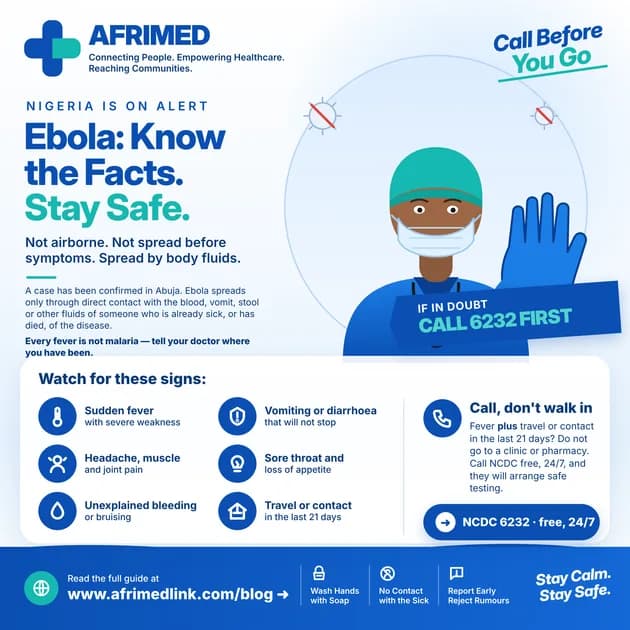
The single most important message: Ebola is spread only by direct contact with the body fluids of someone who is already sick, or who has died, of the disease. It is not airborne, and a person cannot pass it on before symptoms begin. If you have a fever and any link to the virus in the past 21 days, do not walk into a clinic. Call the NCDC on 6232 (free, 24 hours) first.
What is happening: the 2026 epidemic in brief
Ebola is not one virus but a family. Six species are known, and three of them have caused large human outbreaks: Zaire ebolavirus (the one most people mean by "Ebola", and the cause of the 2014–16 West African epidemic and Nigeria's 2014 cases), Sudan virus, and Bundibugyo virus [6]. Bundibugyo was first identified in Uganda in 2007 and has caused only a handful of outbreaks, all small, until now.
The current epidemic was declared by the Democratic Republic of the Congo on 15 May 2026 after laboratory confirmation of cases in Ituri province in the north-east of the country; genetic sequencing identified Bundibugyo virus the same week [4]. The World Health Organization declared it a Public Health Emergency of International Concern within days. It has since spread across seven Congolese provinces, with Ituri and North Kivu worst affected, and has infected many health workers, 75 of them by mid-June alone [4][5]. The US Centers for Disease Control and Prevention describes it as spreading substantially faster than any previous Ebola outbreak: it passed a thousand confirmed cases within 40 days, something the 2018 Congolese outbreak took 235 days to do [5].
 The 2026 epidemic as of mid-October. The Democratic Republic of the Congo does not count probable cases, so the true toll is higher. Sources: US CDC; WHO; Nigeria FMoH.
Beyond Congo, Uganda recorded 20 confirmed cases and declared its outbreak over on 27 August [5][9]. Kenya confirmed its first case on 6 October, a patient who had died in Nairobi the day before, and has since reported a cluster of nine cases in the capital, almost all of whose contacts have been traced and quarantined [8][10]. One traveller was diagnosed in France in June, and a Dutch health worker infected in Congo was evacuated home for treatment [8]. Then, on 20 October, Nigeria.
The crude case fatality ratio in Congo, the share of confirmed patients who have died, is about 48 per cent [5][8]. That figure is frightening, and it should be, but it also needs context. It reflects an overwhelmed health system in a conflict zone where many patients reach care late or never. In Uganda, where cases were found quickly and treated early, the fatality rate was around 10 per cent [4]. The difference is not the virus. It is how fast people are found and how well they are cared for. That is the whole argument of this article.

Nigeria's confirmed case: what we know and what we do not
According to the Ministry's statement and the Minister's subsequent interviews, the patient is a woman who arrived in Nigeria on an international flight from Uganda [1][2][3]. She had no symptoms during the flight. She became unwell on 7 October, was admitted to a private hospital in the FCT on 11 October, and was treated there for several days before Ebola was suspected and a sample sent for testing. The NCDC laboratory confirmed Ebola on 20 October. She is in isolation and receiving care [1][2].
 The Abuja case, day by day, and the 21-day window that decides whether it stays a single case. Sources: FMoH/NCDC statement, 20 Oct 2026; AP; Premium Times.
As of the announcement, 44 close contacts had been identified: healthcare workers who treated her, other patients and carers at the hospital, and people who travelled with her. Public health teams are following each of them. The authorities are also working with the airlines to obtain passenger manifests so that others on her flights can be contacted [1][3]. A Presidential Task Force on Ebola Virus Disease, set up in June when the risk of importation was first judged high, and the NCDC are leading the response and will publish updates [1]. All public and private health facilities in the country have been instructed to be on high alert, to isolate any suspected case promptly and to report it immediately [1].
Some things are not yet public, and it is worth being clear about them so that rumours do not fill the gap. The Ministry has not published the patient's age, nationality, the date she arrived, or exactly where she was infected; Uganda's own outbreak was declared over in August, so investigators are tracing her movements before she travelled [2][9]. The name of the hospital has not been released, which is deliberate: naming it would stigmatise its staff and patients and could discourage other hospitals from reporting. What has been confirmed is enough for everyone else to act on.
Were you on a flight from Uganda, or in a hospital in Abuja, between 7 and 20 October? If you were, you may be contacted by public health officials. Please answer their calls and cooperate fully. If you believe you were in contact with the patient and have not been contacted, call 6232. You will not be in trouble, you will not be "locked up", and reporting early is the best protection for your own family.
There is one uncomfortable lesson in this timeline, and it is the same one Nigeria learned in 2014: the patient spent days in a hospital, being treated for a fever, before anyone thought of Ebola. In 2014, the traveller from Liberia was first treated for malaria in Lagos [11]. In an era when every fever in Nigeria is assumed to be malaria, the question "where have you been, and who have you been with, in the last three weeks?" is the most important diagnostic test there is, and anyone can ask it.
What Ebola is
Ebola disease is a severe illness caused by viruses of the Orthoebolavirus genus. Fruit bats are thought to be the natural reservoir; the virus spills into people, usually through contact with infected animals, and then spreads from person to person [6]. Without treatment it kills between a quarter and nine out of ten of the people it infects, depending on the species, the outbreak and the quality of care [6].
The name "haemorrhagic fever" has done a lot of harm. Most patients do not bleed, and when bleeding happens it is late in the illness. What kills most Ebola patients is not blood loss but the enormous loss of fluid through vomiting and diarrhoea, and the shock and organ failure that follow. That matters because it means the single most effective treatment is also the simplest: replacing fluids and salts, early and aggressively, in a properly equipped centre [6][12].
How Ebola spreads, and how it does not
This is the part of the article to share. Most of the fear around Ebola, and most of the harm done by that fear, comes from misunderstanding how it moves.
 Ebola needs direct contact with the body fluids of someone who is already sick or has died. Sources: WHO; NCDC.
It spreads through direct contact with body fluids
Ebola enters the body through broken skin or through the lining of the eyes, nose or mouth, when those come into contact with the blood, vomit, stool, urine, sweat, saliva, breast milk or semen of a person who is sick with the disease, or with the body of someone who has died of it [6]. Objects soiled with those fluids, such as needles, bedding, clothing and medical equipment, can carry it. The people at highest risk are therefore exactly the people who are closest to the sick: family carers, nurses, doctors, laboratory staff, cleaners, and those who wash and prepare bodies for burial. In every Ebola outbreak, health workers and funeral attendees make up a large share of cases [6][8].
Two further points about transmission are important. First, a person is not infectious before symptoms begin [1][6]. The passengers who sat near the Abuja patient on her flight were not at risk from her, because she was well at the time; the people at risk are those who had close contact with her after 7 October. Second, the amount of virus rises as the illness worsens. A patient in the first day of fever carries far less virus than one who is vomiting and bleeding on day seven, and the body of someone who has died of Ebola is the most infectious thing of all. This is why traditional washing of the dead has been the single biggest amplifier of past epidemics, and why safe, dignified burial by trained teams is non-negotiable [6].
Sexual transmission deserves its own mention. Men who recover from Ebola can carry live virus in their semen for months after they are well; for Zaire virus, transmission through semen has been documented more than a year after recovery [6]. Survivors are therefore offered semen testing and advised to use condoms until they test clear. This is a risk from the small number of survivors, not from the general population, and it is managed within survivor-care programmes.
It does not spread through the air, water, food or money
Ebola is not airborne. You cannot catch it by being in the same room, office, church, market or aircraft as someone who has it, by breathing the air they breathe, or from a cough across a room [6]. You cannot catch it from mosquitoes, from money, from a phone, from food cooked and served hygienically, or from drinking water. You cannot catch it from someone who is incubating the virus but has no symptoms, and you cannot catch it from someone who has recovered and whose blood tests negative, except through semen [6].
You cannot catch it from a handshake with a healthy person. The 2014 advice to stop shaking hands was about limiting contact with people who might be sick without yet knowing it; it was a reasonable precaution in Lagos with many contacts under watch, but it is not evidence that handshakes with well people are dangerous.
Incubation: why the magic number is 21 days
The incubation period, the time between infection and the first symptom, is between 2 and 21 days, most often 8 to 10 days [6]. Twenty-one days is the outer limit, and it is the basis of everything that happens next in Nigeria.
 Symptoms can appear any time from day 2 to day 21 after exposure. Before they do, a person is not infectious. Sources: WHO; NCDC.
Every one of the 44 contacts will be monitored for 21 days from their last contact with the patient, with daily temperature checks. If none of them falls ill in that time, the chain of transmission from this case is closed. If one does, they are tested and isolated immediately, and the clock starts again for their contacts. Nigeria is declared free of Ebola 42 days (two full incubation periods) after the last confirmed patient tests negative or is buried safely; that is how the 2014 outbreak was declared over on 20 October 2014, 93 days after the index case arrived [11][13]. Expect to see those numbers, 21 and 42, in every official update for the next several weeks.
Being monitored is not the same as being sick, and it is not the same as being quarantined in a facility. Most contacts live at home, go about their lives with some restrictions on travel and crowds, and report their temperature every day. The NCDC's advice is blunt about the alternative: a contact who hides, runs or refuses monitoring puts their own family in the greatest danger, because if they do fall ill, the people who nurse them at home will be the next cases.
Symptoms: what to watch for
Ebola starts the way a hundred other illnesses start. The first days bring sudden fever, severe weakness, headache, muscle and joint pain and a sore throat, a picture indistinguishable from malaria, typhoid or influenza [6]. After three to five days the illness moves to the gut: vomiting, watery diarrhoea that can amount to litres a day, stomach pain, loss of appetite, and sometimes a rash and persistent hiccups [6][14]. The sickest patients then develop confusion, bleeding from the gums, nose or injection sites, blood in vomit or stool, and the signs of shock and kidney and liver failure. Death, when it comes, is usually in the second week.

The NCDC's case definition for this outbreak lists fever, fatigue, muscle pain, headache, sore throat, malaise, vomiting, diarrhoea, abdominal pain, rash, hiccups, unexplained bleeding or bruising, and signs of shock, and tells doctors not to wait for bleeding before they suspect Ebola [14]. The Minister, in his broadcast on the day of the announcement, listed headache, nausea, vomiting and muscle aches [3].
Every fever is not malaria, but fever alone is not Ebola
Here is the balance to strike. Nigeria records tens of millions of fevers a year, and the overwhelming majority are malaria, typhoid and ordinary viral infections. If every one of them is treated as possible Ebola, the health system stops and the people who really need isolation cannot get it. Equally, if every fever is treated as malaria without a question asked, the next Ebola patient will spend a week on a ward, as this one did.
 The rule of thumb: symptoms plus a link to the virus within 21 days is what should trigger a call, never fever alone. Sources: NCDC; FMoH.
The rule the NCDC uses, and that the public can use too, is symptoms plus a link. The link is anything in the previous 21 days that could have brought you into contact with the virus: travel to the affected parts of the Democratic Republic of the Congo, to Uganda or to Nairobi; contact with someone who travelled from those places and then fell ill; contact with the Abuja patient, her hospital or her flights; caring for someone with Ebola-like symptoms; attending a burial of someone who died after a feverish illness; or handling bushmeat or animals found dead [14]. Fever with a link should be reported. Fever without a link should still be tested for malaria and treated properly, and the question about travel and contacts should still be asked and answered.
The best thing any of us can do for our doctors right now is to volunteer the answer before they ask. "I came back from Kampala ten days ago." "My uncle was on a ward at that hospital last week." "I helped bury a cousin who died of fever." Those sentences change the whole course of a consultation.
If you think you may have been exposed
This is the practical heart of the guide.
 Five steps if you have symptoms and a possible link to the virus. Sources: NCDC; WHO.
- Call before you go anywhere. Ring the NCDC on 6232 (toll-free, 24 hours a day), send an SMS to 0809 955 5577, or message +234 708 711 0839 on WhatsApp [14]. Describe your symptoms and your link to the virus. They will tell you what to do next and, if a test is needed, arrange for a trained team to collect you or your sample safely. Do not go to a clinic, pharmacy, laboratory or hospital unannounced: if you do have Ebola, you will expose the staff, the other patients, the people in the waiting room and whoever drove you, and you will probably be treated for malaria while the virus is confirmed days later [1][11].
- Separate yourself from the household. Stay in one room. Use your own cup, plate, spoon, towel and, where possible, your own toilet or bucket. Keep children, pregnant women and elderly relatives out of the room entirely.
- Protect whoever looks after you. One carer only, ideally a healthy adult. Gloves, or at least plastic bags over the hands, for anything soiled with vomit, stool or blood; handwashing with soap and water after every contact; soiled bedding and clothing kept apart and not washed with the family's clothes. Disinfect surfaces with diluted household bleach.
- Drink, and keep drinking. Oral rehydration solution (ORS), sips at a time, as much as you can keep down. Dehydration is the thing most likely to kill an Ebola patient before they reach care, and ORS is cheap and in every chemist [12].
- Do not self-medicate and do not take injections at home or at a chemist. An injection given without proper protection exposes whoever gives it; herbal mixtures and "fever drips" delay the diagnosis; and nothing bought over the counter treats Ebola.
If you are a contact being monitored: keep your phone on, report your temperature every day, and the moment you feel feverish or unwell in any way, say so. Do not wait to see whether it passes. A contact who reports a fever on the first day is tested, isolated and treated within hours; a contact who waits three days may already have exposed their family. You will not be blamed for reporting a fever that turns out to be malaria. You will be thanked.
Testing: who needs it, and how it works
There is no rapid home test for Ebola and no test a pharmacy can sell you. Diagnosis is a laboratory test on a blood sample, carried out under strict biosafety conditions, and it is arranged by public health teams for people who meet the case definition [6][15].
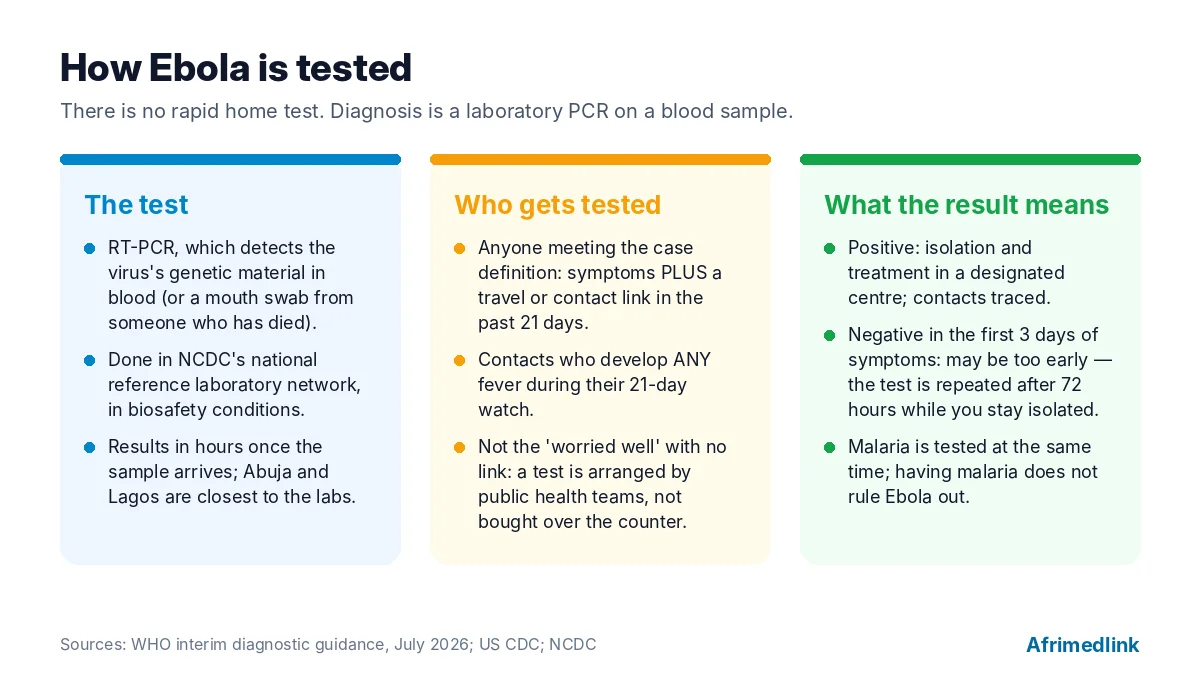 How Ebola testing works, who is tested, and what a negative result does and does not mean. Sources: WHO; US CDC; NCDC.
The test is RT-PCR, which detects the virus's genetic material in blood, or in a mouth swab from someone who has died [6]. It is the same technology that was used for COVID-19, and NCDC's national reference laboratory network has had it for Ebola since 2014, when Lagos University Teaching Hospital confirmed Nigeria's cases in-country [11]; the Minister has confirmed that the NCDC has the laboratory capacity to detect this virus [3]. Once a sample reaches the laboratory, a result takes hours. Samples have to be collected by trained staff, triple-packaged and transported by a defined route, which is one of the reasons walking into an ordinary laboratory is both dangerous and pointless [6].
Who gets tested? Anyone with symptoms and a link, as described above, and any monitored contact who develops a fever, however mild. The "worried well", people who are anxious but have no symptoms and no link, do not need testing; a test on someone without symptoms is not informative, because the virus is not detectable in blood before illness begins [6][15].
Two things about results matter. A positive result means transfer to a designated isolation and treatment centre, where the patient's contacts are traced and the patient receives the best available supportive care; it is not a death sentence, and in this epidemic more than 2,200 people in Congo have recovered [8]. A negative result taken within the first three days of symptoms may simply be too early; the amount of virus in blood is low at the start, so patients who still meet the case definition stay isolated and are tested again at least 72 hours after their symptoms began [15]. Malaria is tested at the same time, and a positive malaria test does not rule Ebola out; in 2014, co-infection was common.
The wider laboratory picture is also changing. In July the WHO granted its first emergency-use listing to a commercial Ebola PCR kit for this outbreak, and several more, including a cartridge-based test that can run on the GeneXpert machines many Nigerian hospitals already use for tuberculosis, are under review [16]. A rapid antigen test that could be used at the bedside does not yet exist for Bundibugyo virus, and the Africa CDC has advised countries to rely on PCR [4][16].
Treatment: what works, and what does not yet exist
The honest answer is that for Bundibugyo virus there is, today, no approved specific treatment and no licensed vaccine [6][7][8]. That is a hard sentence to read, and it is important to understand what it does and does not mean.
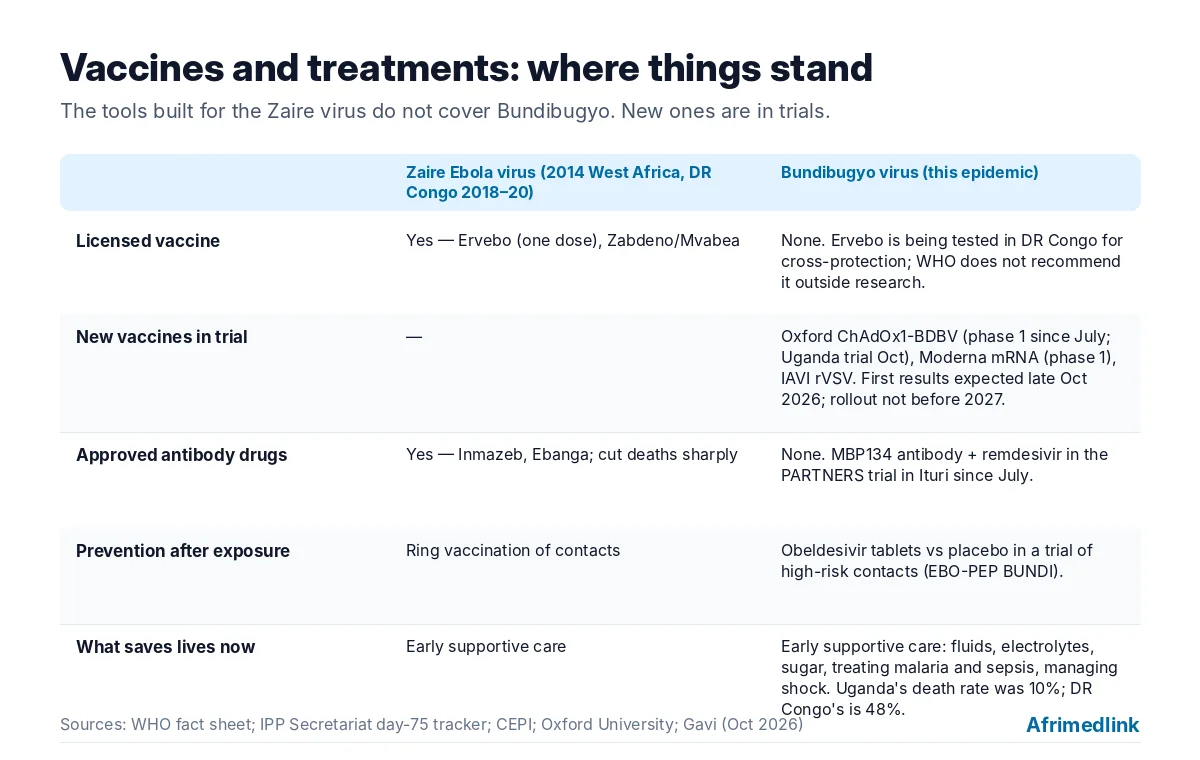 The tools that ended previous outbreaks were built for the Zaire virus. For Bundibugyo, new ones are in trials. Sources: WHO; IPP Secretariat; CEPI; Oxford; Gavi.
What exists for Zaire virus
For the Zaire species, the world now has two licensed vaccines, Ervebo and the two-dose Zabdeno/Mvabea, and two monoclonal antibody treatments, Inmazeb and Ebanga, that dramatically improve survival when given early [6]. Ring vaccination of contacts with Ervebo helped end the 2018–20 Congolese outbreak. None of these products was designed for Bundibugyo virus, whose surface proteins differ enough that the antibodies do not reliably bind. The NCDC's advisory to the states is explicit: Zaire-directed vaccines and antibodies "should not be relied on" for this strain [14]. WHO's expert group recommended against using Ervebo in this outbreak outside controlled research, because the evidence that it cross-protects is limited to animal studies [4][17].
What is being tested for Bundibugyo
The response has been fast by any historical measure:
- Vaccines. Oxford University's ChAdOx1-BDBV vaccine, built on the same platform as its COVID-19 vaccine, entered a first-in-human trial on 24 July 2026, about eight weeks after the outbreak was declared; a follow-on trial began in Uganda in October, and the Serum Institute of India has stockpiled about 620,000 investigational doses [18]. Moderna's mRNA candidate entered a phase 1 trial in August, and an IAVI vaccine on the same rVSV platform as Ervebo is being manufactured for trials, all with funding from the Coalition for Epidemic Preparedness Innovations [7][19]. Early safety and immune-response results from the first trials are expected around the end of October. Gavi, which runs the global Ebola vaccine stockpile, has said that if those results are good, larger trials would take several months and a rollout could come in the first half of 2027 [17]. Separately, 70,000 doses of Ervebo have been released to the Democratic Republic of the Congo, where health workers are being vaccinated under a research protocol to find out whether it offers any protection against Bundibugyo [17].
- Treatments. The WHO-sponsored PARTNERS trial has been treating confirmed patients in Bunia, Ituri, since July with the antibody MBP134, the antiviral remdesivir, both or neither, to find out whether either works [7][20]. A second trial, EBO-PEP BUNDI, is giving high-risk contacts the oral antiviral obeldesivir or a placebo to see whether it can prevent infection after exposure [7].
None of these will be available in Nigeria for this case or its contacts; they are experimental, and they are being tested where the epidemic is. What Nigerian patients will receive is what the evidence says matters most.
What saves lives now: early, optimised supportive care
The WHO's recommendation for every Ebola patient, whatever the species, is "optimised supportive care": intravenous fluids and electrolytes to replace what is lost through vomiting and diarrhoea, monitoring and correction of blood sugar, potassium and other salts, treatment of co-infections such as malaria and bacterial sepsis, oxygen, management of shock, pain relief and nutrition [6][12]. It sounds unglamorous. It is the reason Uganda's fatality rate in this epidemic was around 10 per cent against Congo's 48 per cent, and the reason that patients who reach a well-run treatment centre in the first days of illness have a far better chance than those who arrive in the second week [4][5]. The NCDC's instruction to health facilities lists exactly these measures: rapid assessment, fluid and electrolyte management, glucose monitoring, treatment of malaria or bacterial co-infection, shock management and symptom control [14].
Treatment is not a reason to avoid care. Some people reason that if there is no cure, there is no point in going to an isolation centre, and that they would rather be at home with family. That reasoning gets people killed, twice over: the patient loses the fluids and monitoring that give them the best chance, and the family becomes the next cluster of cases. The isolation centre is where survival is highest and where loved ones are protected.
Protecting yourself and your family
For the great majority of Nigerians, who have no link to the case, the risk from this single imported patient is very low, and the precautions are the ordinary ones that protect against a dozen other infections as well.
 Six habits that cover almost all of the risk. Sources: WHO; NCDC; US CDC.
- Wash your hands with soap and water, or use alcohol sanitiser, after using the toilet, before eating or preparing food, after caring for anyone who is sick, and after public transport. This is the measure that protects against Ebola, cholera, typhoid and Lassa fever at once.
- Do not touch the body fluids of anyone who is sick with fever, vomiting or diarrhoea, and do not touch the body of anyone who has died of a feverish illness. If someone in your household falls ill after travel or contact, call 6232 for advice and, if needed, an ambulance. Do not carry them in a taxi or your own car from hospital to hospital.
- Leave the care of suspected patients to trained staff in protective equipment. The families and nurses who care for the sick are the people Ebola kills most. Love is not a substitute for a gown and gloves.
- Travel sensibly. The WHO advises against travel restrictions, and Nigeria has not imposed any; but if you must travel to the affected areas of the Democratic Republic of the Congo, to Uganda or to Nairobi, avoid health facilities, burials and contact with the sick, and on your return complete the Health Declaration Form the NCDC now requires of arrivals from affected countries, and monitor yourself for 21 days [8][21].
- Avoid bushmeat and animals found dead. Do not handle or eat bats, monkeys or other wild animals, and cook all meat thoroughly [6]. This is how the virus first enters people.
- Protect the people who protect you. Give every clinician your full travel and contact history. Expect, and insist on, gloves for every injection and blood draw, in every clinic, every time. Do not pressure a nurse to skip precautions because "it is only malaria".
Burials and funerals
In every Ebola epidemic, funerals have been the fire that spread the disease, because the body is at its most infectious and because our traditions involve washing, dressing and embracing the dead. If someone in your family dies after a feverish illness, especially with vomiting, diarrhoea or bleeding, and especially with any link to the virus, do not wash or prepare the body. Call 6232. Trained teams can carry out a safe and dignified burial that respects faith and family, with the family present at a distance, and that protects everyone who attends [6]. This is not a rejection of our customs; it is what love looks like in an outbreak.
Schools, workplaces, markets and places of worship
There is no reason, from a single imported case under control, to close schools, markets or places of worship, and the NCDC has not asked for it. Ebola is not spread by gathering. What institutions can usefully do is make handwashing easy and visible, send anyone who is feverish home and to a doctor rather than letting them push through, and make sure staff know the 6232 number and the "symptoms plus a link" rule. Employers should allow monitored contacts to work from home without penalty; a contact who fears losing their job is a contact who hides a fever.
Stigma: the second disease
In 2014, families of patients were thrown out of their homes, survivors were shunned, and the hospital that stopped the index case was stigmatised for months [11]. Stigma is not only cruel; it drives the epidemic, because people who fear being shunned conceal symptoms, avoid testing and bury their dead in secret. A survivor whose blood tests negative is not a danger to anyone. A contact completing 21 days of monitoring is not a danger to anyone. The Abuja hospital and its staff, who are now living with the consequences of having cared for a very sick woman, deserve the country's gratitude, not its suspicion.
What the government and the NCDC are doing
Nigeria did not start preparing for this on 20 October. On 28 May, two weeks after the epidemic was declared, the NCDC issued a national advisory rating the risk of importation as high and ordering every state to activate its public health coordination structure, carry out a risk assessment, identify at least one isolation facility with a referral pathway, prepare screening, protective equipment, sample transport and ambulance arrangements, train and protect frontline workers, intensify traveller monitoring, and report its readiness within 72 hours [14]. A Presidential Task Force on Ebola was established in June [2].
 The NCDC's importation-risk tiers describe how likely a case is to arrive in a state, not how dangerous it is to live there. Source: NCDC advisory, 28 May 2026.
The advisory placed ten states in the highest tier because of their international airports, seaports and porous borders: Lagos, the FCT, Rivers, Kano, Enugu, Borno, Akwa Ibom, Cross River, Taraba and Adamawa; and twelve more in a moderate tier [14][22]. In September the NCDC required all travellers arriving from countries with Ebola transmission to complete a Health Declaration Form for follow-up, and after Kenya's first case on 6 October it announced it was reviewing the risk to Nigeria upwards [21][23]. The Abuja case arrived, in other words, exactly as the advisory anticipated: by air, into a high-risk state.
Since the confirmation, the response has followed the 2014 playbook with the stronger institutions built since: the patient isolated; her hospital supported with infection-prevention teams; contacts listed and under daily follow-up; airline manifests obtained; all health facilities, public and private, instructed to screen, isolate and report; and a single national hotline, 6232, publicised for information and for reporting suspected cases [1][3]. International partners, the Minister has said, have offered support [3]. The 2014 response was built on the polio eradication programme's emergency operations centre and its army of contact tracers, who made some 18,500 home visits in three months [11]. The NCDC that exists today, with a national emergency operations centre, a laboratory network, state-level EOCs in every state and a decade of Lassa fever, cholera, mpox and COVID-19 responses behind it, is a far stronger platform than the one improvised in Lagos in 2014.
 Nigeria in 2014 and in 2026: the same weak point at the start, and a stronger system to respond. Sources: US CDC MMWR; WHO; FMoH/NCDC.
What a good outcome looks like
A good outcome is the one Nigeria achieved in 2014: a small number of cases, all linked to the index patient, all found through contact tracing rather than turning up unannounced in hospitals, and no new cases after two incubation periods. Even in 2014, the index case infected eleven people at the Lagos hospital and one of them carried the virus to Port Harcourt, so the public should not be surprised or alarmed if one or more of the 44 contacts, most likely a health worker, tests positive in the coming days. That would be the system working: the person is already under watch, is isolated the day they fall ill, and their own contacts are already known. What would be alarming is a case with no link to this one, and that is what the "symptoms plus a link" rule and the 6232 line are designed to catch.
Myths and facts
- "Ebola is in the air; I can catch it on a bus or in a plane." No. Ebola needs direct contact with the body fluids of someone who is sick. You cannot catch it from sharing a space, a bus, an office or an aircraft with someone who is well or even someone who is ill, unless you touch their fluids [6].
- "Drinking or bathing in salt water prevents it." No. This rumour, which spread by text message in 2014, killed at least two people and hospitalised dozens with salt poisoning, and prevented nothing [11]. The same goes for bitter kola, garlic, high doses of vitamin C, chloroquine, antibiotics and "immune boosters". There is no food, herb or drug that prevents Ebola.
- "There is a vaccine, the government is hiding it." There is a vaccine for a different Ebola virus, the Zaire species, and it does not reliably work against Bundibugyo. Vaccines for this virus are in early trials and could be available in 2027 at the earliest [17][18].
- "If you get it, you die, so there is no point going to hospital." Half of patients in Congo have died; in Uganda, with early care, nine in ten survived [4]. Survival depends heavily on how early you are found and how well you are treated. The isolation centre is where you are most likely to live.
- "Survivors are still infectious." A survivor whose blood tests negative is not a danger to anyone in daily life. The exception is semen, which can carry virus for months; male survivors are tested and counselled [6].
- "Mosquitoes spread it, like malaria." No. There is no evidence that any insect spreads Ebola [6].
- "The Abuja hospital should be named and shut." The hospital did what hospitals do: it cared for a sick woman before anyone knew what she had. It is now the most Ebola-aware facility in the country. Naming hospitals and families drives the next patient to hide.
- "It only affects poor people in villages." The index case flew into the capital on an international flight and was admitted to a private hospital. The virus does not check bank balances.
Pregnant women, children and the elderly
Pregnant women with Ebola have historically had very poor outcomes, and the virus can persist in the placenta, amniotic fluid and breast milk [6]. Pregnant women and nursing mothers should be especially careful to avoid caring for anyone with Ebola-like symptoms, and a pregnant contact who develops fever should say so immediately, because she needs expert obstetric and infection care together. Children are infected the way adults are, through contact, usually while being nursed by a sick parent or nursing one; they should be kept away from any sick relative's room. Older people and those with other illnesses are at greater risk of dying if infected, for the same reasons as with any severe infection.
For health workers and private hospitals
The Abuja case was diagnosed in a private hospital, as Nigeria's 2014 index case was, and private facilities see most of the country's fevers. The NCDC's instructions to facilities, which apply to every clinic, laboratory and pharmacy, are: ask every febrile patient about travel and contacts in the last 21 days; isolate anyone who meets the case definition in a separate room at once, before confirmation; use standard precautions, gloves, gown, mask and eye protection for all contact with suspected cases; do not collect or transport samples without NCDC guidance; notify the state epidemiologist or 6232 immediately; and do not wait for bleeding before suspecting Ebola [14]. A nurse who insists on gloves for every injection, in every clinic, every day, is doing more for Nigeria's safety than any amount of airport screening.
Health workers exposed to a suspected case, whether by a needlestick, a splash or unprotected contact, should report it the same day, without shame. In 2014 the health workers who cared for the index patient became the next cases, and some died, including Dr Stella Ameyo Adadevoh, whose refusal to discharge him is the reason the outbreak stayed small [11]. The way to honour that is to make sure that this time, the people caring for the sick are protected before they are exposed.
How Afrimedlink can help
An outbreak produces two epidemics: one of a virus, and one of fear and misinformation. Afrimedlink can do little about the first beyond what the NCDC does; it can do a great deal about the second, and it can keep people who are frightened but not at risk out of crowded waiting rooms, where they would be exposed to other infections and would crowd out those who need care.
 How to use Afrimedlink during this outbreak, and when to bypass it and call 6232. Afrimedlink is not an emergency service.
- Check your symptoms and your risk online. Our symptom guide asks the questions a clinician would ask, including the ones about travel and contacts in the last 21 days. If your answers meet the NCDC case definition, it tells you plainly to call 6232 and how to isolate while you wait, rather than booking you into a clinic. If they do not, it helps you decide whether your fever needs a malaria test, a consultation or rest.
- Talk to a doctor from home. An online consultation lets a feverish patient with no Ebola link be assessed, tested for malaria through a partner laboratory and treated without sitting in a waiting room, and lets an anxious one talk it through with a professional. During the outbreak, our consulting doctors have been briefed on the NCDC case definition and the referral pathway, and every consultation begins with the travel and contact questions.
- Find the right facility, the first time. Our hospital directory shows the designated isolation and treatment centres, the facilities equipped to take suspected cases, and their emergency numbers, so that no family drives a sick relative from gate to gate as happened in 2014. Hospitals on the platform can update their status and capacity directly.
- Verified updates only. We republish the NCDC's daily situation updates and advisories, in plain language, with the date and the source on every figure, and we correct the rumours that reach us. If a message about Ebola did not come from the NCDC, the Federal Ministry of Health, the WHO or a source you can name, do not forward it; send it to us and we will check it.
- Support for contacts and survivors. Being monitored for 21 days is lonely and frightening. Our mental health consultations are available to contacts and their families, and we will connect survivors to the NCDC's survivor-care services, including the testing and counselling that male survivors need.
- For hospitals and clinics on the platform. We provide the NCDC's infection-prevention guidance, the case definition and the reporting pathway in one place for your staff, and a channel to report a suspected case or a readiness gap to the state EOC.
What Afrimedlink is not: an emergency service or a substitute for the NCDC. If you have symptoms and a link to the virus, call 6232 first and follow their instructions. If you cannot pass urine, cannot keep fluids down, are confused or bleeding, you need an ambulance, not an app.
Key takeaways
- Nigeria has one confirmed, imported case of Ebola, in Abuja, confirmed on 20 October 2026, with 44 contacts under monitoring. It is linked to the Bundibugyo-virus epidemic that has infected more than 9,200 people in the Democratic Republic of the Congo and reached Uganda and Kenya.
- Ebola spreads only by direct contact with the body fluids of someone who is sick, or the body of someone who has died, of the disease. It is not airborne, and people are not infectious before symptoms begin.
- Symptoms start like malaria: fever, weakness, headache, muscle pain, sore throat; then vomiting and diarrhoea. Bleeding is late and uncommon. The rule is symptoms plus a link in the last 21 days.
- If you have symptoms and a link, call 6232 first. Do not walk into a clinic, pharmacy or laboratory. Separate yourself, protect your carer, drink ORS, and do not self-medicate.
- Testing is a laboratory PCR, arranged by public health teams. There is no home test, and a negative result in the first three days may need repeating.
- There is no licensed vaccine or specific drug for Bundibugyo virus yet; candidates are in trials. What saves lives is early supportive care in a treatment centre: Uganda's death rate was 10 per cent, Congo's 48.
- Protect your family with handwashing, by never touching the sick or the dead, by giving doctors your travel history, and by refusing injections without gloves.
- Reject stigma and rumour. Salt water, bitter kola and forwarded messages prevent nothing. Contacts and survivors are not dangerous. The hospital that found this case did its job.
- Nigeria stopped Ebola in 93 days in 2014 with a weaker system than it has now. Whether it does so again depends on contacts cooperating, health workers asking the right questions, and all of us calling before we go.
References and further reading
- Federal Ministry of Health and Social Welfare / Nigeria Centre for Disease Control and Prevention. Nigeria confirms a case of Ebola disease in the FCT and activates public health response. Press statement, 20 October 2026 (via Nigeria Health Watch / allAfrica). allafrica.com
- Associated Press. Nigeria confirms an Ebola case in Abuja as a woman arriving from Uganda tests positive. 20 October 2026. opb.org
- Premium Times. How we are responding to new Ebola case in Abuja — Minister. 21 October 2026 (via allAfrica). allafrica.com
- Wikipedia contributors. 2026 Ebola epidemic (with its cited WHO, INRB and Africa CDC sources). en.wikipedia.org
- US Centers for Disease Control and Prevention. Ebola outbreak: current situation (data to 15 October 2026). cdc.gov · summary in Contagion Live
- World Health Organization. Ebola disease: fact sheet. who.int
- International Pandemic Preparedness Secretariat. Ebola (Bundibugyo) Day 75: tracking progress on medical countermeasures. July 2026. ippsecretariat.org
- World Health Organization. Disease Outbreak News: Ebola disease caused by Bundibugyo virus, Democratic Republic of the Congo (DON619). 8 October 2026. who.int
- Ebola Tracker. Ebola in Nigeria: first case confirmed in Abuja (October 2026), with country-by-country status. ebola-tracker.org
- TRT World. Ebola outbreak spreads to Nigeria as Kenya reports ninth case. October 2026. trtworld.com
- Shuaib F, Gunnala R, Musa EO, et al. Ebola virus disease outbreak — Nigeria, July–September 2014. MMWR Morbidity and Mortality Weekly Report, 2014;63(39):867–872. cdc.gov
- World Health Organization. Optimized supportive care for Ebola virus disease: clinical management standard operating procedures. 2019. who.int
- World Health Organization Regional Office for Africa. WHO declares Nigeria Ebola-free. 20 October 2014. afro.who.int
- Nigeria Centre for Disease Control and Prevention. National Public Health Advisory on State Preparedness for Bundibugyo Ebola Virus Disease. 28 May 2026. ncdc.gov.ng
- US Centers for Disease Control and Prevention. Considerations for discharging people under evaluation for selected viral haemorrhagic fevers (repeat testing when a negative PCR is taken less than 72 hours after symptom onset). cdc.gov
- World Health Organization. Interim guidance on diagnostic testing for Ebola disease caused by Bundibugyo virus. 9 July 2026, linked from DON619. who.int
- AllAfrica / Gavi. Ebola vaccine trials "reason for hope" in DR Congo and beyond. 18 October 2026. allafrica.com
- University of Oxford. First volunteer vaccinated in the world's first Bundibugyo ebolavirus vaccine trial. 24 July 2026. ox.ac.uk
- CEPI. Moderna's Bundibugyo ebolavirus vaccine candidate enters first human trial. 2026. cepi.net
- World Health Organization. Ebola outbreak — DRC 2026 (situation page, with links to the PARTNERS treatment trial). who.int
- Channels Television. NCDC releases advisory on Ebola, says Nigeria on "high alert". 23 September 2026. channelstv.com
- BusinessDay. NCDC places Lagos, FCT, Rivers, 7 others among high-risk states for Ebola importation. May 2026. businessday.ng
- Gazette Nigeria. NCDC Ebola alert: Nigeria heightens vigilance over Kenya's Bundibugyo virus case. October 2026. gazettengr.com
- Africa CDC. Ebola disease outbreak: situation updates and guidance. africacdc.org
- Nigeria Centre for Disease Control and Prevention. Press releases and daily situation updates; toll-free 6232, SMS 0809 955 5577, WhatsApp +234 708 711 0839. ncdc.gov.ng
This article is for general health education and does not replace advice from a doctor who knows your medical history, or the instructions of the NCDC and your state health authorities during this outbreak. If you have symptoms or concerns, call 6232 or see a qualified health professional. Figures are correct as of 21 October 2026 and will change; check the NCDC's updates for the latest.
Sign in to react.
Speak with verified foreign doctors and other healthcare professionals — within minutes. Vetted professionals abroad, then a vetted partner hospital near you if you need more care.
Consult a doctor nowTake Control
of Your Health
Get access to qualified doctors, personalised health records, and expert care — all from your phone.