
Sickle Cell Disease in Nigeria: Genotype Testing, Crisis Prevention and Living Well
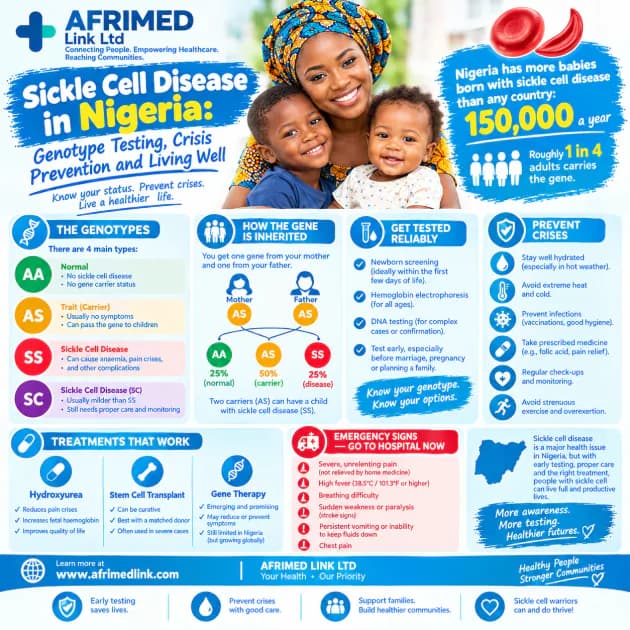
Nigeria has more babies born with sickle cell disease than any country: about 150,000 a year, with roughly one adult in four carrying the gene. This guide explains the AA, AS, SS and SC genotypes, how the gene is inherited, how to test reliably, how to prevent crises, which treatments work (hydroxyurea, transplant, gene therapy), and the emergency signs that mean go to hospital now.
Introduction
If you are Nigerian, there is roughly a one-in-four chance that you carry the sickle cell gene. Almost every family has a story about it: a cousin "always in and out of hospital", a couple whose wedding plans changed after a genotype result, a child lost too young. Nigeria has more babies born with sickle cell disease than any other country: about 150,000 a year, by WHO's estimate [1][2][3]. The Federal Ministry of Health says about 25 per cent of adults carry the gene [4].
Sickle cell disease (SCD) can be tested for before conception, detected at birth, and managed for a lifetime. In countries where care is routine, more than 95 per cent of children with SCD survive beyond five; in Nigeria, only about half do [4]. That gap is not biology. It is a gap in testing, access and knowledge.
If you only have two minutes, read the emergency signs section and the key takeaways.
The single most important message: Know your genotype, and your partner's, before you plan a family. Carriers (AS) are healthy; the disease (SS or SC) is serious but treatable. A child with SCD who has a fever, chest pain or breathing difficulty needs a hospital the same day. Prayer can comfort a family, but it must go alongside medical care, not replace it.
What sickle cell disease is
Haemoglobin is the protein in red blood cells that carries oxygen. Sickle cell disease is an inherited blood disorder caused by a change in the HBB gene, which produces an abnormal haemoglobin S (HbS). In people with the disease, red cells become rigid and sickle-shaped and block blood flow in small vessels [1]. Blocked vessels starve tissue of oxygen, causing sudden severe pain (a "crisis") and, over time, organ damage; and sickled cells break down quickly, leaving the person anaemic.
Carrier or disease: what the letters mean
We each inherit two copies of the haemoglobin gene, one from each parent. The combination is your genotype.
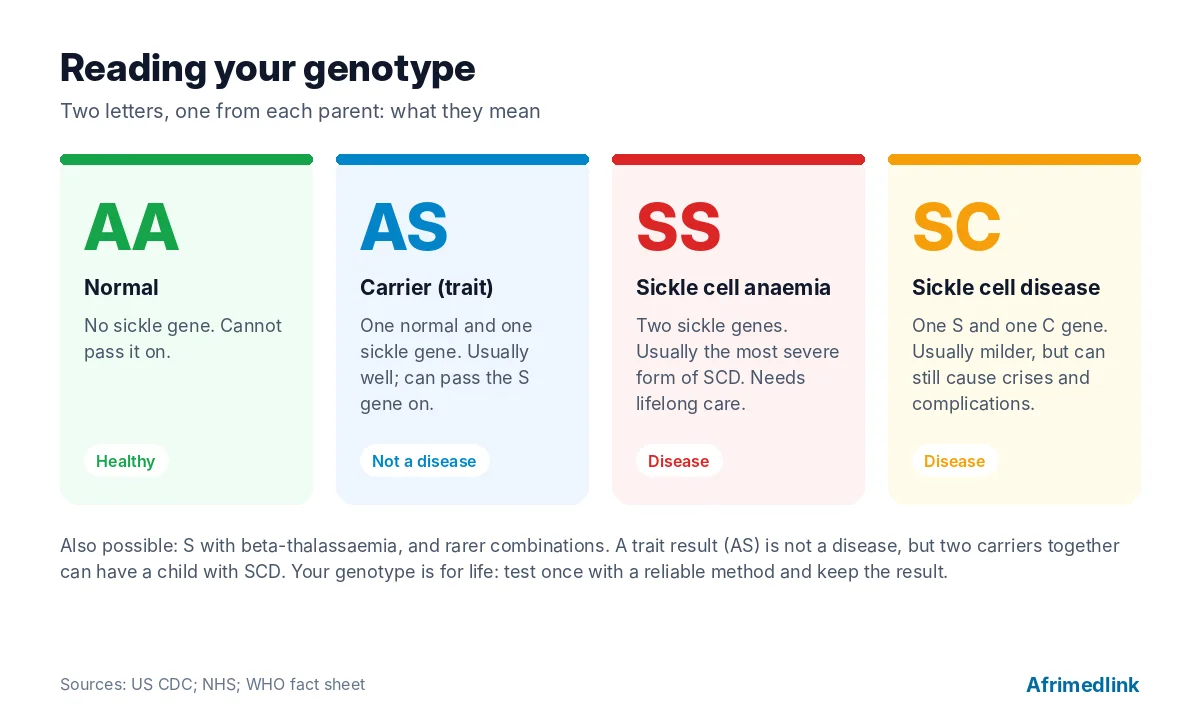 The four genotypes you will hear about in Nigeria: two are healthy states, two are forms of sickle cell disease. Sources: US CDC; NHS; WHO fact sheet.
- AA: two normal copies. No sickle gene.
- AS: one normal and one sickle copy, called sickle cell trait or being a carrier. Carriers usually have no symptoms and do not have the disease, but can pass the S gene to children [1][8][9].
- SS: two sickle copies, called sickle cell anaemia, usually the most severe form [9].
- SC: one sickle copy and one for a different abnormal haemoglobin, C. It is also sickle cell disease, usually milder than SS but still capable of crises and complications [9].
The practical rule: AS is a carrier state, not an illness; SS and SC are illnesses that need a specialist. The CDC notes that carriers can, rarely, run into trouble under severe stress such as dehydration or very strenuous exercise [9], so an AS footballer or farm worker should drink water. That is a reason for sensible habits, not for stigma.
How the gene is passed on
SCD is not infectious. Nobody catches it from a classmate, and it is not caused by witchcraft, a curse or bad food. It is inherited, and the chances follow simple arithmetic.
 When both parents are carriers (AS and AS), each pregnancy has a 25% chance of a child with SS, a 50% chance of a carrier and a 25% chance of a child with no sickle gene. Sources: NHS; US CDC.
When both parents are AS, each pregnancy has a 25 per cent chance of a baby with SCD (SS), a 50 per cent chance of a carrier (AS) and a 25 per cent chance of a baby with no sickle gene (AA) [8]. The odds apply to every pregnancy separately: a couple with one healthy child have not "escaped", and a couple with an SS child have not "used up" their bad luck.
Other pairings: AS with AA gives no disease; AS with SS gives a 1-in-2 chance of SS each time; SS with AA gives all AS. Couples who most need counselling, ideally before marriage or the first pregnancy, are AS with AS, AS with SS or SC, and SS with SC.
The numbers: Nigeria and the world
 Nigeria's share of the world's sickle cell burden is the largest of any country. Sources: WHO; WHO AFRO; Africa Check; FMoH briefing, 19 June 2026.
Africa and the world
WHO reports that in 2021 an estimated 7.74 million people lived with SCD worldwide and 515,000 babies were born with it; sub-Saharan Africa accounts for nearly 80 per cent of cases [1]. WHO's Africa office puts the African Region's 2021 births at about 405,000 [2]. Older figures that 50 to 90 per cent of African children with SCD die before five reflect settings with almost no care [2][3].
Nigeria
- Births: the most widely quoted figure is at least 150,000 babies with SCD a year [2][3][5]. Africa Check noted that without national newborn screening nobody can give an exact count [3]; 150,000 is about three in ten of WHO's global 515,000 [1].
- Carriers: officials say about 25 per cent of adults [4]. In the 2018 Nigeria Demographic and Health Survey, about 20 per cent of children aged 6 to 59 months had the trait and about 1.3 per cent had SCD [7].
- Survival: a modelling study using the same survey estimated under-five mortality of about 490 per 1,000 for children with SCD born 2003 to 2013, four times that of children with normal haemoglobin, so roughly half did not reach five; the excess accounts for about 4.2 per cent of all under-five deaths [6]. The Ministry has put infant deaths from SCD at about 100,000 a year [4]. Estimates differ with method; all agree it is a major, preventable cause of child death.
- Treatment gap: hydroxyurea uptake in Nigeria is below 20 per cent [4].
West Africa
In Ghana, an estimated 15,000 to 18,000 babies are born with SCD each year. Newborn screening began in Kumasi in 1995, but most facilities remain in Greater Accra [10]. Across WHO's African Region, no country runs SCD screening as a national strategy; 14, including Nigeria and Ghana, run subnational programmes; and national management guidelines exist in only 11 member states [2].
Symptoms and complications
Symptoms usually start in the first year of life, often around five or six months, and range from mild to severe, often coming and going [9][12].
 The main complications of sickle cell disease. Sources: WHO fact sheet; US CDC; NHLBI; NHS.
- Pain crises: sudden severe pain in bones, joints, chest, back or belly, lasting hours to weeks. Triggers include dehydration, sudden temperature change, infection and stress [1][12]. In babies, the first sign is often painful swelling of the hands and feet (dactylitis) [1].
- Anaemia: tiredness, breathlessness, pale lips, sometimes yellow eyes; slower growth in children [1].
- Infections: the spleen is damaged early, so pneumococcal infection (pneumonia, meningitis, blood infection) and salmonella are dangerous. In a child with SCD, fever can be the first and only sign [1][13].
- Acute chest syndrome: chest pain, cough, fever and difficulty breathing, like pneumonia. In children infection is the usual cause. A medical emergency [14].
- Stroke: sudden weakness or numbness on one side, confusion, slurred speech, trouble seeing or walking [11]. In children, a brain-artery ultrasound (transcranial Doppler, TCD) can identify those at high risk [11].
- Splenic sequestration: in young children blood pools in the spleen, causing left-sided belly pain, a swollen belly, pale lips, fast breathing and sudden weakness. Parents can be taught to feel the spleen [15].
- Priapism: a painful, prolonged erection; episodes of four hours or more risk permanent damage [16][11].
- Eyes, kidneys, legs: retinal damage that can threaten vision; kidney changes (bedwetting in childhood); leg ulcers after age 10; gallstones [11].
Each of these has a response, and people in regular care have fewer and milder complications.
Emergency signs: when to get help
Every family should have a written plan: who to call and which hospital to go to, one with a doctor, oxygen and blood that you can reach within an hour.
 A three-level guide: call your clinic, go to hospital today, or go now. Sources: US CDC; NHLBI; NHS; Sickle Cell Society; SickKids. Afrimedlink is not an emergency service.
Call your clinic soon
- Pain that your home plan is controlling but not settling after a day.
- New yellow eyes, more tiredness than usual, vision change or a leg sore that is not healing.
- A missed dose or an empty supply of medicine. Ask the clinic what to do; do not simply stop.
Go to hospital today
- Fever of 38.5°C (101.3°F) or higher. The CDC says people with SCD should get emergency care at this level, because fever may signal infection or acute chest syndrome and in young children may be the only warning [17]. Some hospitals use a slightly lower threshold, about 38°C under the armpit [12]. Keep a working thermometer. Do not give paracetamol and wait.
- Severe pain not relieved by fluids, paracetamol or ibuprofen, warmth and rest [12].
- A baby with painful swollen hands or feet; repeated vomiting so fluids will not stay down.
- A painful erection not settling within about two hours of home measures [18].
Emergency: go now
- Chest pain or difficulty breathing [14].
- Weakness or numbness on one side, slurred speech, confusion, a fit or a sudden severe headache [11][12].
- Sudden paleness with a swollen, hard belly or fast heartbeat [15].
- A painful erection lasting four hours or more [16].
- A child who is very sleepy, hard to wake, or collapses [12].
Go straight to the nearest hospital, not first to a chemist or prayer house, and say: "This patient has sickle cell disease." Do not give aspirin to children under 16 unless a doctor prescribes it [24].
Testing: genotype, newborn screening and lab quality
Why test before you marry or conceive
A genotype test is a simple blood test and the only way to know, because carriers look entirely healthy. Test early in a relationship or as a young adult, so that the result is information, not an emergency.
- An AS result is not a verdict. Two AS partners have a 3-in-4 chance of a child without SCD each time. The decision about marriage and family belongs to the couple and should never be forced by relatives or congregations.
- A genotype is permanent. If two tests disagree, one is wrong.
How testing works
WHO says haemoglobin electrophoresis confirms the diagnosis and type [1]. A Kano consultant haematologist calls electrophoresis cheaper but prone to error, and chromatography (HPLC) more reliable [19]. Six federal Centres of Excellence, one per geopolitical zone, now have HPLC machines [4].
For babies, screening at birth lets protection start before the first dangerous infection. In 2026 the Federal Government began a Universal Newborn Screening Policy for SCD at selected facilities in Lagos, Kano and the FCT; the University of Abuja centre has screened more than 38,000 babies in the FCT [4]. Elsewhere, ask for a test if your baby was not screened.
Why some results cannot be trusted
Nigerian haematologists list the causes of wrong genotype results: sample mix-ups, poorly cleaned equipment and expired reagents, documentation errors (said to be the commonest), unqualified laboratories, and forged results bought at business centres by people under pressure before a wedding [20].
- Use a hospital or accredited laboratory with trained staff [20].
- If the result matters for marriage or pregnancy, ask for HPLC or an equally reliable method [19].
- If results disagree, repeat the test at a teaching hospital and have a haematologist interpret it.
- Never buy a result: a forged certificate does not change your genotype and can put a child at risk.
Preventing crises
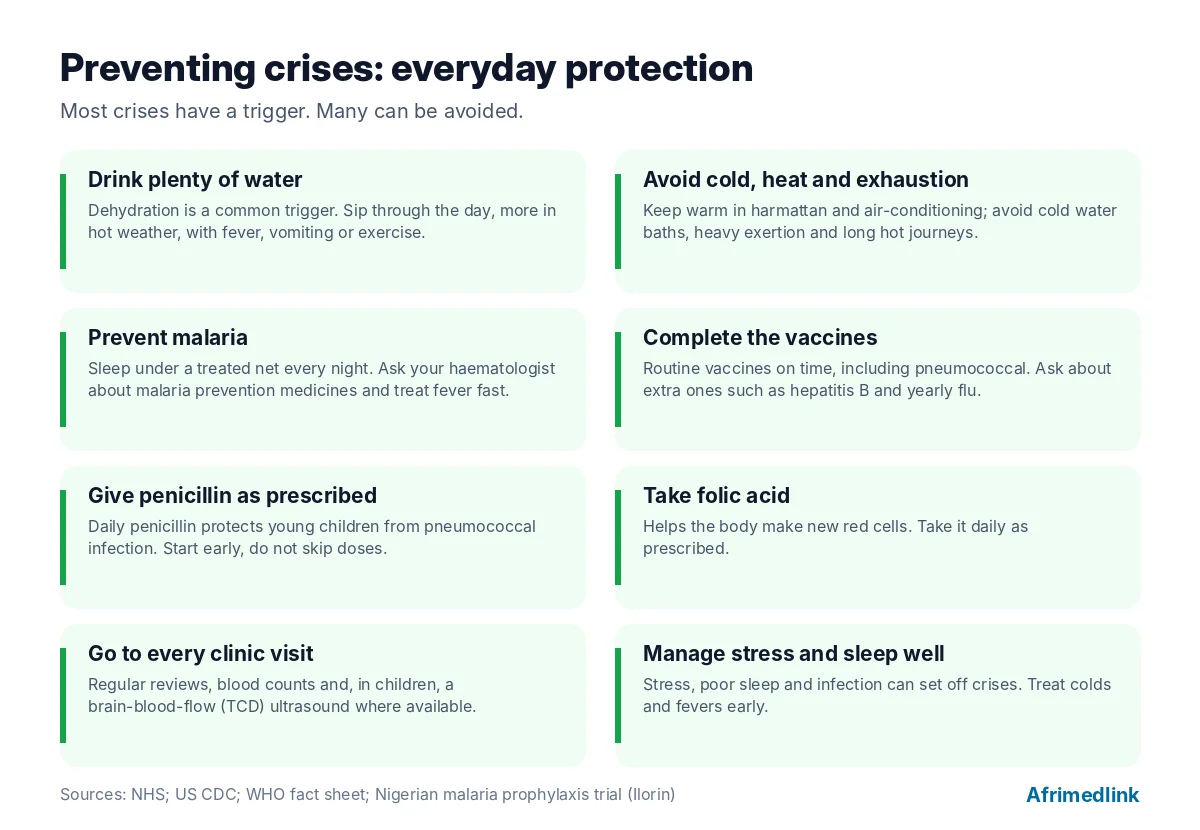 Eight everyday habits that reduce crises and infections. Sources: NHS; US CDC; WHO fact sheet; Ilorin malaria prophylaxis trial.
- Water, warmth, rest. Dehydration and sudden temperature changes are known triggers [12]. Drink through the day, more in heat or with fever; keep warm in harmattan and air-conditioning; avoid cold swimming and exhaustion.
- Prevent malaria. Sleep under a treated net, treat fever promptly, and ask about preventive medicine. In a trial of 270 patients at the University of Ilorin Teaching Hospital, 57 per cent of those on daily proguanil took fewer than three-quarters of their doses, and a 2-monthly mefloquine-artesunate course given at clinic visits worked better [22].
- Vaccines. WHO lists vaccines against pneumococcus, Haemophilus influenzae type b and hepatitis B as part of preventive care [1]. Nigeria added PCV10 to routine immunisation from December 2014, starting in 11 states [23]; check your child's card.
- Penicillin for young children. A daily antibiotic, usually penicillin, protects against pneumococcal infection [24]. A 1986 trial in 215 children under three found penicillin cut pneumococcal sepsis by 84 per cent; experts advise starting by three to four months and continuing to at least age three, many centres to five [25]. Give it daily, even when the child seems well.
- Folic acid helps the body make new red cells [1][24].
- Regular clinic visits to check growth, blood counts, eyes and, in children, TCD where available.
Treatment: what works and what is reachable
Hydroxyurea
Hydroxyurea (hydroxycarbamide) is a once-daily tablet or capsule that raises fetal haemoglobin and so reduces pain crises and transfusions [1][24]. WHO has listed it as an essential medicine for sickle cell disorders since 2011 [26]. It lowers white cell and platelet counts, so regular blood tests are required [24].
 Treatment options for sickle cell disease and how realistic each is in Nigeria. Sources: Healio/ASH 2018 (REACH); WHO EML; NAN 2025; ThisDay 2024; ARY News/FDA 2023.
- REACH gave hydroxyurea to 606 children aged 1 to 10 in four sub-Saharan countries. Average falls were about 55 per cent in pain, 38 per cent in infections and 51 per cent in malaria [27]; deaths fell from 3.6 to 1.1 per 100 patient-years, and only 4.9 per cent had a dose-limiting toxicity in the first three months [21].
- NOHARM in Uganda found that the maximum tolerated dose gave fewer severe pain episodes, admissions and transfusions than a lower fixed dose [28].
- SPRING, in Nigeria, compared low and moderate doses in 220 children aged 5 to 12 at high stroke risk. Strokes occurred in 3 of 109 on the lower dose and 5 of 111 on the moderate dose, not a significant difference, and the authors said the findings support low-dose use [29].
Hydroxyurea needs a prescription and monitoring. The government says it is revising national guidelines to expand its use and talking to the National Health Insurance Authority about subsidised hydroxyurea and screening; no timeline has been given [4]. If you cannot find or afford it, tell your clinic rather than quietly stopping.
Pain relief and transfusion
Mild crises are often managed at home with fluids, paracetamol or ibuprofen, warmth and distraction; hospital may be needed for stronger painkillers [24]. Transfusions treat severe anaemia and help prevent stroke in high-risk people, but repeated transfusions can overload the body with iron [1][24].
Transplant and gene therapy: honest expectations
Stem cell (bone marrow) transplant is the only established cure but is rarely done because of its risks; it is generally considered for children with severe disease and usually needs a matched donor, often a sibling [24]. Nigeria has begun. LUTH, with the Sickle Cell Foundation Nigeria, carried out its first transplants in September 2024 on two patients using family donors [30], and by June 2025 reported further cycles with all transplanted patients alive and with working grafts [31]. This is real progress but very limited, and treatment abroad can cost tens of thousands of dollars [30].
In December 2023 the US FDA approved two gene therapies, Casgevy and Lyfgenia, for people aged 12 and over, at list prices of US$2.2 million and US$3.1 million [32]. They matter for the future but are out of reach for almost every family here. Be wary of anyone selling a "cure".
Pregnancy with sickle cell disease
Women with SCD can have healthy babies, but pregnancy needs a team. In June 2025 WHO issued its first global guideline on SCD in pregnancy, noting a 4- to 11-fold higher likelihood of maternal death, more pre-eclampsia, and higher risks of stillbirth, preterm birth and low birth weight. Its 20-plus recommendations cover folic acid, crisis management, infection prevention, selected transfusions and extra monitoring by a team including a haematologist, midwife and obstetrician [33].
- Plan ahead. See your haematologist and an obstetrician before conceiving so medicines can be reviewed; WHO says early discussion, ideally before pregnancy, is best [33].
- Book antenatal care early at a hospital with haematology and obstetrics.
- Know your partner's genotype. If he is AA, your child cannot have SCD; if AS or SC, each pregnancy has a 1-in-2 chance of SCD, so discuss newborn testing and counselling [8].
School, work and mental health
Children with SCD can learn and thrive when those around them understand the condition. Teachers should allow water and toilet access at any time (frequent urination can be medical, not misbehaviour [11]), avoid cold rooms and exhausting midday games, hold a clinic letter with an emergency plan, and help with lessons missed to crises.
Stigma is part of the disease for many. In a 2013 survey of 370 Nigerian secondary school students, only 41 per cent thought most students would invite a classmate with SCD to a birthday party; 30 per cent believed spiritual or traditional healers can cure SCD, 11 per cent blamed evil spirits and 9 per cent thought it infectious [34]. At the 2026 national briefing, a person living with SCD said stigma "takes the place of our name, our ability and our capacity" [4].
Pain, hospital stays and being "the sick one" can weigh on mood. Withdrawal, loss of interest or hopelessness are signs that someone needs support: talk to a doctor or counsellor; it is part of care.
Myths and facts
- "It is a spiritual attack, or ogbanje/abiku." No. SCD is caused by a gene change. The belief in children "born to die and return" (ogbanje among the Igbo, abiku among the Yoruba) has long been tied to children with repeated illness and early death; a 2001 study of 100 Nigerian children labelled "malevolent ogbanje" asked in its title whether the explanation was reincarnation or sickle cell disease [35]. A child who is repeatedly ill needs a blood test and a doctor, not shame or ritual.
- "Two AS people should never marry." That is for the couple to decide with good information: each pregnancy has a 1-in-4 risk of SS and a 3-in-4 chance of a child without SCD [8]. Nobody should be shamed or forced.
- "Sickle cell patients die young, so treatment is pointless." Without care many do; with care, outcomes are far better, as survival of about half to age five in Nigeria against over 95 per cent in rich countries shows [4].
- "Hydroxyurea is chemotherapy and will harm my child." In African children with SCD it was well tolerated in trials [21], with monitoring.
- "Prayer or a herbal product alone will cure it." The only established cure is transplant, and gene therapy is out of reach here. Faith can sustain a family; "cures" for sale delay real care.
What you can do
- Do not know your genotype? Get tested at a hospital or accredited lab, ideally with HPLC, and ask your partner to do the same.
- Are you AS? You are healthy. Tell your partner early; if your partner is AS, SC or SS, see a genetic counsellor or haematologist.
- Do you or your child have SCD? Find one haematologist and one hospital that know you, keep a folder with the genotype result, medicines and emergency numbers, give medicines daily, keep a thermometer, and share the emergency signs with relatives, school and house help.
- For the family: test siblings too, and avoid blame: a child's genotype takes both parents.
How Afrimedlink can help
Much of sickle cell care happens between hospital visits: remembering a daily tablet, finding the right clinic, understanding a result, or judging whether a worry can wait. Afrimedlink is built for those moments.
 Four ways to use Afrimedlink for sickle cell care. Afrimedlink is not an emergency service.
- Find a haematology clinic or a genotype testing laboratory. Use the hospital directory to find hospitals with haematology services, sickle cell clinics and laboratories offering genotype testing, so you can choose trained staff and, where listed, HPLC.
- Talk to a doctor online. Ask about a genotype result, a symptom, a medicine, pregnancy or your child's school, and decide whether you need to be seen in person and how soon.
- Medicine and appointment reminders for daily folic acid, penicillin or hydroxyurea, vaccines, blood tests and clinic days.
- Verified information from WHO, CDC and Nigerian sources, with the source on every figure, plus counselling and mental health consultations when the weight of a long illness is too much.
What Afrimedlink is not: an emergency service. If you or your child has chest pain, difficulty breathing, weakness on one side, slurred speech, a fit, a swollen hard belly with sudden pallor, a painful erection lasting four hours or more, or a fever of 38.5°C or above, go to the nearest hospital now and say the patient has sickle cell disease. Do not wait for an online reply.
Key takeaways
- Nigeria has the world's largest sickle cell burden: about 150,000 babies born with SCD a year and about 1 in 4 adults carrying the gene.
- AS is a carrier state, not a disease. When two AS partners have a child, each pregnancy has a 25 per cent chance of SS, 50 per cent carrier and 25 per cent normal.
- Test early, at an accredited laboratory, ask for HPLC, and repeat any result that does not make sense.
- About half of children with SCD in Nigeria do not reach five, against fewer than 5 in 100 in rich countries. The difference is care.
- Hydroxyurea works in African children, yet uptake in Nigeria is under 20 per cent. Ask for it.
- Fever of 38.5°C or more, chest pain, breathing difficulty, stroke signs, sudden pallor with a swollen belly, and a painful erection of four hours or more are emergencies. Go to hospital at once.
- Prevent crises with water, warmth, malaria prevention, vaccines, penicillin in young children and regular clinic visits.
- Pregnancy with SCD needs specialist care, planned before conception where possible.
- Transplant is the only established cure and has only begun in Nigeria; gene therapy costs US$2.2 to 3.1 million. Beware of anyone selling a cure.
- Sickle cell is not a curse, not infectious and nobody's fault. Keep medical care at the centre.
References and further reading
- World Health Organization. Sickle-cell disease: fact sheet. who.int
- WHO calls for increased awareness, treatment to reduce Africa's sickle cell burden. allAfrica, 20 June 2025. allafrica.com
- Africa Check. Weighing Nigeria's sickle cell burden: is it the world's highest? africacheck.org
- News Agency of Nigeria, 19 June 2026; Voice of Nigeria, 21 June 2026. Federal Ministry of Health briefing on newborn screening. nannews.ng · von.gov.ng
- Nigeria Health Watch. Sickle cell disorder in Nigeria (undated). nigeriahealthwatch.com
- Child mortality from sickle cell disease in Nigeria: analysis of the 2018 Demographic and Health Survey. The Lancet Haematology, 2021 (results summary). idmod.org
- Malaria and sickle cell disease in anaemia among Nigerian children aged 6 to 59 months, 2018 Demographic and Health Survey (preprint). medrxiv.org
- NHS. Sickle cell disease: causes. nhs.uk · Overview nhs.uk
- US Centers for Disease Control and Prevention. About sickle cell disease. cdc.gov
- Ghana News Agency. Newborn screening, June 2026; sickle cell crisis, July 2026. gna.org.gh · gna.org.gh
- US National Heart, Lung, and Blood Institute. Sickle cell disease: health effects. nhlbi.nih.gov
- NHS. Symptoms. nhs.uk · SickKids. What to do if your child is unwell. aboutkidshealth.ca
- Nationwide Children's Hospital. Sickle cell disease and fever. nationwidechildrens.org
- US CDC. Acute chest syndrome. cdc.gov
- US CDC. Splenic sequestration. cdc.gov
- US CDC. Priapism. cdc.gov
- US CDC. Complications of SCD: fever. cdc.gov
- Sickle Cell Society (UK). Priapism. sicklecellsociety.org
- Daily Trust. Sickle cell: why genotype tests give wrong results. 22 June 2019 (Prof. Sagir Ahmed, Aminu Kano Teaching Hospital). dailytrust.com
- ICIR Nigeria. Why are there blood genotype test results inconsistencies? 7 October 2024. icirnigeria.org
- Healio. REACH trial results (ASH 2018). healio.com
- Randomised trial of 3 antimalarial regimens in Nigerian patients with SCD (Ilorin). pmc.ncbi.nlm.nih.gov
- WHO Regional Office for Africa. Nigeria introduces new vaccine: PCV 10. December 2014. afro.who.int
- NHS. Sickle cell disease: treatment. nhs.uk
- Relias Media. Pneumococcus, sickle cell disease, vaccination, and penicillin. reliasmedia.com
- WHO Essential Medicines List. Hydroxyurea. list.essentialmeds.org
- NHLBI. Sickle cell disease drug proves safe, effective in African children (REACH). 2018. nhlbi.nih.gov
- Indiana University School of Medicine. NOHARM trial, Uganda. medicine.iu.edu
- HCPLive. SPRING trial (The Lancet Haematology). hcplive.com
- ThisDay. LUTH's first bone marrow transplant. 3 October 2024. thisdaylive.com
- News Agency of Nigeria. LUTH transplant cycles. 19 June 2025. nannews.ng
- ARY News. US approves two gene therapies for sickle cell disease. 9 December 2023. arynews.tv
- WHO. First global guideline on pregnancy care for women with sickle cell disease. 19 June 2025. who.int
- Ola, Coker and Ani. Stigmatising attitudes towards peers with SCD in Nigerian secondary schools. Int J Child Youth Fam Stud, 2013. journals.uvic.ca
- Nzewi E. Malevolent ogbanje: recurrent reincarnation or sickle cell disease? Soc Sci Med, 2001. socialscienceinaction.org
This article is for general health education and does not replace advice from a doctor who knows your medical history. If you or your child has sickle cell disease, follow your haematologist's plan; in an emergency, go to the nearest hospital. Figures are correct as of 22 October 2026 and will change as new data appear.
Sign in to react.
Speak with verified foreign doctors and other healthcare professionals — within minutes. Vetted professionals abroad, then a vetted partner hospital near you if you need more care.
Consult a doctor nowTake Control
of Your Health
Get access to qualified doctors, personalised health records, and expert care — all from your phone.