
HIV Prevention, Testing and Treatment in West Africa: What Every Community Should Know
HIV is now a manageable condition, yet across West Africa too many people are diagnosed late. This guide gives the latest UNAIDS figures for the region and Nigeria, explains why testing is delayed, the signs that need a test now, the full prevention toolkit (condoms, PrEP, PEP within 72 hours, U=U, PMTCT), how testing and free treatment work, and how Afrimedlink offers confidential consultations, testing and fast referral.
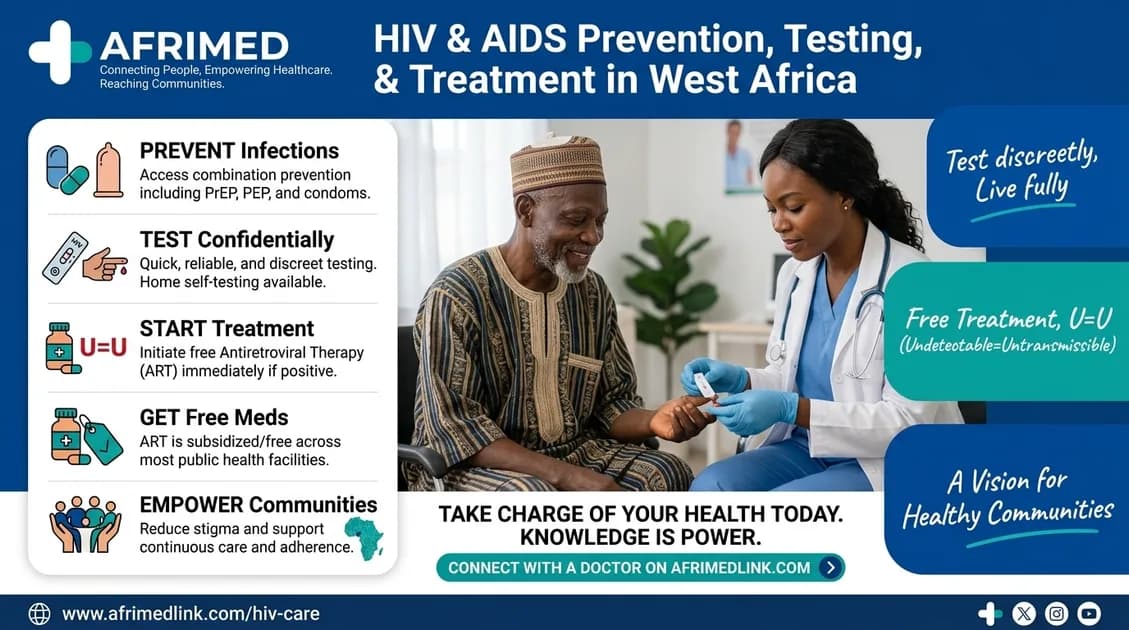
Introduction
HIV remains one of the most serious public health challenges across sub-Saharan Africa. West Africa generally has lower adult HIV prevalence than Southern and East Africa, but the region faces its own vulnerabilities: high mobility along the major trade corridors, stigma, structural barriers to healthcare, and pockets of concentrated risk among key populations [1][2].
The tragedy of HIV today is not a lack of scientific solutions. It is the gap between those solutions and the people who need them: late testing, late diagnosis, and treatment that is started late or not kept up. An infection caught early and managed with modern antiretroviral therapy (ART) allows a person to live a long, healthy life, and someone whose virus is suppressed by treatment cannot pass it on to a sexual partner at all: Undetectable = Untransmittable [3][4].
This guide sets out the numbers for the world and for West Africa, explains why diagnosis is so often delayed, lists the signs that should send you for a test, walks through the combination prevention toolkit (condoms, PrEP, PEP, U=U and prevention of mother-to-child transmission), describes how testing works and what happens after a positive result, and explains how Afrimedlink supports confidential care.
Knowing your status puts you in control. Modern treatment is highly effective at halting the virus, is free at designated public facilities across the region, and turns HIV into a manageable long-term condition. Do not let stigma delay care.
The numbers: worldwide and in West Africa
According to the latest UNAIDS estimates, published in June 2026 for the year 2025 [1]:
- Global burden. About 41.0 million people were living with HIV in 2025, with 1.2 million new infections and 570,000 AIDS-related deaths. 32.1 million people were on antiretroviral treatment by the end of the year, the highest number ever.
- Western and Central Africa. An estimated 5.2 million people live with HIV across the region. There were about 190,000 new infections in 2025, including 32,000 in children, and 110,000 AIDS-related deaths. Treatment coverage has risen to 74 per cent of all people living with HIV, but only 41 per cent of children with HIV are on treatment, and 70 per cent of pregnant women living with HIV receive the drugs that protect their babies [1].
- Nigeria. The country carries the region's largest burden. The Nigeria HIV/AIDS Indicator and Impact Survey found 1.4 per cent of adults aged 15–49 living with HIV, about 1.9 million people, with prevalence highest in the south-south states and among women [5].
- Who is most affected. Women and girls make up 53 per cent of all people living with HIV and 44 per cent of new infections worldwide; in West Africa, adolescent girls and young women in particular acquire HIV at higher rates than their male peers, driven by economic and gender inequalities [1]. Key populations, including sex workers, men who have sex with men and people who inject drugs, face risks many times higher than the general adult population [1].
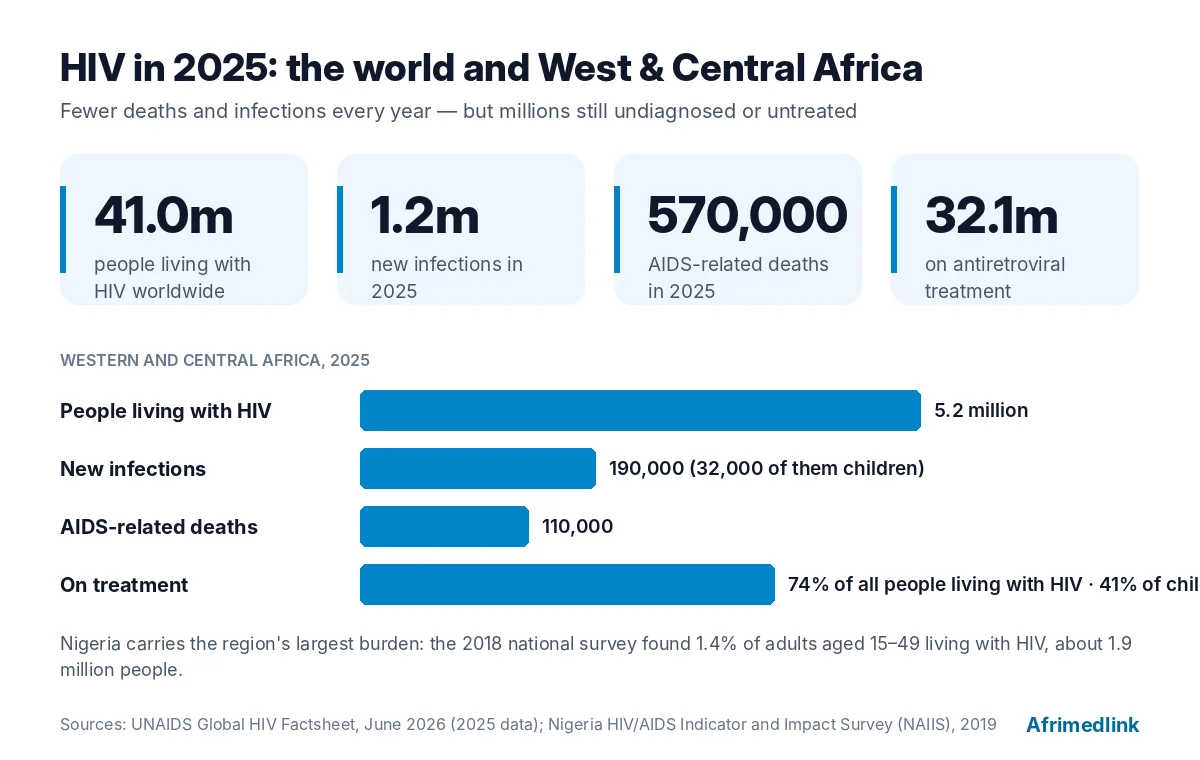 HIV in 2025: the world and Western and Central Africa. Sources: UNAIDS Global HIV Factsheet, June 2026; NAIIS 2019.
The treatment and survival gap
The world has set a target of 95–95–95: 95 per cent of people living with HIV knowing their status, 95 per cent of those on treatment, and 95 per cent of those virally suppressed. In 2025 the figures were 88, 78 and 74 per cent [1]. The striking number is the last link: among people who are on treatment, 95 per cent are suppressed. The medicines work. The gap is in getting tested and in starting and staying on treatment.
 The 95–95–95 cascade in 2025: the medicines work; the gap is in testing and treatment. Source: UNAIDS, June 2026.
That gap is widest in our region. Hospital studies and national surveillance across West Africa find that a large share of patients are diagnosed late, often presenting with advanced HIV disease or an opportunistic infection such as tuberculosis, when treatment is more complex and the chance of dying in the first months of care is much higher [2][6].
Why diagnosis is often delayed
Studies from across West Africa point to the same recurring barriers to early testing and care [2][6]:
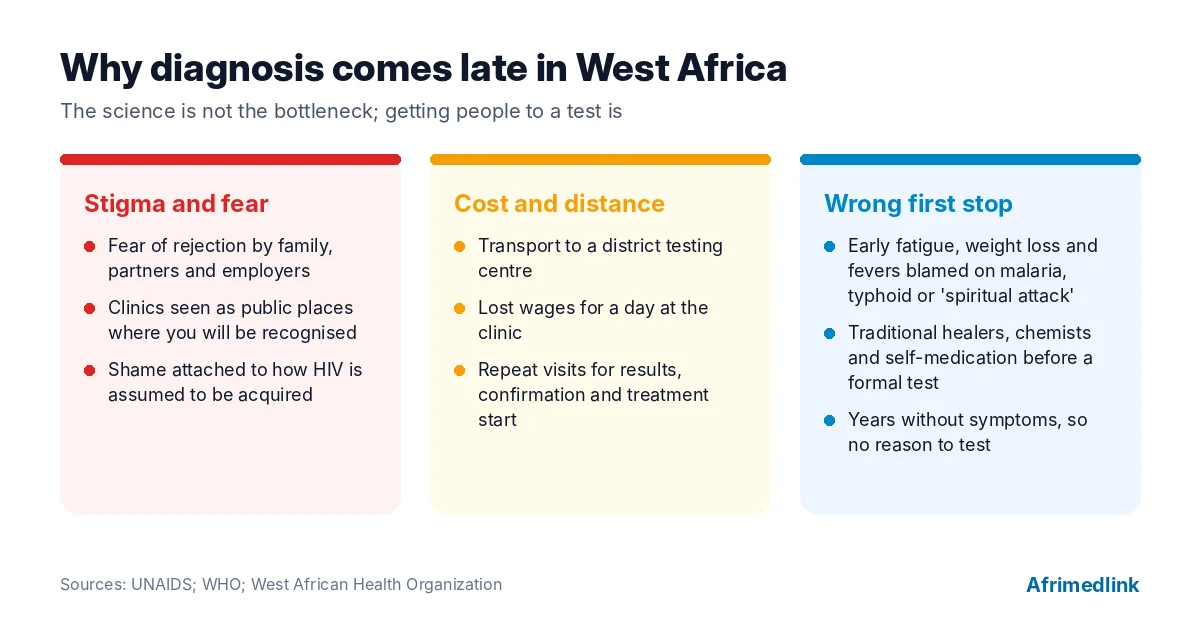 The science is not the bottleneck; getting people to a test is. Sources: UNAIDS; WHO; WAHO.
- Stigma and discrimination. Fear of social exclusion, rejection by family members and discrimination at work deter people from walking into a clinic for voluntary counselling and testing.
- Financial and geographic barriers. The cost of transport to a district testing centre, lost wages for a day at the clinic and repeat visits for results and treatment start all put off regular check-ups.
- Traditional and alternative first stops. Many people attribute early fatigue, weight loss or recurring fevers to malaria, typhoid or a spiritual affliction, and consult traditional healers, chemists or self-medicate before they reach a formal health facility.
- No symptoms, no reason to test. HIV can be completely silent for years. Without routine testing, the first sign is often a serious illness.
The signs to act on, and when to test
Early HIV infection can mimic other common tropical illnesses, with fever, fatigue, rash and swollen lymph nodes two to four weeks after exposure, or it can remain completely silent for years [3]. Rather than waiting for symptoms, routine testing is recommended for everyone who is sexually active, and at least once a year for anyone at higher risk. The following presentations, however, need a test now:
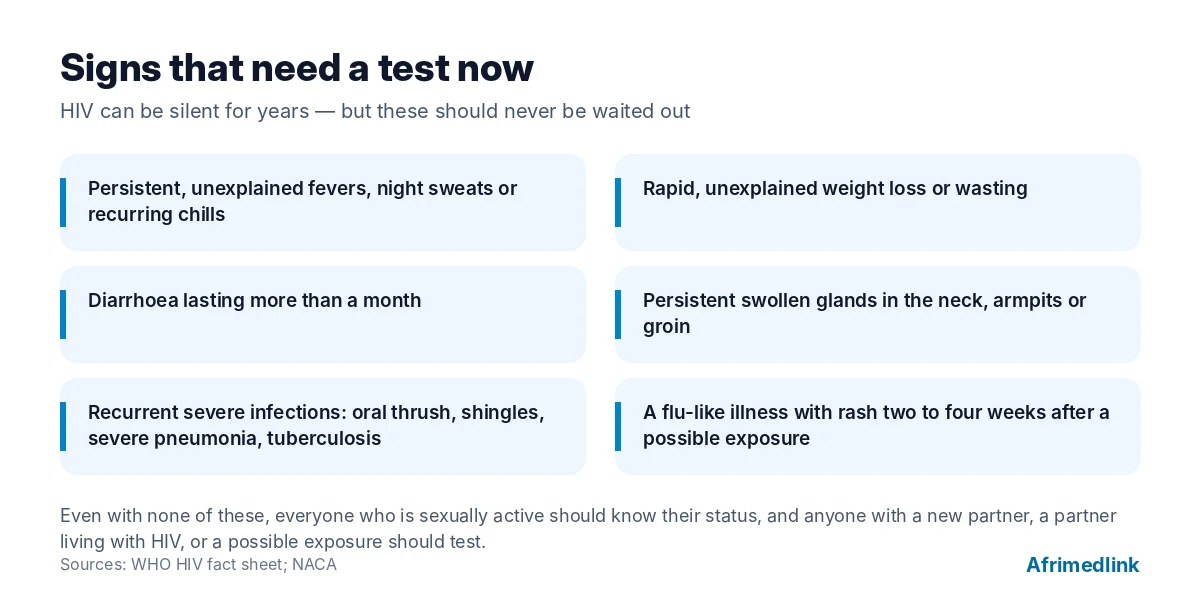 Signs that need a test now. Sources: WHO; NACA.
- Persistent, unexplained fevers, night sweats or recurring chills.
- Rapid, unexplained weight loss or chronic wasting.
- Diarrhoea lasting more than a month.
- Persistent swollen lymph nodes in the neck, armpits or groin.
- Recurrent severe infections, such as oral thrush, shingles, severe pneumonia or tuberculosis.
Every pregnant woman should be tested at her first antenatal visit, and anyone diagnosed with tuberculosis or another sexually transmitted infection should be offered an HIV test as a matter of routine [3].
How prevention works: the combination approach
Preventing HIV means using a multi-layered toolkit. No single method does everything; together they stop transmission [3][7].
 Combination prevention: the toolkit. Sources: WHO; NIH.
- Condoms and barrier methods. Consistent and correct use of male and female condoms remains the cornerstone of preventing sexual transmission, and protects against other sexually transmitted infections too.
- PrEP (pre-exposure prophylaxis). HIV-negative people at higher risk can take antiretroviral medicine to prevent infection: a daily pill, or, since the WHO's July 2025 recommendation, a twice-yearly injection of lenacapavir [7][8]. Taken as prescribed, PrEP reduces the risk of acquiring HIV through sex by about 99 per cent.
- PEP (post-exposure prophylaxis). Emergency antiretroviral treatment started within 72 hours of a possible exposure, such as a condom break, sexual assault or a needle-stick injury at work, and taken for 28 days, can prevent infection. The sooner it is started, the better it works [3].
- ART as prevention (U=U). People living with HIV who take their treatment consistently and reach an undetectable viral load cannot transmit the virus sexually [4].
- PMTCT (prevention of mother-to-child transmission). Pregnant women living with HIV who receive antiretroviral drugs during pregnancy, delivery and breastfeeding can bring the risk to their baby to under one per cent [3].
PEP is an emergency. If you think you have been exposed to HIV, do not wait to see a specialist next week. Go to the nearest hospital or call a doctor today; after 72 hours, PEP no longer works.
Testing options and taking charge
Getting tested is quick, confidential and widely available across West Africa [3][9].
 Getting tested, and what happens next. Sources: WHO; NACA; Ghana AIDS Commission.
- Rapid diagnostic tests. Available at almost every primary health centre, district hospital and community outreach clinic, these give a result in under 20 minutes from a finger-prick blood sample.
- HIV self-testing. Oral-fluid or blood-based self-test kits, now sold in pharmacies and distributed by many programmes, let you check your status privately at home. A positive self-test always needs a confirmatory test at a facility.
If a test is positive, confirmatory testing is done and treatment is started promptly, often the same day. National programmes across the region, including Nigeria's NACA and the PEPFAR- and Global Fund-supported network, Ghana's National AIDS Control Programme and their regional partners, provide antiretroviral medicines free of charge at designated public health facilities [9][10]. Treatment today is usually a single tablet a day with few side effects, and the viral load is checked at six and twelve months and then yearly to confirm it is working.
How Afrimedlink supports people living with or at risk of HIV
Navigating HIV prevention, diagnosis and long-term treatment can feel overwhelming because of lingering stigma and practical obstacles. Afrimedlink (afrimedlink.com) is built to bridge those gaps by connecting people safely, privately and remotely with trusted care across West Africa.
 Private, remote, and connected to free treatment.
- Discreet online consultations. Speak directly with verified infectious-disease specialists, general practitioners and counsellors from the privacy of your home, with no fear of being recognised in a crowded clinic waiting room.
- Confidential diagnostics and self-test access. Through our network of accredited partner laboratories and pharmacies, you can order a discreet HIV self-test kit, book a confidential viral-load check or routine baseline blood tests, with your data protected under the Nigeria Data Protection Act 2023.
- Fast-track referral to free ART. If you test positive, our doctors navigate the system for you, with a fast-track referral to a designated government treatment centre so that free, life-saving treatment starts at once.
- PrEP and PEP guidance. Clinical assessment for PrEP, and emergency guidance for PEP within the 72-hour window, so that you get a prescription quickly.
- Adherence support and long-term care. Digital health records, appointment and refill reminders, and mental-wellness support to help you reach and stay undetectable.
Talk to a specialist. Visit www.afrimedlink.com/talkto/consultation to book a private, confidential consultation with a licensed healthcare professional today.
Key takeaways
- HIV is a manageable chronic condition, not a death sentence. Early diagnosis saves lives.
- 41 million people live with HIV worldwide and 5.2 million in Western and Central Africa; Nigeria alone has about 1.9 million. Deaths and new infections are falling, but too many people are diagnosed late.
- Combination prevention works: condoms, PrEP (including the new twice-yearly injection), PEP within 72 hours, U=U and treatment in pregnancy.
- Get tested regularly. Rapid tests take 20 minutes; self-tests can be done at home. Treatment is free at designated public facilities.
- Among people on treatment, 95 per cent are undetectable and cannot pass HIV on. The medicines work; the gap is testing and staying in care.
- Afrimedlink offers private online consultations, confidential testing, PrEP and PEP guidance, and fast referral to free treatment centres.
References and further reading
- UNAIDS. Global HIV & AIDS statistics — fact sheet 2026 (data for 2025). Geneva, June 2026. unaids.org
- UNAIDS. Path to ending AIDS by 2030: addressing disparities in Western and Central Africa. unaids.org
- World Health Organization. HIV and AIDS: key facts. who.int
- US National Institutes of Health, NIAID. HIV undetectable = untransmittable (U=U), or treatment as prevention. niaid.nih.gov
- Federal Ministry of Health, Nigeria. Nigeria HIV/AIDS Indicator and Impact Survey (NAIIS): national summary sheet. March 2019. fmino.gov.ng · UNAIDS country page: unaids.org
- West African Health Organization. Regional HIV/AIDS surveillance and epidemiological reports. wahooas.org
- World Health Organization. Pre-exposure prophylaxis (PrEP) and post-exposure prophylaxis (PEP). who.int
- World Health Organization. WHO recommends injectable lenacapavir for HIV prevention. July 2025. who.int
- National Agency for the Control of AIDS (NACA), Nigeria. Fact sheets and treatment information. naca.gov.ng
- Ghana AIDS Commission. National HIV and AIDS programme and treatment services. ghanaids.gov.gh
- Nigeria Data Protection Commission. Nigeria Data Protection Act, 2023. ndpc.gov.ng
This article is for general health education and does not replace advice from a doctor who knows your medical history. If you have symptoms or concerns, please see a qualified health professional.
Sign in to react.
Speak with verified foreign doctors and other healthcare professionals — within minutes. Vetted professionals abroad, then a vetted partner hospital near you if you need more care.
Consult a doctor nowTake Control
of Your Health
Get access to qualified doctors, personalised health records, and expert care — all from your phone.