
Silent Shadows: The Eye Health Crisis in West Africa, with Nigeria and Ghana as Case Studies
More than four in five cases of blindness in West Africa are avoidable, yet 1.13 million Nigerian adults and 300,000 Ghanaians are blind, mostly from cataract and glaucoma. Using both countries’ national surveys, this guide shows where sight is being lost and why, the warning signs that need an eye check, the barriers to care, what is being done, and how to protect your own sight.
Introduction
Across the cities, markets and farmlands of West Africa, millions of people go about their lives through a haze of diminished vision or in darkness. Blindness and visual impairment are a profound public health and economic burden on the region: they take children out of school, take farmers and traders out of work, and turn a family member into a full-time carer. Sub-Saharan Africa carries one of the highest rates of blindness in the world, and the cruellest fact about that burden is that more than four in five cases are avoidable, either preventable in the first place or curable with an operation, a course of medicine or a pair of spectacles [1][2].
This guide uses the region's two most complete national surveys, Nigeria's National Blindness and Visual Impairment Survey and Ghana's Blindness and Visual Impairment Study, to show where sight is being lost, to what, and why. It explains the conditions that matter most in West Africa (cataract, glaucoma, uncorrected refractive error, and the infections and injuries that scar the cornea), the warning signs that should send you for an eye check, the barriers that keep treatment from reaching people, what is being done about it, and what you can do to protect your own sight and your family's.
The one message to take away: most blindness in West Africa is avoidable, but only if it is caught in time. A cataract can be removed in twenty minutes. Glaucoma can be held in check for life if it is found before the damage is done. Neither of those things happens unless people have their eyes examined, so if you are 40 or older and have never had your eye pressure checked, that is the single most useful thing this article can persuade you to do.
The numbers: West Africa, Nigeria and Ghana
The World Health Organization estimates that more than a billion people worldwide live with a vision impairment that could have been prevented or has not been addressed, and that the burden falls hardest on low-income regions, among older people, women and rural communities [1]. Sub-Saharan Africa has a higher age-standardised prevalence of blindness than any high-income region, and the number of people affected is set to rise as the population grows and ages [1][2].
 Two national surveys, one message: cataract and glaucoma dominate, and most blindness is avoidable. Sources: Nigeria NBVIS; Ghana BVIS 2015.
Nigeria: the case study in numbers
The Nigeria National Blindness and Visual Impairment Survey, carried out between 2005 and 2007 on more than 13,000 adults across all 36 states and the FCT, remains the most rigorous national eye survey conducted in Africa [3][4]. Its findings still frame national policy:
- 4.2 per cent of Nigerians aged 40 and over are blind, about 1.13 million people, with a further 0.4 million severely and 2.7 million moderately visually impaired: some 4.25 million adults living with significant sight loss [3].
- 84 per cent of that blindness is avoidable [3].
- Cataract causes 43 per cent of blindness; glaucoma 16.7 per cent; corneal scarring 7.9 per cent; trachoma 4.2 per cent and onchocerciasis (river blindness) 1.1 per cent. Uncorrected refractive error is the leading cause of moderate visual impairment, at 57 per cent [3].
- Women are 1.3 times more likely to be blind than men, and far less likely to have had cataract surgery: 28 per cent of cataract-blind women had been operated on, against 50 per cent of men [3][4].
The Federal Ministry of Health today puts the number of Nigerians with some form of sight loss at around 24 million, with about 1.3 million adults completely blind [5].
 Blindness in Nigeria follows a clear north–south gradient. Source: Nigeria NBVIS.
The survey also mapped a stark geography. Blindness is highest in the North East (6.1 per cent) and the Sahel belt (6.6 per cent), and lowest in the South West (2.8 per cent) and the Niger Delta (3.3 per cent). The North West, because of its population, holds the largest number of blind adults, 28.6 per cent of the national total [3][4]. Poverty, dust and sun, the historical reach of trachoma and onchocerciasis, the scarcity of eye specialists and the popularity of couching (a traditional procedure that pushes the cataract into the back of the eye) all concentrate in the north.
Ghana: the second case study
Ghana's Blindness and Visual Impairment Study of 2015 found an all-ages blindness prevalence of 0.74 per cent, about 300,000 people, with roughly 330,000 more severely visually impaired [6][7]. The pattern of causes is almost the same as Nigeria's: cataract 54.5 per cent, glaucoma 19.4 per cent, posterior-segment disease including diabetic retinopathy 12.9 per cent, and corneal disease 11.2 per cent [6][7].
 Ghana at a glance: smaller numbers, the same pattern, and one landmark win. Sources: Ghana BVIS 2015; GHS 2025; Budenz et al. 2013.
Ghana stands out in two ways. It has one of the highest rates of glaucoma ever recorded: the Tema Eye Survey of some 5,600 adults aged 40 and over found open-angle glaucoma in 6.8 per cent, and 97 per cent of those affected did not know they had it [8]. And it has a genuine public health triumph to its name: in 2018 Ghana became the first country in the WHO African Region to be validated as having eliminated trachoma as a public health problem, after two decades of the SAFE strategy in its northern regions [9].
Marking World Sight Day in October 2025, the Ghana Health Service summed up the remaining task: about 165,000 Ghanaians blind from cataract, 30,000 cataract operations a year against 68,000 needed, 140 ophthalmologists for the whole country, six regions with none, and nearly 68 per cent of the population with little or no access to essential eye care [7].
The conditions that take sight in West Africa
Cataract: a cure that does not reach people
Cataract, the clouding of the eye's natural lens, is the leading cause of blindness in both countries. It is mainly a disease of ageing, but in West Africa it comes earlier, driven by intense sunlight, malnutrition and poorly controlled diabetes [1]. The treatment is one of the most cost-effective operations in all of medicine: the cloudy lens is replaced with a plastic one in about twenty minutes, usually under local anaesthetic, and most patients see well within days.
 Cataract surgery works; the problem is coverage. Sources: Nigeria NBVIS; Ghana Health Service, Oct 2025.
The problem is not the surgery but getting to it. In Nigeria's survey only 37 per cent of cataract-blind people had been operated on, and a shocking 46 per cent of "operated" eyes had been couched rather than given modern surgery, leaving seven in ten of those eyes still blind [3][4]. Around 400,000 Nigerians were waiting for cataract surgery at the time, a number that has only grown. Ghana performs roughly 30,000 cataract operations a year, less than half of the 68,000 its Health Service estimates are needed, and about a tenth of the WHO benchmark rate [7]. People stay away for reasons that recur in every study: the cost of the operation, transport and an escort; fear of surgery; the belief that failing sight is simply old age or God's will; waiting until both eyes have gone; and the fact that couchers and healers reach the village long before an eye team does [3][10].
Glaucoma: the silent thief of sight
People of West African descent have the highest rates of primary open-angle glaucoma in the world, develop it younger, and lose sight from it faster [8][11]. It causes 16.7 per cent of blindness in Nigeria and 19.4 per cent in Ghana [3][6]. Raised pressure inside the eye slowly destroys the optic nerve, taking the edges of vision first, so that people notice nothing until the centre goes, and by then what is lost cannot be recovered.
 Glaucoma in West Africa: common, early, aggressive, and almost always undiagnosed. Sources: Tema Eye Survey; Kyari et al.; WHO.
The Tema finding that 97 per cent of people with glaucoma were unaware of it is matched in Nigeria, where the national survey found that the great majority of people with glaucoma had never been diagnosed, and many of those who had were not on treatment [11]. Treatment, with daily pressure-lowering drops, laser or surgery, is lifelong, and it is undermined by cost, erratic supply of drops and the understandable temptation to stop taking a medicine for an eye that feels fine. The only defence is to find it early: an eye-pressure check and optic-nerve examination every one to two years from the age of 40, and from 35 if a parent or sibling has glaucoma, because it runs strongly in families.
Uncorrected refractive error and presbyopia
Short sight, long sight and astigmatism are the single largest cause of visual impairment short of blindness in the region: 57 per cent of moderate visual impairment in Nigeria [3]. The remedy is a pair of spectacles, yet in both countries most adults pay for them out of pocket and most schoolchildren are never screened. A child who cannot see the blackboard falls behind and is often labelled slow; a trader or tailor who cannot see close work after 45 loses income to presbyopia that a pair of reading glasses costing less than a day's earnings would fix.
Corneal blindness: infection, injury and "traditional eye medicine"
Scarring of the cornea, the clear window at the front of the eye, causes 8 per cent of blindness in Nigeria and 11 per cent in Ghana [3][6]. Its causes are a catalogue of the avoidable: measles and vitamin A deficiency in children, untreated infections, farm and workshop injuries, and above all traditional eye medicine: herbs, cow dung, urine, breast milk, kerosene and corrosive "native" drops applied to a sore eye, which turn a treatable infection into a perforated, scarred, blind eye. Among the infectious causes, two neglected tropical diseases deserve mention because West Africa is winning against them:
- Trachoma, a bacterial infection spread by flies, fingers and shared cloths, which scars the inner eyelid until the lashes turn in and scrape the cornea. Ghana eliminated it as a public health problem in 2018; Nigeria has driven it back to a shrinking set of northern districts through the SAFE strategy (surgery, antibiotics, facial cleanliness, environmental improvement) [9][12].
- Onchocerciasis (river blindness), carried by blackflies along fast-flowing rivers, once blinded whole villages across the Guinea savannah. Decades of mass ivermectin distribution have suppressed transmission in most of Nigeria and Ghana, and both countries are now working towards verified elimination; the 1.1 per cent of Nigerian blindness it still causes is a legacy of the past rather than new infection [3][12].
Diabetic retinopathy and hypertension: the rising threat
Ghana's survey already attributes nearly 13 per cent of blindness to diseases of the retina and optic nerve, diabetic retinopathy chief among them [6]. As diabetes and hypertension spread through West Africa's cities, this is the cause that is growing fastest, and it is silent until late. Anyone with diabetes needs a dilated retinal examination every year, because laser and injection treatment can prevent sight loss but cannot restore it.
Warning signs: when to have your eyes checked
Most of the sight lost in West Africa is lost slowly and painlessly, which is exactly why people wait. These are the signs that should not be waited out.
 Which eye symptoms can wait for an appointment, which need a doctor within days, and which are an emergency. Sources: WHO; NHS; NBVIS.
Book an eye check within the next few weeks if
- Your distance or near vision is blurred, or you hold things further away to read.
- You get headaches or tired eyes after reading or close work.
- Lights seem to glare or have haloes, or your vision is getting slowly misty (the classic story of cataract).
- You are 40 or older and have never had your eye pressure measured, or a parent, brother or sister has glaucoma.
- You have diabetes or high blood pressure and have not had a retinal examination in the past year.
See an eye doctor within days if
- An eye is red, painful or sticky for more than two days.
- You see new floaters or flashes of light, or a shadow or "curtain" over part of your vision.
- You have double vision.
- A child squints, tilts the head, holds books very close, or has a white reflection in the pupil in photographs: the last can be a sign of cataract or, rarely, a tumour, and must be examined at once.
- Vision in one eye has become suddenly worse.
Go to an eye unit immediately if
- You suddenly lose vision in one or both eyes.
- You have severe eye pain with nausea or vomiting and a hazy, red eye: this can be acute angle-closure glaucoma, which can blind an eye in days.
- A chemical has splashed into the eye. Rinse with clean water for at least fifteen minutes first, then go.
- Something has cut or gone into the eye. Do not try to remove it.
Never put traditional preparations into an eye. Herbs, urine, cow dung, kerosene, breast milk and "native" drops are among the leading causes of corneal blindness in northern Nigeria. A sore eye needs an eye clinic, not a concoction, and the cost of a consultation is a fraction of the cost of a lifetime of blindness.
Why care does not reach people: the barriers
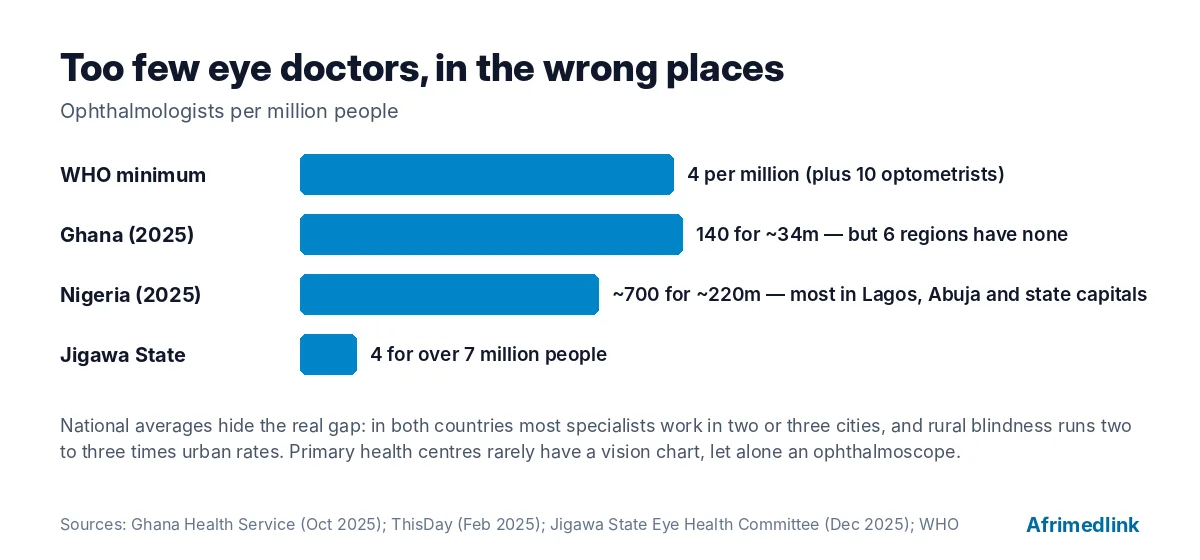 Ophthalmologists per million people. National averages hide a far worse rural picture. Sources: GHS; ThisDay; Jigawa State Eye Health Committee; WHO.
- Too few specialists, in the wrong places. Nigeria has roughly 700 ophthalmologists for more than 220 million people, about three per million; Ghana has 140 for 34 million, about four per million but with six of its sixteen regions having none at all [5][7][13]. Jigawa State, with over seven million people, has four ophthalmologists and three optometrists against an estimated need of 28 and 70 [14]. Most specialists work in Lagos, Abuja, Accra, Kumasi and a few state capitals, while blindness runs two to three times higher in rural areas.
- Cost. More than 70 per cent of health spending in Nigeria is paid out of pocket, and a cataract operation, a year of glaucoma drops or a pair of spectacles can each represent months of a rural household's income [1][5]. Ghana's National Health Insurance Scheme covers cataract surgery, which is one reason its coverage is better, but spectacles and most glaucoma medicines are still paid for by patients [7].
- Equipment and infrastructure. Primary health centres rarely have a vision chart, let alone an ophthalmoscope or a slit lamp, and the equipment that exists breaks down for want of power and maintenance.
- Beliefs and low awareness. Failing sight is accepted as part of ageing or as fate; surgery is feared; healers and couchers are trusted and nearby. In Nigeria's survey, couching was commoner than modern surgery in the North East [3][4].
- Gender. Women in both countries are more likely to be blind and less likely to be treated, because they are less likely to control money, to travel alone, or to be prioritised when a family can afford only one operation [3].
What is being done, and what needs to happen
Both countries have national eye health plans aligned to the WHO's integrated people-centred eye care approach and the 2030 targets set by the World Health Assembly: a 30-percentage-point increase in effective coverage of cataract surgery and a 40-point increase in effective coverage of refractive error correction by 2030 [1][15]. The proven strategies are well known [1][2][15]:
- Eye care in primary health care. Training community health workers and nurses to test vision with a simple chart, recognise the red flags above, dispense reading glasses and refer early. Ghana's 2023 Eye Health Summit committed the country to exactly this; Nigeria's national eye health policy does the same, but fewer than half of states had a functioning plan at the last count [3][16].
- High-volume, low-cost cataract surgery. Manual small-incision cataract surgery, performed at scale in outreach camps and district hospitals and paired with training of local surgeons, is how India and parts of East Africa drove cataract blindness down. Both countries need to multiply their surgical rates several times over.
- Financial protection. Nigeria's National Health Insurance Authority and Ghana's NHIS need to cover cataract surgery, spectacles and glaucoma medicines explicitly and reliably, so that no one goes blind for want of a sum that would not buy a motorcycle.
- Finishing the job on trachoma and river blindness. Ghana has shown it can be done; Nigeria's remaining trachoma districts and both countries' onchocerciasis programmes need sustained mass drug administration and surveillance until elimination is verified [9][12].
- Technology where there are no specialists. Smartphone-based retinal cameras, artificial-intelligence screening for diabetic retinopathy and glaucoma, and tele-ophthalmology that connects a nurse in a district clinic to a consultant in Lagos or Accra can put specialist judgement in places that will not see a specialist for years.
- Glasses for every child. School eye screening with on-the-spot spectacles is among the cheapest interventions in global health and among the most neglected in West Africa.
Protecting your sight: what you can do
 Simple habits, and the two checks that matter most. Sources: WHO; IAPB; NBVIS.
- Have a baseline eye examination at 40, including eye pressure, optic nerve, lens and retina, and repeat it every one to two years; every year if a parent or sibling has glaucoma or you have diabetes.
- Have cataracts treated early. Surgery is quick, safe and restores sight within days. Do not wait until you cannot see at all, and never accept couching.
- Control diabetes and blood pressure, and if you have either, insist on a yearly retinal examination.
- Wear sunglasses and a brimmed hat outdoors; ultraviolet light accelerates cataract, especially in the north and for outdoor workers.
- Protect your eyes at work and at home: goggles for farming, grinding, welding and cutting, and corrosive liquids and sharp objects kept away from children.
- Never use traditional eye medicine.
- Get children's eyes tested before they start school and whenever a teacher says a child cannot see the board; spectacles cost less than a term's fees.
- If you have glaucoma, take your drops every day, and tell your brothers, sisters and children to be checked. If cost or supply is the problem, tell your doctor: cheaper drops and one-off surgery exist.
- Eat well. A diet with leafy greens, orange fruits and vegetables, fish and eggs supplies the vitamin A and antioxidants the eye needs; vitamin A deficiency still blinds children in the poorest households.
How Afrimedlink can help
Most of the sight lost in West Africa is lost between the moment a person first notices a problem and the moment they reach someone who can treat it. Afrimedlink is built to shorten that gap.
 Find, book, and follow up. Sudden sight loss or severe eye pain is an emergency: go to the nearest eye unit.
- Find an eye clinic near you. Our hospital directory lists eye departments, eye clinics and optometrists on the platform, with the services each offers: cataract surgery, glaucoma care, children's eye care, diabetic eye screening and spectacles, so that you go to the right place first time rather than from gate to gate.
- Book a consultation. See an ophthalmologist or optometrist in person, or start with an online consultation to describe your symptoms and find out how urgently you need to be seen and where.
- Outreach and surgical camps. Partner hospitals and NGOs announce free or subsidised cataract operations and screening camps on the platform, with dates and locations, so that a cataract in a village is not a life sentence.
- Reminders for lifelong care. Glaucoma drops, follow-up appointments and yearly diabetic eye checks are only useful if they happen; Afrimedlink's reminders make sure they do.
- Trusted information. Plain-language explainers like this one, reviewed by clinicians, so that families can recognise the signs early and push back against the myths that cost people their sight.
Afrimedlink is not an emergency service. Sudden loss of vision, severe eye pain with vomiting, a chemical splash or an injury to the eye needs the nearest eye unit or emergency department now.
Key takeaways
- More than 80 per cent of blindness in West Africa is avoidable. In Nigeria, 4.2 per cent of adults over 40, about 1.13 million people, are blind; in Ghana about 300,000 people are.
- Cataract and glaucoma are the two great causes: cataract 43 per cent of blindness in Nigeria and 55 per cent in Ghana; glaucoma 17 and 19 per cent. Uncorrected refractive error is the leading cause of lesser visual impairment, and spectacles fix it.
- Cataract surgery works but does not reach people. Only 37 per cent of cataract-blind Nigerians had been operated on, nearly half of "operations" were couching, and Ghana performs fewer than half the operations it needs.
- Glaucoma is almost always found too late: 97 per cent of people with it in Tema did not know. Have your eye pressure checked from 40, or 35 with a family history.
- Blindness is a northern, rural and female problem in both countries, driven by poverty, distance, too few specialists and traditional practices.
- Never use traditional eye medicine, protect your eyes from sun and injury, control diabetes and blood pressure, and get children's eyes tested.
- Ghana eliminated trachoma in 2018; both countries are closing in on river blindness. Avoidable blindness can be beaten when the system reaches the village.
- Afrimedlink helps you find the right eye clinic, book a consultation, learn about surgical camps and keep up lifelong care.
References and further reading
- World Health Organization. World report on vision. Geneva: WHO, 2019. who.int
- International Agency for the Prevention of Blindness. Vision Atlas: magnitude and projections, Sub-Saharan Africa. iapb.org
- Abdull MM, Sivasubramaniam S, Murthy GVS, et al. Causes of blindness and visual impairment in Nigeria: the Nigeria National Blindness and Visual Impairment Survey. Investigative Ophthalmology & Visual Science, 2009;50(9):4114–4120. pubmed.ncbi.nlm.nih.gov · Full survey report: iceh.lshtm.ac.uk
- Kyari F, Gudlavalleti MVS, Sivasubramaniam S, et al. Prevalence of blindness and visual impairment in Nigeria: the National Blindness and Visual Impairment Survey. Investigative Ophthalmology & Visual Science, 2009;50(5):2033–2039. researchonline.lshtm.ac.uk
- Blindness rises in Jigawa amid shortage of ophthalmologists (Federal Ministry of Health figures). Premium Times, December 2025. allafrica.com
- International Agency for the Prevention of Blindness. 2023 Ghana Eye Health Summit (citing the Ghana Blindness and Visual Impairment Study, 2015). iapb.org
- Ghana Health Service. Cataract tops blindness causes in Ghana as country struggles to meet surgery target. Ghanaian Times, World Sight Day, October 2025. ghanaiantimes.com.gh
- Budenz DL, Barton K, Whiteside-de Vos J, et al. Prevalence of glaucoma in an urban West African population: the Tema Eye Survey. JAMA Ophthalmology, 2013;131(5):651–658. jamanetwork.com · Summary: ophthalmologytimes.com
- International Agency for the Prevention of Blindness. Ghana eliminates trachoma. June 2018. iapb.org · Sightsavers: sightsavers.org
- Abubakar T, Gudlavalleti MVS, Sivasubramaniam S, et al. Coverage of hospital-based cataract surgery and barriers to the uptake of surgery among cataract blind persons in Nigeria. Ophthalmic Epidemiology, 2012;19(2):58–66. doi.org
- Kyari F, Entekume G, Rabiu M, et al. A population-based survey of the prevalence and types of glaucoma in Nigeria: results from the Nigeria National Blindness and Visual Impairment Survey. BMC Ophthalmology, 2015;15:176. doi.org
- World Health Organization. Trachoma and Onchocerciasis fact sheets. who.int · who.int
- Dealing with visual impairment (editorial, with ophthalmologist numbers). ThisDay, February 2025. thisdaylive.com
- Jigawa State Eye Health Committee, stakeholders' meeting, Dutse, December 2025, as reported by Premium Times. allafrica.com
- World Health Organization. Eye care in health systems: guide for action and the 2030 global eye care targets. 2022. who.int
- 91 eye doctors in Ghana; 68 work in Greater Accra alone. Daily Graphic, October 2018 (Ophthalmological Society of Ghana). graphic.com.gh
This article is for general health education and does not replace advice from a doctor who knows your medical history. If you have symptoms or concerns, please see a qualified health professional.
Sign in to react.
Speak with verified foreign doctors and other healthcare professionals — within minutes. Vetted professionals abroad, then a vetted partner hospital near you if you need more care.
Consult a doctor nowTake Control
of Your Health
Get access to qualified doctors, personalised health records, and expert care — all from your phone.