
Childhood Immunisation in Nigeria: The Schedule, Myths, and Catching Up on Missed Vaccines
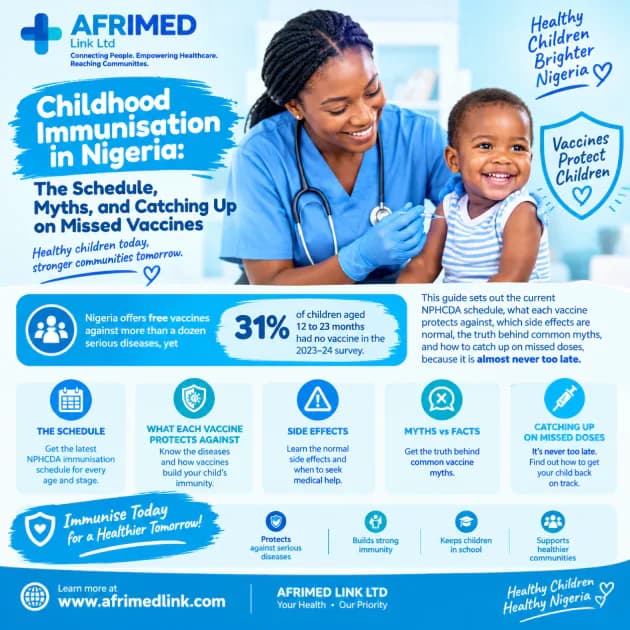
Nigeria offers free vaccines against more than a dozen serious diseases, yet 31% of children aged 12 to 23 months had no vaccine in the 2023-24 survey. This guide sets out the current NPHCDA schedule, what each vaccine protects against, which side effects are normal, the truth behind common myths, and how to catch up on missed doses, because it is almost never too late.
Introduction
A baby born in Nigeria today can be protected, free of charge, against more than a dozen serious illnesses with a handful of visits to a primary health centre in the first two years of life. Tuberculosis, polio, tetanus, whooping cough, measles, severe diarrhoea, pneumonia, meningitis and yellow fever are all on the list. Since 2023 there has been a vaccine against cervical cancer for girls, and since December 2024 a malaria vaccine in the first states to receive it [1][14][16]. Worldwide, the World Health Organization (WHO) estimates that vaccines have saved at least 154 million lives in the past 50 years, 101 million of them infants [8].
Yet too many Nigerian children are still missed. In 2025 Nigeria had the largest number of "zero-dose" children in the world, children who have received no routine vaccine at all [3]. In the 2023-24 Nigeria Demographic and Health Survey (NDHS), 31 per cent of children aged 12 to 23 months had had no vaccine, and only 39 per cent had received all the "basic" vaccines [7]. Behind those numbers are ordinary families: a mother who did not know the clinic was free, a father who heard a rumour, a child whose card was lost, a village a long way from the nearest health centre.
This guide is for those families, and for anyone who wants to help them. It sets out the current Nigerian schedule, what each vaccine does, which side effects are normal and which are not, what the evidence says about common myths, and what to do if your child has missed a vaccine. The short answer is that it is almost never too late.
The single most important message: If your child has missed a vaccine, or you do not know whether they are up to date, take the child and any card you have to the nearest government primary health centre (PHC). Missed doses can usually be given late, you do not start the series again, and routine vaccines are free under the national programme [21][29].
Why vaccines matter
A vaccine shows the body a harmless piece or weakened form of a germ, so the immune system learns to recognise it and can fight it quickly, often before the child feels ill. Protection can last for years or a lifetime, and a vaccinated child is less likely to pass the disease on, which protects babies too young to be vaccinated [9].
The numbers are striking. WHO estimates that immunisation has saved about six lives every minute for 50 years, and that measles vaccine alone accounts for about 60 per cent of all lives saved. In the WHO African Region, vaccination against 14 diseases has cut infant deaths by more than half [8]. Measles vaccination averted nearly 59 million deaths between 2000 and 2024, yet measles still killed about 95,000 people in 2024, mostly children under five [10].
Closer to home, Nigeria introduced rotavirus vaccine on 22 August 2022, aiming to avert more than 50,000 child deaths from diarrhoea a year [12]. In 2024 the NCDC reported more than 18,000 suspected measles cases across all 36 states and the FCT [13]. These diseases are not history. They are what happens when children are not protected.
Where Nigeria stands: coverage and zero-dose children
 Vaccine coverage in Nigeria: WHO and UNICEF estimates for 2025 and the 2023-24 household survey. Sources: WHO; WHO/UNICEF WUENIC; NDHS 2023-24.
Coverage is measured in two main ways, and they give different answers. The WHO/UNICEF Estimates of National Immunization Coverage (WUENIC), published each July, combine clinic reports and surveys to estimate the share of infants vaccinated. A household survey such as the NDHS asks mothers and checks cards for children aged 12 to 23 months. Both tell the same story.
The WHO and UNICEF estimates for 2025
For 2025, WUENIC estimates Nigeria's coverage at 70 per cent for the first dose of DTP (the diphtheria, tetanus and whooping cough component of pentavalent), 62 per cent for the third dose, 56 per cent for the first dose of measles vaccine and only 35 per cent for the second. Rotavirus coverage was 47 per cent, down from 54 per cent in 2024 [2]. WHO and UNICEF graded most of these figures as "challenged" because the supporting data are weak, and noted a one-month stock-out of some vaccines in 2025 and that the 2025 household surveys had not yet reported [2]. Treat them as the best available estimate, not an exact count.
Zero-dose children
About 13.5 million infants worldwide were zero-dose in 2025, roughly 750,000 fewer than the year before [4]. UNICEF's analysis ranks Nigeria first, because of "a combination of low coverage and a large birth cohort" [3]. For 2024 the figure was 2.1 million, well ahead of India and Sudan [5], and UNICEF has put it at about 2.2 million for 2025 [6].
Nigeria has been making an effort. In the Big Catch-Up, a global drive that ran from 2023 to March 2026, Nigeria reached 2 million previously zero-dose children with a first dose of DTP and gave 3.4 million doses of injectable polio vaccine [30].
What the 2023-24 survey found
Among children aged 12 to 23 months [7]:
- 67 per cent had received BCG, 53 per cent the third dose of pentavalent, 51 per cent a measles vaccine, 49 per cent yellow fever vaccine and 48 per cent meningitis vaccine;
- 39 per cent had received all basic vaccines (BCG, three doses each of polio and DTP-containing vaccine, and one measles dose), up from 13 per cent in 2003;
- 20 per cent had completed the full national schedule (a measure that excludes rotavirus); and
- 31 per cent had received no vaccine at all.
Only about half of the children (2,572 of 5,121) had a card the interviewer could see, and about one in three had never had a card [7].
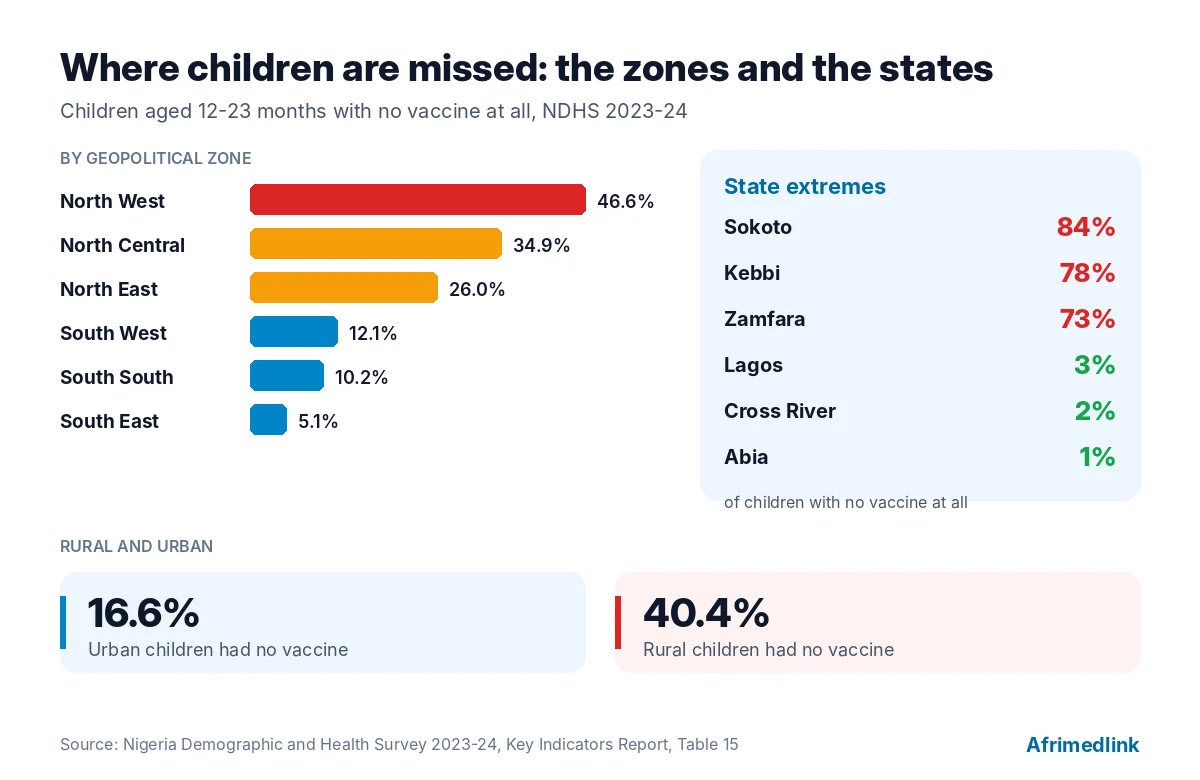 The share of children aged 12-23 months who received no vaccine at all, by zone, selected states, and rural versus urban residence. Source: NDHS 2023-24.
Zone, state and place
The national picture hides sharp differences. The share of children with no vaccine was 46.6 per cent in the North West, 34.9 per cent in the North Central zone, 26.0 per cent in the North East, 12.1 per cent in the South West, 10.2 per cent in the South South and 5.1 per cent in the South East. Sokoto (84.2 per cent), Kebbi (78.1 per cent) and Zamfara (73.4 per cent) had the highest state figures, while Lagos (3.1 per cent), Cross River (2.0 per cent), Ebonyi (1.8 per cent) and Abia (1.3 per cent) had the lowest. Rural children were far more likely to be missed than urban ones (40.4 per cent against 16.6 per cent), and children of sixth or later birth order were less likely to be fully vaccinated (36 per cent, against 42 per cent for second and third-born) [7].
The routine immunisation schedule
 Nigeria's routine immunisation schedule for children. Sources: NPHCDA Immunization FHIR IG; NDHS 2023-24; WHO AFRO.
The schedule is set by the National Primary Health Care Development Agency (NPHCDA). The version below follows NPHCDA's own published immunisation specification, which was still a working draft when we checked and may change [1]. Confirm the details with your PHC. It is front-loaded because the youngest babies are at greatest risk.
At birth
- BCG, against tuberculosis, ideally in the first two weeks but possible up to 11 months of age.
- Oral polio vaccine (OPV 0), two drops by mouth, before the baby is two weeks old.
- Hepatitis B, within 24 hours of delivery [1].
At 6, 10 and 14 weeks
At each of these three visits a baby receives [1]:
- Pentavalent (diphtheria, whooping cough, tetanus, hepatitis B and Hib), by injection;
- Pneumococcal conjugate vaccine (PCV), a second injection in the other thigh;
- Oral polio vaccine (OPV 1, 2 and 3), drops;
- Rotavirus vaccine, drops by mouth [12]; and
- Injectable polio vaccine (IPV), at 6 and 14 weeks.
That sounds like a lot at once, but WHO is clear that giving several vaccines at one visit is safe [9].
From 5 months
- Malaria vaccine (R21), four doses at 5, 6, 7 and 15 months, in states where it has been introduced [1][16]. Nigeria launched it on 5 December 2024 in Kebbi and Bayelsa [16], and by April 2026 had extended it to Ondo and Bauchi, reaching more than a million children [17]. It is not yet offered everywhere, so ask your PHC. It does not replace bed nets or treatment [18].
- Vitamin A at 6 months (100,000 IU) and 12 months (200,000 IU) [1]. This is a supplement, not a vaccine, but it is given at the same clinics.
At 9 and 15 months
- At 9 months: measles (or measles-rubella, MR), yellow fever and meningitis vaccines [1].
- At 15 months: the second measles or MR dose, and the fourth malaria dose where offered [1][21]. The second measles dose is the one most often missed: WUENIC puts coverage at only 35 per cent [2].
Nigeria began replacing the stand-alone measles vaccine with MR in October 2025, starting with 21 states [2][20]. As this spreads, your child's measles doses will be recorded as MR.
Girls aged 9 to 14
- HPV vaccine, a single dose [1][14]. More on this below.
Keep it simple: You do not have to memorise the schedule. Ask the nurse to write the next date on the card each time, and take a photo of the card on your phone.
What each vaccine protects against
 What the vaccines in Nigeria's schedule protect against. Sources: NPHCDA schedule; DCVMN Nigeria profile; WHO; UNICEF Nigeria.
Knowing what a vaccine is for makes it easier to keep going back. BCG protects against tuberculosis, hepatitis B vaccine against the liver infection, pentavalent against five diseases in one injection, and PCV against most causes of pneumonia and meningitis. Rotavirus vaccine protects against severe diarrhoea, yellow fever vaccine against a disease that can cause liver damage and death, and meningitis A vaccine against one strain of meningitis [22]. A few deserve more words.
Polio. Polio is a virus that attacks the nerves. About one in 200 infections causes irreversible paralysis, usually of the legs, and 5 to 10 per cent of those paralysed die when the breathing muscles are affected. There is no cure; it can only be prevented [11].
Measles. One infected person can infect 12 to 18 people who are not immune [21]. Most deaths come from complications such as pneumonia, severe diarrhoea, blindness and brain swelling, and measles also weakens the immune system for a time, leaving a child open to other infections. Two doses are recommended because not every child develops immunity from the first [10].
Rotavirus. The vaccine is given as drops and must be started early: WHO does not recommend giving it after 24 months of age because the benefit is limited [29].
Tetanus. In newborns it usually follows an unclean cord cut or a contaminated stump, and survivors do not gain natural immunity, so they need vaccination too [28].
New in the schedule: HPV, malaria and measles-rubella
HPV vaccine: protecting girls from cervical cancer
Nigeria introduced the HPV vaccine on 24 October 2023, in the largest single-round HPV drive in the African region, aiming to reach 7.7 million girls aged 9 to 14 with a single dose. It protects against HPV types 16 and 18, which cause at least 70 per cent of cervical cancers. Cervical cancer is Nigeria's third most common cancer, and in 2020 caused about 12,000 new cases and 8,000 deaths [14]. Gavi, citing NPHCDA figures, reports that more than 13 million girls had been vaccinated by April 2025 [27]. The vaccine contains no live virus and cannot cause cancer [15]. If your daughter is 9 to 14 and has not had her dose, ask your PHC or her school.
Malaria vaccine: a new tool, not a replacement
Nigeria accounts for 31.9 per cent of malaria deaths in the WHO African Region [18]. The R21 vaccine is a welcome new defence, but it needs four doses, and NPHCDA says dropout between doses is a concern [17]. If your child is in a state where it is offered, take every dose. WHO stresses that the greatest effect comes when vaccines are combined with bed nets and preventive medicines [18].
Measles-rubella: the 2025-26 campaign
In October 2025 Nigeria launched its largest integrated vaccination campaign, aiming to reach about 106 million children aged 9 months to 14 years with measles-rubella vaccine, with polio and HPV vaccines and other services alongside, in phases from the north to the south in early 2026 [13][19]. If your child received a campaign dose, ask the nurse how it should be recorded and whether routine doses are still due.
Side effects: what is normal, and when to get help
 Normal reactions after vaccination, and when to seek help. Sources: Public Health Wales; WHO GACVS.
Vaccines are among the most carefully monitored medicines in use, and most children have no reaction or a mild one [9][23].
Normal reactions
The commonest effects are soreness, redness, swelling or a small hard lump where the injection went in. They usually last a couple of days and need no treatment. Young children may be unsettled and have a fever for a day or two, and older children may be tired or have muscle aches [23]. At home:
- keep feeding, and give plenty of fluids; breastfed babies may want to feed more often;
- dress the child lightly, without extra blankets;
- give paracetamol only if the child seems uncomfortable, at the dose on the bottle or from the nurse; and
- never give aspirin to children [23].
Get help soon
Go back to the clinic or speak to a doctor if redness or swelling keeps spreading, a lump oozes pus, the child is unusually drowsy or refuses feeds, or a mild fever is not settling after a couple of days. Any reaction that worries you is a good reason to ask [23].
Emergency: go to hospital now
Public Health Wales advises calling a doctor immediately if a child has a temperature of 39 degrees C or above, or a fit [23]. Severe allergic reactions are very rare (fewer than one in a million routine vaccinations in UK data), usually start within minutes, and cause breathing difficulty, rash and swelling of the face or lips [23]. Stay at the clinic for a little while after the injection and tell staff at once if you notice any of these.
One signal is specific to rotavirus vaccine. It carries a small increased risk of intussusception, a bowel blockage, mostly in the first week after the first or second dose. WHO's vaccine-safety committee concluded that the benefits outweigh the risk, particularly where rotavirus kills children. If a baby has repeated vomiting, tummy pain with bouts of screaming, or passes red, jelly-like stool in the week after the vaccine, go to hospital straight away. Treated early, it usually has a good outcome [24].
Some children should wait: a child with severe illness and high fever on the day, or one who has had a severe allergy to a vaccine ingredient, should be assessed first [9].
Myths and facts
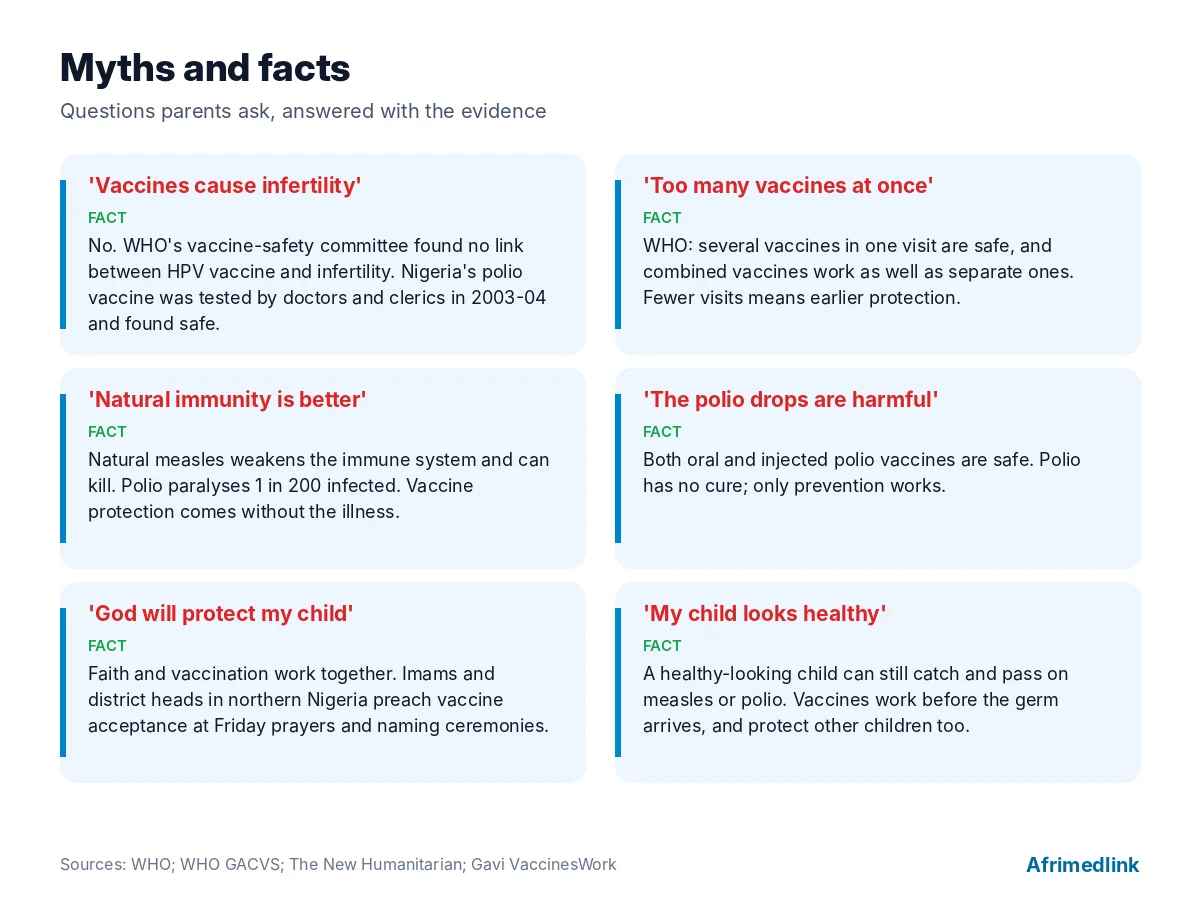 Six common worries about vaccines, with the evidence. Sources: WHO; WHO GACVS; The New Humanitarian; Gavi.
Parents who hesitate are usually trying to protect their children. The best answer is honest information from people they trust.
"Vaccines cause infertility"
This rumour has a long history in northern Nigeria. Kano State suspended polio immunisation from September 2003 to November 2004 after some clerics claimed the vaccine contained hormones to sterilise children. Committees of doctors and clerics tested it, and trials in Nigeria, South Africa and Indonesia found it safe; the suspension was followed by an unprecedented number of infections and the spread of the virus to 17 countries that had been polio-free [25]. The same worry has since been attached to HPV vaccine. WHO's Global Advisory Committee on Vaccine Safety reviewed the evidence and concluded that the available data do not support an association between HPV vaccination and infertility [26].
"Too many vaccines at once overwhelm a baby"
WHO says it is safe to receive several vaccines in one visit, and that combination vaccines such as pentavalent are as safe and effective as separate ones. A baby's immune system meets countless germs every day, and vaccine antigens are a small fraction of that load. Fewer visits also mean earlier protection [9].
"Natural immunity is better"
Surviving a disease can give immunity, but it can also kill or disable. Measles can lead to pneumonia, blindness and brain damage [10]. Polio paralyses about one child in 200 infected [11]. People who recover from tetanus do not gain natural immunity [28]. Vaccines build protection without the illness [9].
"The polio drops are harmful"
Both the oral and the injectable polio vaccine are effective and safe [11]. The programme wants children to complete both, and the injectable vaccine is a growing priority across Africa [36].
"I trust God" and other religious objections
Faith and the clinic are not opposites, and many Nigerians of both faiths see no conflict. Traditional rulers and imams in the north are among the programme's strongest allies. The Northern Traditional Leaders Council, with members from the 19 northern states and the FCT, was set up to tackle refusals of polio vaccine and meets regularly with NPHCDA. Imams preach vaccine acceptance at Friday prayers and at naming ceremonies, and district heads accompany teams from house to house. Traditional leaders resolved 65 per cent of refusal cases across 17 northern states [27]. If your faith leader cannot answer a question, ask the nurse or a doctor, and invite your leader to come with you.
"My child looks healthy"
Vaccines work before the child meets the germ, not after. A healthy-looking child can still catch and pass on measles or polio, and vaccination protects the community as well as the child [9].
Catching up on missed vaccines
 What to do if a vaccine has been missed. Sources: WHO; WHO AFRO; UNICEF.
Life interrupts schedules: illness, travel, floods, insecurity, a stock-out, a lost card, a pandemic. WHO estimates that 6.2 million Nigerian children missed vaccines between 2019 and 2021 because of COVID-19 disruption alone [31]. The good news is that missed vaccines can almost always be given late.
What WHO advises
WHO's guidance on interrupted or delayed immunisation sets out the principle: for most routine vaccines, the series resumes where it stopped, without repeating earlier doses [29]. In practice:
- Pentavalent, polio, PCV and hepatitis B: resume the series. A child who starts late still needs the full number of doses.
- Measles: two doses, at any age, at least four weeks apart.
- BCG: a single dose, even if late.
- Rotavirus: must be started early; WHO does not recommend it after 24 months.
- HPV: the target group is girls aged 9 to 14 [29].
What to do, step by step
- Find the card or any record. If it is lost, tell the nurse the child's age and what you remember.
- Go to your nearest government PHC. Routine vaccines are free [21].
- Carry on, do not restart. The nurse will give what is due now.
- Ask about age limits. Rotavirus is the main one, so do not delay.
- Update the card and set the next date.
In a "Big Catch-Up" outreach in Imo State in 2023, one mother said she had not known her son could still be vaccinated after missing the dates [31]. Do not let that be your family. Across 36 countries the Big Catch-Up reached an estimated 18.3 million children aged 1 to 5 and delivered more than 100 million doses [30]. The programme closed in March 2026, but the principle did not: your PHC can still catch a child up [30][32].
Never too late: Whether your child is four months, four years or fourteen, ask. A few vaccines have an upper age limit, and most do not.
Vaccines for pregnant women, mothers and adolescents
Tetanus-diphtheria (Td) for women. Tetanus-containing vaccine can be given during pregnancy, often at antenatal care [28], and a baby is protected from neonatal tetanus when the mother has been vaccinated [7]. WHO recommends six doses over a lifetime: three in a primary series and three boosters [28]. Ask for the vaccine at your first antenatal visit, show your old cards, and your midwife will tell you how many doses you still need.
Adolescent girls. HPV vaccine at 9 to 14 is the key adolescent vaccine on Nigeria's schedule [1][14]. WHO also recommends tetanus boosters at 4 to 7 and 9 to 15 years [28]; these are not in NPHCDA's published schedule, so ask what is available.
The vaccination card, and where to get vaccinated
Think of the card as your child's second birth certificate. It is the proof that doses were given and the guide to what is due next, and it is the first thing a nurse will ask for in a catch-up visit. Only about half of the children in the NDHS had a card the interviewer could see [7]. Keep it in a plastic sleeve, photograph every page, and if it is lost ask your PHC to open a new one and enter the doses from its register.
Routine vaccines are free at government primary health centres [21]. Many clinics vaccinate on set days, so ask. Do not buy vaccines from chemists, patent medicine vendors or roadside sellers: vaccines must be kept cold from factory to clinic, and the national programme supplies them through the PHC system.
The polio story: a victory that is not yet finished
The last case of wild poliovirus in the African Region was detected in Nigeria in 2016, and on 25 August 2020 the African Regional Certification Commission declared the region free of wild polio after four years without a case [33]. Nigeria has recorded no wild poliovirus in 2025 or 2026 [34].
But a second form persists. Circulating vaccine-derived poliovirus type 2 (cVDPV2) spreads where too few children are immunised. Nigeria recorded 66 paralysis cases in 2025 and a further 30 in 2026 up to early August [34]. WHO's polio team reports that detections fell by 35 per cent in 2025 compared with 2024, and that the virus persists in low-immunity areas affected by insecurity, population movement and missed children [35]. The answer is the one that works for every disease: reach every child with the full schedule. As the Global Polio Eradication Initiative puts it, the last chains of poliovirus persist in the same communities where routine coverage is weakest [36].
How Afrimedlink can help
Keeping a child on schedule is mostly knowing what is due, where to go, and having someone to ask when you are unsure. Afrimedlink is built to help with all three.
 How Afrimedlink helps families stay on schedule. Afrimedlink is not an emergency service.
- Find the nearest clinic. Our directory lists hospitals, clinics and primary health centres with addresses and contact details, so you can find the one nearest to you that offers routine immunisation. Ask which days it vaccinates.
- Reminders for each due vaccine. Enter your child's date of birth and we will remind you of each visit, at 6, 10 and 14 weeks, 9 months and 15 months, and tell you what is usually given.
- Ask a doctor online. An online consultation lets you ask about side effects, whether your child can be vaccinated with a cold, what to do about missed doses, or whether a fever or rash after vaccination needs to be seen in person.
- Verified information. We summarise guidance from NPHCDA, WHO and UNICEF, with sources and dates, and we check rumours that reach us. If a message about vaccines does not come from a source you can name, do not forward it.
What Afrimedlink is not: an emergency service. If a child has trouble breathing, a swollen face or lips, a fit, a temperature of 39 degrees C or more, or any sign of a serious reaction after a vaccine, go to the nearest hospital emergency unit now. Do not wait for an online reply.
Key takeaways
- Vaccines have saved at least 154 million lives worldwide in 50 years. In Nigeria they protect against more than a dozen diseases, free, at government primary health centres.
- Nigeria has the most zero-dose children in the world (2025). In the 2023-24 survey, 31 per cent of children aged 12-23 months had no vaccine, from 5 per cent in the South East to 47 per cent in the North West.
- The schedule: BCG, OPV 0 and hepatitis B at birth; pentavalent, PCV, OPV, rotavirus and IPV at 6, 10 and 14 weeks; measles or MR, yellow fever and meningitis at 9 months; second measles or MR dose at 15 months; HPV for girls aged 9 to 14; malaria vaccine where offered.
- Most side effects are mild and pass in a day or two. Go to hospital for a temperature of 39 degrees C or above, a fit, trouble breathing, a swollen face or lips, or screaming bouts and bloody stool after rotavirus vaccine.
- Vaccines do not cause infertility, and several can safely be given at one visit. Imams, traditional rulers and health workers are working together to reach every child.
- It is almost never too late. Missed doses are given late and the series is resumed, not restarted. Rotavirus is the exception that must be started early.
- Pregnant women should receive tetanus-containing vaccine at antenatal care, and girls aged 9 to 14 should have the HPV vaccine.
- Keep the card, photograph it, and take it to every visit. Polio is not yet beaten in Nigeria, and only high routine coverage will finish the job.
References and further reading
- National Primary Health Care Development Agency. Health interventions and recommendations, NPHCDA Immunization FHIR Implementation Guide v0.9.0 (working build). build.fhir.org
- WHO and UNICEF. Nigeria: estimates of immunization coverage, 2025 revision. July 2026. data.unicef.org
- WHO and UNICEF. WUENIC progress and challenges. July 2026. data.unicef.org
- allAfrica. Nigeria: 13.5m children miss vaccines in 2025 - WHO, UNICEF. 15 July 2026. allafrica.com
- BusinessDay. Nigeria tops global list as 14 million children receive no vaccine in 2024. July 2025. businessday.ng
- allAfrica. Africa: 9.5m children received no routine vaccine in 57 countries in 2025 - Gavi. 9 October 2026. allafrica.com
- National Population Commission and ICF. Nigeria Demographic and Health Survey 2023-24: Key Indicators Report. dhsprogram.com
- World Health Organization. Global immunization efforts have saved at least 154 million lives over the past 50 years. 24 April 2024. who.int
- World Health Organization. Vaccines and immunization: what is vaccination? who.int
- World Health Organization. Measles: fact sheet. who.int
- World Health Organization. Poliomyelitis: fact sheet. who.int
- WHO Regional Office for Africa. Nigeria to avert 50,000 deaths in children annually, introduces rotavirus vaccine. 2022. afro.who.int
- Gavi VaccinesWork. "The mother of all campaigns": inside Nigeria's 100 million child integrated vaccine drive. 2025. gavi.org
- UNICEF. Nigeria to vaccinate 7.7 million girls against the leading cause of cervical cancer. 24 October 2023. unicef.org
- World Health Organization. Human papillomavirus (HPV) and cancer: fact sheet. who.int
- WHO Regional Office for Africa. Nigeria introduces the R21 vaccine in a pivotal move for malaria control. December 2024. afro.who.int
- Radio Nigeria. Over 1 million Nigerian children vaccinated against malaria as NPHCDA expands programme to four states. April 2026. radionigerialagos.gov.ng
- World Health Organization. Malaria: fact sheet. who.int
- WHO Regional Office for Africa. Nigeria intensifies fight against vaccine-preventable diseases with nationwide measles-rubella and polio campaign. 14 October 2025. afro.who.int
- New Telegraph. FG targets stronger child immunity with measles-rubella vaccine integration. 2025. newtelegraphng.com
- allAfrica. Nigeria: US CDC calls for improved immunisation to curb measles spread. June 2025. allafrica.com
- DCVMN. Nigeria country profile 2024. dcvmn.org
- Public Health Wales. What to expect after vaccinations: babies and children up to five. phw.nhs.wales
- WHO Global Advisory Committee on Vaccine Safety. Statement on rotavirus vaccines and intussusception. 20 November 2015. who.int
- The New Humanitarian. The roots of polio vaccine suspicion. 4 April 2013. thenewhumanitarian.org
- WHO Global Advisory Committee on Vaccine Safety. Human papilloma virus vaccines and infertility. who.int
- Gavi VaccinesWork. How traditional rulers are boosting immunisation uptake in northern Nigeria. gavi.org
- World Health Organization. Tetanus: fact sheet. who.int
- World Health Organization. Table 3: Recommendations for interrupted or delayed routine immunization. who.int
- UNICEF. Largest catch-up initiative delivers over 100 million childhood vaccinations. April 2026. unicef.org
- WHO Regional Office for Africa. Imo State Government vaccinates over 3000 missed children in the "Big Catch-Up" campaign. June 2023. afro.who.int
- WHO, UNICEF and Gavi. The Big Catch-Up: an essential immunization recovery plan for 2023 and beyond. who.int
- South African Government News Agency. Africa declared free of wild polio. 25 August 2020. sanews.gov.za
- Global Polio Eradication Initiative. Polio global update, 4 August 2026. szu.gov.cz
- WHO Regional Office for Africa. Nigeria refines polio eradication strategy as WHO strengthens support toward 2026 targets. 22 December 2025. afro.who.int
- Global Polio Eradication Initiative. What the latest routine immunization coverage estimates mean for eradication. 2026. polioeradication.org
This article is for general health education and does not replace advice from a doctor or nurse who knows your child's history, or the instructions of NPHCDA and your state primary health care agency. If you are worried about a vaccine reaction or a missed dose, speak to a qualified health professional. Figures are correct as of 22 October 2026 and will change; check NPHCDA and your state for the latest schedule.
Sign in to react.
Speak with verified foreign doctors and other healthcare professionals — within minutes. Vetted professionals abroad, then a vetted partner hospital near you if you need more care.
Consult a doctor nowTake Control
of Your Health
Get access to qualified doctors, personalised health records, and expert care — all from your phone.