Safe Motherhood in Nigeria: Pregnancy Warning Signs, Antenatal Care and Delivering Safely
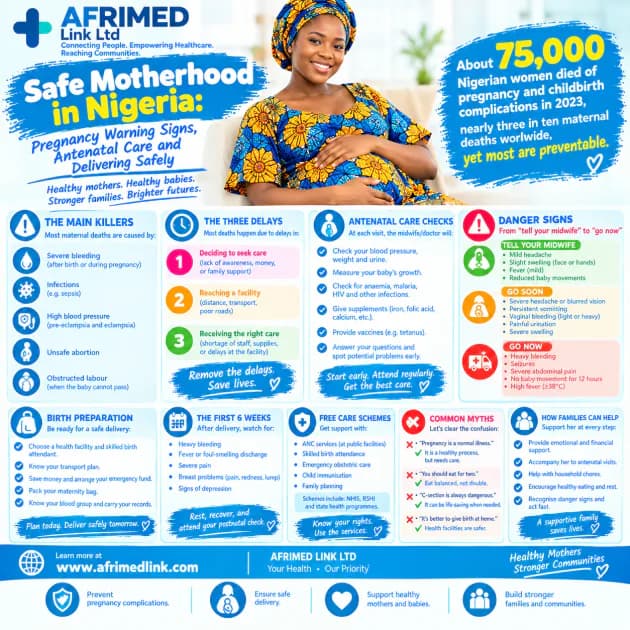
About 75,000 Nigerian women died of pregnancy and childbirth complications in 2023, nearly three in ten maternal deaths worldwide, yet most are preventable. This guide explains the main killers, the “three delays”, what each antenatal visit checks, danger signs from “tell your midwife” to “go now”, birth preparation, the first six weeks after delivery, free care schemes, common myths and how families can help.
Introduction
Every pregnancy is a hope. In Nigeria it is also, still, a risk that too many families know first-hand. According to the latest United Nations estimates, about 75,000 Nigerian women died of pregnancy and childbirth complications in 2023, close to three in every ten maternal deaths in the entire world [1][2][3]. That is about one woman every seven minutes: a daughter, a wife, a mother whose children will grow up without her.
The painful truth is that most of these deaths can be prevented. Bleeding, high blood pressure with fits, infection and obstructed labour are well understood and treatable, but only if a woman reaches a skilled health worker, with the right drugs, blood and equipment, in time. Where she lives, how much money the family has and how early the family decides to go to hospital can make the difference between a safe birth and a funeral.
This guide is for expectant mothers, husbands, mothers-in-law and anyone who helps a woman through pregnancy. If you only have two minutes, read "Danger signs: soon, urgent, emergency" and the key takeaways at the end.
The single most important message: if a pregnant woman, or a woman who has just given birth, has heavy bleeding, fits, a severe headache or blurred vision, fever, or the baby moves much less than usual, she needs a hospital now. Do not wait for the morning, do not wait for permission, and do not treat it at home.
Nigeria's maternal mortality burden
The numbers
The UN Maternal Mortality Estimation Inter-Agency Group (WHO, UNICEF, UNFPA, the World Bank and the UN Population Division) reports that about 260,000 women died worldwide in 2023 from causes related to pregnancy and childbirth, and that sub-Saharan Africa accounted for about 70% of them [1][4]. Four countries, Nigeria, India, the Democratic Republic of the Congo and Pakistan, together accounted for 47% of all maternal deaths. Nigeria alone had about 75,000 deaths, around 28.7% of the world total, the highest of any country, and a maternal mortality ratio of 993 deaths per 100,000 live births [2][3].
 Nigeria's share of the world's maternal deaths in 2023. Sources: UN MMEIG report, April 2025; WHO; UNFPA.
The global target is fewer than 70 deaths per 100,000 live births by 2030 [1]. Worldwide, maternal deaths fell by about 40% between 2000 and 2023, so progress is possible [2].
A word of caution: many maternal deaths are never recorded, especially when a woman dies at home, so national figures are statistical estimates, and different agencies sometimes quote different numbers. This article uses the latest UN estimates and the 2023-24 Nigeria Demographic and Health Survey (NDHS), the national household survey.
Where Nigerian women get care, and where they do not
The NDHS 2023-24 surveyed women with a birth in the previous two years [5]:
- 63% received antenatal care from a skilled provider (a doctor, nurse or midwife). This was 67% in 2018, so the trend has slipped slightly.
- 52% had four or more antenatal visits. WHO now recommends eight contacts, so even this figure overstates how many women get the full recommended care.
- 46% of live births were assisted by a skilled provider, and 43% took place in a health facility. More than half of Nigerian births still happen outside one.
- 43% of mothers had a postnatal check within two days of delivery, even though the first days after birth are the most dangerous.
- 26% received three or more doses of the malaria-preventive drug SP during pregnancy, and 46% of pregnant women slept under an insecticide-treated net the night before the survey.
 Antenatal and delivery care in Nigeria, with the wide gap between zones. Source: Nigeria DHS 2023-24 Key Indicators Report.
North and south, rich and poor, town and village
The national averages hide enormous gaps [5]:
- By zone. A skilled provider assisted 88% of births in the South East, 85% in the South West and 77% in the South South, against 55% in the North Central, 32% in the North East and just 26% in the North West.
- By state. The range is wider still. In Kebbi State only 9.6% of births were assisted by a skilled provider, and about 12% of women had antenatal care from one; in Imo State the figure for births was 97%.
- By residence. In towns, 70% of births were skilled-assisted; in rural areas, 31%.
- By wealth. 92% of births in the richest fifth of households had skilled help, against 16% in the poorest fifth.
A woman's chance of surviving childbirth depends heavily on her address, her purse and her schooling. The greatest effort is needed in the North West and North East, in rural communities and in poor households.
What actually kills mothers
WHO estimates that five causes account for around three-quarters of all maternal deaths: severe bleeding (mostly after childbirth), infections (usually after childbirth), high blood pressure in pregnancy (pre-eclampsia and eclampsia), complications from delivery, and unsafe abortion [4]. A WHO analysis of global data puts haemorrhage at about 27% of maternal deaths, hypertensive disorders at about 16%, and "indirect" causes, such as HIV, malaria, anaemia and diabetes made worse by pregnancy, at about 23% [6]. These are worldwide shares; national breakdowns for Nigeria are less certain, but the same causes dominate.
 The main causes of maternal death worldwide. Sources: WHO.
Haemorrhage (severe bleeding)
Bleeding is the biggest single killer, and most of it happens in the hours after the baby is born, when the womb fails to contract properly. A woman can bleed to death within hours. Treatment, with drugs that make the womb contract, fluids, blood transfusion and sometimes surgery, needs a health facility. After birth, soaking a pad in an hour or passing large clots is a reason to call for help at once [17].
Pre-eclampsia and eclampsia
Pre-eclampsia is a condition, usually appearing after 20 weeks of pregnancy, in which blood pressure rises and protein leaks into the urine. It can progress to eclampsia, which means seizures (fits), and both can be fatal. WHO attributes about 16% of maternal deaths worldwide, around 42,000 in 2023, to hypertensive disorders [7]. Many women feel perfectly well in the early stages, which is why blood pressure and urine checks at every antenatal visit matter so much. Symptoms, when they come, include a severe headache that does not ease with simple painkillers, blurred vision or flashing lights, pain under the ribs, sudden swelling of the face and hands, and vomiting [7][15]. Magnesium sulfate, given in hospital, prevents fits and can cut the risk of eclampsia by more than half [7].
Infection (sepsis)
Infection after childbirth or abortion can spread to the bloodstream. The warning signs are fever, chills, foul-smelling discharge, lower abdominal pain and feeling very unwell. Clean delivery and early antibiotics are what protect women; WHO also notes that iron and folic acid supplements help to prevent anaemia, puerperal sepsis and low birth weight [14].
Obstructed labour
When the baby cannot pass through the pelvis, labour drags on, the baby may die and the womb can rupture. A woman in labour for a very long time without progress needs a skilled assessment and often a caesarean section. Herbs and waiting do not solve a mechanical problem. Some Nigerian women delay because caesarean section is stigmatised as a failure, or because of religious teaching against surgery [30].
Unsafe abortion
WHO reports that in Africa about three in four abortions are unsafe, and that complications such as incomplete abortion, haemorrhage, infection and injury from dangerous objects cause deaths that are often under-reported because of stigma [8]. A review of 2009 to 2020 data attributed about 8% of maternal deaths to abortion [8]. Any woman with bleeding, fever or severe abdominal pain after a miscarriage or attempted abortion needs urgent hospital care, and deserves compassion rather than judgement. Silence out of shame is what makes these complications fatal.
Anaemia and malaria
Anaemia means too little haemoglobin in the blood, so that the woman cannot carry oxygen well and tolerates blood loss badly. WHO estimates that 37% of pregnant women worldwide were anaemic in 2019, and that anaemia in pregnancy is linked to premature birth, low birth weight and maternal death [9]. Malaria in pregnancy is a leading preventable cause of anaemia, low birth weight, premature delivery and stillbirth [31][32]. A woman who is anaemic when labour starts has little margin if she bleeds.
The "three delays": why women die even when care exists
Public-health researchers Thaddeus and Maine described in 1994 a model that is still used worldwide to explain why women die of complications that could be treated. It is called the three delays [10]:
- Delay in deciding to seek care. At home, the family does not recognise the danger, waits, tries herbs or prayer, has no money, or the person who must give permission is not there.
- Delay in reaching a facility. There is no transport, the road is bad, it is night or raining, or the nearest facility is too far or cannot handle emergencies.
- Delay in receiving adequate care. At the facility there is no staff on duty, no blood, no drugs, a demand for a deposit, or a long wait before anyone acts.
Delays 1 and 2 are things a family can plan for, which is what birth preparedness is about. Delay 3 is the health system's responsibility, but a family can reduce it by registering early at a facility that can handle emergencies.
 The three delays, and how to plan for each. Sources: Thaddeus and Maine, 1994; WHO; NHIA.
Antenatal care: what the visits are for
Antenatal care (ANC) is not just a card to be stamped. It finds problems you cannot see from outside, such as rising blood pressure, anaemia, infections and slow baby growth, and treats them before they become emergencies.
WHO's eight-contact model
In 2016 WHO changed its advice from a minimum of four visits to eight contacts, with the first before 12 weeks of pregnancy and later contacts at 20, 26, 30, 34, 36, 38 and 40 weeks [11][12]. More frequent contact finds problems earlier, and WHO estimated that eight or more contacts can reduce deaths of babies around birth by up to 8 per 1,000 births [11]. Nigerian surveys still report "four or more visits", so if you are told four is enough, know that the global standard is higher. Book your first visit as soon as you know you are pregnant.
 The eight antenatal contacts, and what is checked. Sources: WHO.
What is checked, and why
A good clinic will usually do the following; schedules vary, so ask your midwife.
- Blood pressure and urine test, every visit. To pick up pre-eclampsia early. Many women feel well when blood pressure starts to rise [7][15].
- Weight, belly measurement and baby's heartbeat, to check growth.
- Blood tests. Haemoglobin (anaemia), blood group, genotype (important in a country where sickle cell disease is common), and screening for HIV, syphilis and hepatitis B. Finding these infections early lets them be treated in pregnancy, which protects the baby.
- Malaria prevention. WHO advises that in areas of moderate to high malaria transmission in Africa, IPTp-SP (sulfadoxine-pyrimethamine) should start as early as possible in the second trimester, from 13 weeks, with doses at least four weeks apart until delivery, taken in front of the health worker [13]. Women living with HIV who take co-trimoxazole should not be given SP [13]. In Nigeria only 26% of women received three or more doses in the NDHS, so ask for it at every visit from 13 weeks [5]. Sleep under an insecticide-treated net every night: only 46% of pregnant women did in the survey [5].
- Iron and folic acid. WHO recommends daily iron (30 to 60 mg) with folic acid (400 micrograms) for pregnant women, to prevent anaemia, and ideally starting folic acid before conception to help prevent birth defects of the brain and spine [14].
- Tetanus-diphtheria vaccine. Protects mother and baby from tetanus; only 58% of recent births in the NDHS were protected against neonatal tetanus [5].
- Preventing pre-eclampsia in high-risk women. WHO advises low-dose aspirin for women at risk, started by 20 weeks or when ANC begins, and calcium supplements where the diet is low in calcium [7]. Your doctor decides if this applies to you.
- Planning. Danger signs, where you will deliver, breastfeeding and family planning.
Women with high blood pressure, diabetes, sickle cell disease, twins, a previous caesarean or heavy bleeding in an earlier birth need extra attention, and should plan to deliver in a hospital with doctors, a theatre and a blood bank.
Danger signs: soon, urgent, emergency
Pregnancy brings many normal aches. Some signs are not normal. The rule is: if you are afraid something is wrong, go and be checked. What follows draws on NHS, US CDC and WHO guidance [15][16][17].
 What to do and how fast, for pregnancy, labour and after birth. Sources: CDC Hear Her; NHS; WHO.
Tell your midwife soon (at your next visit)
Mild foot swelling at day's end, heartburn, backache, tiredness, manageable nausea, itchy or smelly discharge, burning when passing urine, and feeling low or tearful for more than about two weeks.
See a doctor today
Pain or frequent urination with backache (possible urine infection), vomiting so much that you cannot keep fluids down, looking pale and feeling breathless and dizzy (possible anaemia), a swollen, painful, red calf (possible blood clot), and after birth foul-smelling discharge, wound pain or swelling, or painful breasts.
Emergency: go to hospital now
- Any vaginal bleeding in pregnancy beyond light spotting, or fluid leaking from the vagina.
- Fits (convulsions) or fainting.
- Fever. A temperature of 38°C or higher, or shivering chills, in pregnancy or after birth [17].
- Severe headache that does not ease, blurred vision, flashing lights, pain under the ribs, or sudden swelling of face and hands [7][15][17].
- The baby moves much less than usual, or not at all. Babies usually move from about 16 to 24 weeks. There is no set number of movements that is normal; a change from your baby's own pattern is what counts, and you should call immediately even in the middle of the night rather than wait until morning [16][17]. Do not rely on home heartbeat devices [16].
- Labour, or waters breaking, well before your due date.
- In labour: labour that does not progress, a hand or the cord coming out first, or severe, constant abdominal pain.
- After birth: soaking a pad in an hour, passing large clots, or foul-smelling discharge [17].
- Trouble breathing or chest pain, and thoughts of harming yourself or your baby [17].
Do not argue about whose permission is needed. Call a vehicle, take the antenatal card and go to the nearest facility that can handle emergencies.
Preparing for the birth
Birth preparedness is simply doing, in advance, the things that remove the first two delays. Start by about the seventh month.
- Choose the facility. Pick a hospital or a health centre with skilled staff that can manage emergencies and, ideally, do a caesarean section. Register there for antenatal care so that your records, blood group and plan are on file.
- Save money. Put aside a little each month, even a small amount, in a place that can be reached at night. Consider enrolling in health insurance (see the section on free care).
- Arrange transport. Know who will drive you at any hour. Keep the driver's number and some fuel or transport money set aside. Check the road in the rainy season.
- Find a blood donor. Identify one or two healthy adults of a compatible blood group who can come to donate if needed.
- Decide who will decide. Agree in advance, husband and wife, with the elders and mother-in-law, that bleeding, fits or no progress in labour means hospital immediately.
- Pack a bag. Antenatal card, ID, phone and charger, clean cloths, baby clothes, pads and water.
After the birth: the first six weeks
The hours and days after birth are the most dangerous for a mother, and also for the baby. WHO's 2022 postnatal care guidance says that all women and babies should receive quality care in a facility for at least 24 hours after birth, with at least three further checks at 48 to 72 hours, 7 to 14 days and six weeks. After a home birth, the first contact should be as early as possible and no later than 24 hours after birth. WHO also recommends that all women are asked about their mental health [18].
 The postnatal checks, and what to know about low mood. Sources: WHO; NHS; CDC.
What to watch for:
- Bleeding should lessen over days. It should never soak a pad in an hour [17].
- Fever, foul discharge or a painful swollen calf need a doctor the same day [17].
- Blood pressure problems can appear after birth, even weeks later [15]. A severe headache is not "just tiredness".
- Breastfeeding and family planning. Ask for help with feeding in the first days, and about family planning at the six-week visit.
- The baby needs checks and immunisations on schedule.
Baby blues and postnatal depression
Tearfulness and mood swings in the first two weeks, the "baby blues", are very common and usually pass. Postnatal depression is different: it lasts longer and may include low mood, loss of enjoyment, guilt, anxiety, trouble sleeping or bonding with the baby, and sometimes thoughts of self-harm. It can start in pregnancy or up to a year after birth, fathers can be affected too, and it improves with support and treatment [19]. It is not a weakness, a spiritual attack or a sign that you do not love your child. Please speak to a nurse, doctor or someone you trust. If you ever have thoughts of harming yourself or your baby, go to a hospital straight away and make sure she is not left alone [17][19].
Free and subsidised maternal care in Nigeria
Cost is a main reason women deliver at home or arrive late. The federal government has launched several schemes. Coverage differs by state and facility, so treat what follows as what was reported at the time of writing, and confirm locally.
- Free caesarean sections and emergency obstetric care (NHIA). The National Health Insurance Authority (NHIA) began a programme in April 2025 under which "indigent" women can get caesarean sections at no cost in participating hospitals; the woman is checked by the hospital's social welfare team and needs only her National Identification Number (NIN) [20]. By September 2026 the NHIA reported that over 63,000 women and 5,300 newborns had benefited, with more than 250 facilities across the 36 states and the FCT taking part [21].
- The Maternal and Newborn Mortality Reduction Innovation Initiative (MAMII). Launched by the federal government in Abuja in April 2025 [22]. Reported components include free health insurance for pregnant women, free caesarean sections, "Mama Kits" for delivery, transport vouchers and tracking of every enrolled pregnant woman [22]. In April 2026 the National Primary Health Care Development Agency (NPHCDA) said that 223,784 women had been enrolled in selected states, that over 111,000 Mama Kits had been distributed, and that emergency maternal services including caesarean sections were free under government-supported programmes [23]. In September 2026 the Federal Government announced incentives to encourage early antenatal registration, facility delivery and postnatal follow-up; the published statement did not explain the form, amount or eligibility, so ask your state ministry of health before assuming anything [24]. The initiative is rolling out in phases, so it may not yet be in your local government area.
- Free supplies. In September 2025 the government began distributing N2.9 billion of free maternal and newborn commodities, including delivery kits, antenatal drugs and nets, starting in 10 high-burden states [25].
- Basic Health Care Provision Fund (BHCPF). This federal and state fund, under the National Health Act of 2014, is meant to provide free minimum health care to the poorest and most vulnerable through accredited primary health centres, including antenatal care, delivery and postnatal care [26]. To enrol, you go to your accredited PHC with a passport photograph and valid identification [26]. An investigation in Niger State in November 2025 found real benefits for those enrolled, but also that a NIN requirement excluded some women, that funds arrived late, and that the fund did not cover emergency referrals, leaving families with bills [27]. In short: the schemes exist and are worth asking about, but they are not yet reliable everywhere.
Practical advice: do not stay at home because you cannot pay. Take your NIN, ask for the social welfare officer or NHIA desk, and ask at your first antenatal visit which schemes your facility takes part in.
Myths and facts
Myth: "Herbal concoctions and bitter leaves make labour easier and the baby cleaner."
Fact: There is no evidence that any herbal preparation prevents or treats bleeding, pre-eclampsia or obstructed labour. Herbal use in pregnancy is common: in a study of pregnant women in Ibadan, 21.7% reported using herbal medicine, and about 32% used some medicine without a prescription [28]. That study did not find a statistically significant link with pregnancy outcomes after adjustment, though herbal users had higher, non-significant rates of preterm birth, birth asphyxia and postpartum haemorrhage [28]. Herbs have cost women their lives when given during prolonged labour in place of a hospital transfer [30]. Tell your midwife about anything you take.
Myth: "A woman who is strong delivers on her own. A caesarean means you failed."
Fact: Needing a caesarean is not weakness, and it is not a lack of faith. Obstructed labour and bleeding are mechanical and medical problems. Some families in Nigeria have refused surgery on religious grounds, with tragic results [30]. A caesarean done in time saves the mother and the baby.
Myth: "A traditional birth attendant (TBA) is enough, and it is cheaper."
Fact: TBAs are the first contact for many women where hospitals are far or costly [30]. But a TBA cannot give blood, operate or give the drugs that stop haemorrhage and fits. Let her be a companion who gets you to hospital early, with delivery by skilled staff.
Myth: "Just get a drip at the chemist to speed up labour."
Fact: The "drip" to speed up or start labour is usually oxytocin, a powerful hormone that is dangerous when misused. A national survey of providers in Nigeria found that community health workers, who are not authorised to use oxytocin during labour, were among those using it, that about one in ten providers gave it by injection into the muscle, and that doses above recommended ranges were common [29]. The authors list uterine hyperstimulation, abnormal baby heart rate and uterine rupture as risks [29]. Oxytocin should only be given in a facility where the labour and the baby's heart rate can be monitored and a caesarean is possible. Never accept a drip from a chemist, a patent medicine vendor or an unqualified person.
Myth: "I feel fine, so I do not need antenatal care."
Fact: Pre-eclampsia, anaemia and several infections can cause no symptoms until they are advanced [7]. The clinic finds them before you can feel them.
For husbands, mothers-in-law and families
Husbands and elders often decide whether, when and where a woman gets care. Some husbands stop wives from registering for antenatal care, and farming or trading can take priority over visits [27]. You can save a life by doing the following.
- Go with her to the antenatal clinic, at least for the first visit and the birth plan. Learn the danger signs yourself.
- Make the emergency decision now. Agree, before labour, that bleeding, fits, severe headache, fever or reduced baby movements means the car comes and you go, without waiting for anyone's approval.
- Put money aside, and be ready to donate blood or find donors.
- Share the work. Let her rest and eat well, and take on housework and childcare.
- Support her after birth. Be patient with the baby blues. Watch for low mood that lasts and for the danger signs. Fathers can get depression after a baby, too [19].
- Mothers-in-law and older women: your experience is precious, and so is learning what has changed. Today we know how to protect far more mothers.
How Afrimedlink can help
Afrimedlink cannot deliver your baby and does not replace your midwife. It can help you find the right care early, ask a question without a long journey, and stay on schedule.
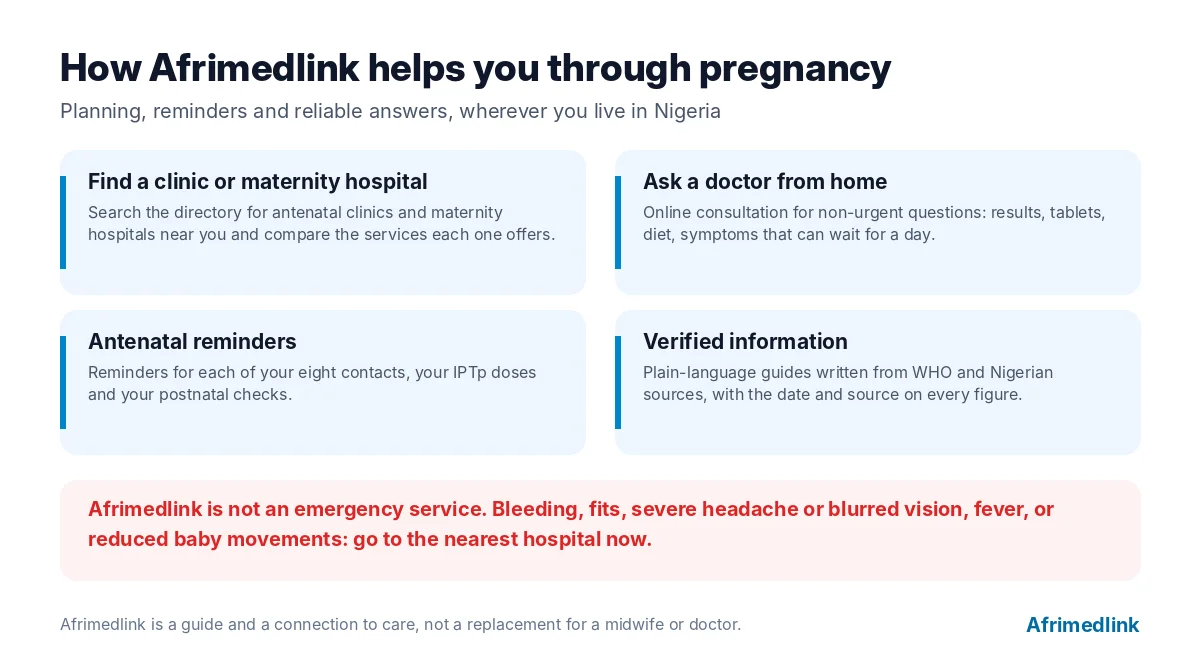 How to use Afrimedlink in pregnancy, and when to go straight to a hospital. Afrimedlink is not an emergency service.
- Find antenatal clinics and maternity hospitals. Our directory helps you find antenatal clinics and maternity hospitals near you, and see which services each offers, so that you can pick the facility for your antenatal care and delivery before labour begins.
- Ask a doctor for non-urgent questions. An online consultation is useful for questions that can wait a day: how to read your test results, whether a tablet is safe, diet and nausea, normal and abnormal changes, or how to prepare for the birth. It is not a substitute for being examined, and a doctor on a screen cannot check your blood pressure or the baby's heartbeat.
- Appointment reminders for antenatal contacts. Reminders for your eight antenatal contacts, IPTp doses and postnatal checks help to make sure you do not slip through the gaps.
- Verified information. Plain-language guides, based on WHO and Nigerian sources, with the source on every figure, so that you do not have to rely on forwarded WhatsApp messages.
What Afrimedlink is not: an emergency service. If you have bleeding, fits, a severe headache or blurred vision, fever, or the baby moves much less than usual, go to the nearest hospital now. Do not book an online consultation first. In labour or after birth, do not wait for a reply to a message.
Key takeaways
- About 75,000 Nigerian women died of maternal causes in 2023, around 29% of the world's total, with a ratio of 993 per 100,000 live births. Most of these deaths were preventable.
- In the 2023-24 NDHS, 52% of women had four or more antenatal visits, 46% of births were assisted by a skilled provider and 43% took place in a facility. The North West and North East, rural areas and poor households are furthest behind.
- The main killers are bleeding, pre-eclampsia and eclampsia, infection, obstructed labour, unsafe abortion and illnesses such as anaemia and malaria. All are treatable with timely skilled care.
- The three delays, in deciding, in reaching care and in receiving care, explain most avoidable deaths. Plan for the first two before labour begins.
- WHO recommends eight antenatal contacts, the first before 12 weeks. Ask for IPTp-SP from 13 weeks, take iron and folic acid, and sleep under a net.
- Emergency signs: bleeding, fits, severe headache or blurred vision, fever, much less baby movement. Go to hospital immediately.
- By about seven months: choose a facility, save money, arrange transport, find a blood donor and agree who decides.
- After birth, stay at least 24 hours, with checks at 48 to 72 hours, 7 to 14 days and six weeks.
- Free or subsidised care exists, including NHIA free caesarean sections, MAMII and the BHCPF, but coverage is uneven. Do not stay at home because of cost.
- Herbs, a "drip" from the chemist and waiting for the morning do not make birth safer. Skilled care does.
References and further reading
- UNFPA, on behalf of the UN Maternal Mortality Estimation Inter-Agency Group (WHO, UNICEF, UNFPA, World Bank Group, UN DESA/Population Division). Trends in maternal mortality 2000 to 2023. April 2025. unfpa.org
- Arab News Pakistan. Pakistan among four countries that accounted for almost half of 2023 maternal deaths: UN report. April 2025. arabnews.pk
- The Guardian (Tanzania). Childbirth deaths alarm sub-Saharan Africa: UN. 18 April 2025. ippmedia.co.tz
- World Health Organization. Maternal mortality: fact sheet. who.int
- National Population Commission (Nigeria) and ICF. Nigeria Demographic and Health Survey 2023-24: Key Indicators Report. Abuja and Rockville, September 2024. dhsprogram.com
- World Health Organization. Many pregnancy-related complications going undetected and untreated. 8 March 2025. who.int
- World Health Organization. Pre-eclampsia: fact sheet. who.int
- World Health Organization. Abortion: fact sheet. who.int
- World Health Organization. Anaemia: fact sheet. who.int
- Thaddeus S, Maine D. Too far to walk: maternal mortality in context. Social Science and Medicine 1994;38(8):1091-1110 (summary on MamaYe). mamaye.org
- World Health Organization. New guidelines on antenatal care for a positive pregnancy experience. 7 November 2016. who.int
- World Health Organization. WHO recommendations on antenatal care for a positive pregnancy experience. 2016. who.int
- Harvard T.H. Chan School of Public Health, Maternal Health Task Force. New guidelines for preventing and treating malaria in pregnancy (summary of WHO IPTp-SP recommendations). hsph.harvard.edu
- World Health Organization. e-Library of Evidence for Nutrition Actions: daily iron and folic acid supplementation during pregnancy. who.int
- NHS. Pre-eclampsia. nhs.uk
- NHS. Your baby's movements. nhs.uk
- US Centers for Disease Control and Prevention. Urgent maternal warning signs and symptoms (Hear Her campaign). cdc.gov
- World Health Organization. WHO urges quality care for women and newborns in critical first weeks after childbirth. 30 March 2022. who.int
- NHS. Postnatal depression. nhs.uk
- News Agency of Nigeria. Free caesarean section commences in over 100 hospitals for indigent women: NHIA. April 2025. nannews.ng
- ThisDay. NHIA's health financing scheme grants over 63,000 women access to maternal healthcare. 10 September 2026. thisdaylive.com
- Gazette Nigeria. FG unveils maternal health plan to curb rising deaths among mothers, newborns (MAMII launch). gazettengr.com
- allAfrica. Nigeria tracks 223,000 pregnant women as maternal, child health improves. 22 April 2026. allafrica.com
- Federal Ministry of Information and National Orientation. FG flags off incentives to boost maternal, newborn care utilisation, reduce maternal and neonatal mortality. 14 September 2026. fmino.gov.ng
- allAfrica. Nigeria: Govt begins distribution of N2.9bn free maternal, neonatal health commodities. September 2025. allafrica.com
- ONE Campaign. How does the BHCPF work? one.org
- ICIR Nigeria. Free maternal healthcare in Niger State falters under fund delays, cultural barriers and administrative gaps. 21 November 2025. icirnigeria.org
- Adeoye IA, Etuk SJ. Prevalence, predictors and pregnancy outcomes of unprescribed and herbal medicine use in Ibadan, Nigeria. BMC Complementary Medicine and Therapies 2023;23:17. pmc.ncbi.nlm.nih.gov
- Ejekam CS, Okafor IP, Okunade KS, et al. Patterns of oxytocin use for induction and augmentation of labour among healthcare providers in Nigeria. BMC Pregnancy and Childbirth 2024. bmcpregnancychildbirth.biomedcentral.com
- Prime Progress NG. Faith vs medicine: the fight to save mothers in Nigeria. 25 March 2025. primeprogressng.com
- Nigeria Health Watch. Malaria in pregnancy in Nigeria: why treatment completion remains a challenge. May 2026. nigeriahealthwatch.com
- World Health Organization. Malaria: fact sheet. who.int
This article is for general health education and does not replace advice from a doctor or midwife who knows your medical history. If you are pregnant or have recently given birth and have bleeding, fits, a severe headache or blurred vision, fever or reduced baby movements, go to the nearest hospital immediately. Figures are correct as of 22 October 2026; schemes and services change, so confirm locally.
Sign in to react.
Speak with verified foreign doctors and other healthcare professionals — within minutes. Vetted professionals abroad, then a vetted partner hospital near you if you need more care.
Consult a doctor nowTake Control
of Your Health
Get access to qualified doctors, personalised health records, and expert care — all from your phone.