The Dangers of Self-Medication and Antibiotic Misuse in West Africa
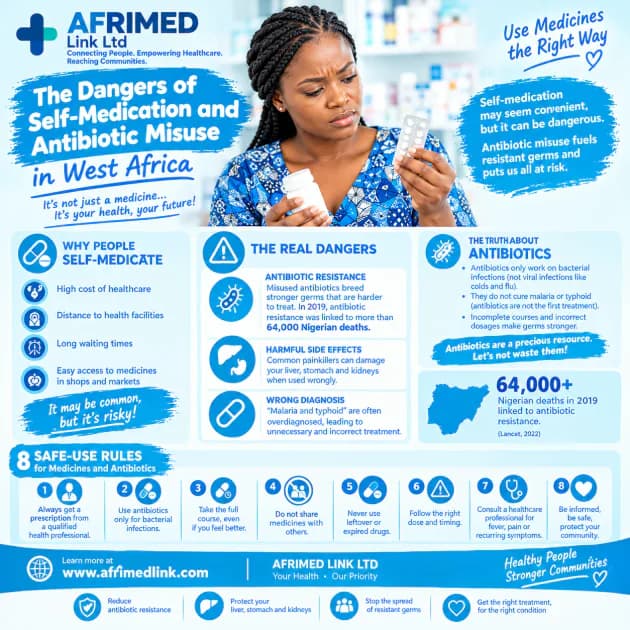
Buying medicines without a prescription is common across Nigeria and Ghana, driven by cost, distance and long waits. But misused antibiotics breed resistant germs that were linked to more than 64,000 Nigerian deaths in 2019, and everyday painkillers can harm the liver, stomach and kidneys. This guide explains resistance simply, why “malaria and typhoid” is overdiagnosed, eight safe-use rules, how to check a pack with NAFDAC’s scratch-and-text service, and when to seek urgent care.
Introduction
Most of us have done it. A headache, a fever, a cough that will not go away, and instead of queuing at the hospital we walk to the nearest chemist or patent medicine shop, describe the problem, and leave with a small nylon bag of tablets. Sometimes it works, and the money and the day are saved. That is why self-medication is so deeply rooted in Nigeria, Ghana and the rest of West Africa: it is quick, close to home and often cheaper than the alternative.
The trouble is that the same habit, repeated millions of times a day, has consequences none of us can see in the moment. A Ghanaian review of 30 studies found that more than half of the population self-medicates [1]. In a survey of pharmacy customers in Ibadan, 85 per cent had done so [3]. In Abia State, almost half of adults had taken antibiotics without a prescription [4]. Every unnecessary antibiotic helps bacteria learn to survive it, every extra paracetamol "to be sure" strains the liver, and every unmarked sachet from a market stall may be fake. When medicines stop working, it is not only the person who misused them who suffers, but their children, their neighbours and the patient in the next hospital bed.
This guide does not tell you never to treat a simple headache at home. It explains how common self-medication is and why, what antimicrobial resistance (AMR) is, which everyday medicines carry the biggest risks, how to use them safely, when to see a doctor, and how Afrimedlink can help. It is timely: World AMR Awareness Week runs from 18 to 24 November 2026, under the theme "One Health, one action: Prevent AMR now" [34].
The single most important message: antibiotics are life-saving medicines, but only when they are used for the right infection, at the right dose, for the right length of time, and on a clinician's advice. Using them for colds, fevers and aches, or sharing and saving them, makes them fail for everyone.
How common is self-medication in Nigeria and Ghana?
Very common, and for many people the first thing they do rather than the last. These figures come from different studies with different definitions, so they cannot be compared exactly, but they point the same way.
 Self-medication in Nigeria and Ghana: headline figures from recent studies, and where Abia State residents got their antibiotics. Sources: Opoku et al., BMJ Open 2023; Akande-Sholabi, BMJ Open 2023; Amuzie et al. 2024; Yeika et al. 2021.
- Ghana: a systematic review of 30 studies and 9,271 people found that 53.7 per cent of Ghanaians self-medicate. The rate was highest among pregnant women (65.5 per cent) and higher in rural settings (61.2 per cent) than in urban ones (52.0 per cent) [1].
- Ibadan, Oyo State: in a 2021 survey of 658 adults at community pharmacies, 85.4 per cent had self-medicated with over-the-counter drugs. More than 95 per cent of them had at least one risky practice, and 60.4 per cent believed over-the-counter drugs are harmless however they are used [3].
- Abia State, south-east Nigeria: in a 2023 household survey of 1,491 adults, 46.5 per cent had used antibiotics without a prescription. The commonest reasons were thinking the illness minor (62.7 per cent) and easy access to antibiotics (49.9 per cent) [4].
- West Africa: a 2021 review of 40 African studies found a median of 55.7 per cent for antibiotic self-medication, with West Africa the highest sub-region at 70.1 per cent [2]. Among 602 young people in Ekiti State, 31.7 per cent self-medicated, mostly with antimalarials [5].
Where do the medicines come from? In Abia State, 52.4 per cent of antibiotics came from pharmacies, 27.5 per cent from patent medicine vendors, 13.8 per cent from tablets stored at home and 7.9 per cent from friends and neighbours (people could name more than one source) [4]. The African review found the same mix [2]. Self-medication is not only something that happens in the shadows: a large share happens across the counter.
Why people do it
Ask someone why they went to the chemist rather than the clinic and you will rarely hear a careless answer. Behind the habit are real barriers, and advice that ignores them will not be followed.
In the Ghanaian review, the commonest reasons (counted as the share of studies reporting them) were long waiting times at facilities (73.3 per cent), having used the drug before (66.7 per cent), the illness seeming not serious (53.3 per cent), and, each in a third of studies, affordable drugs, the high cost of healthcare, and the distance to a facility [1]. In Ibadan, 86.8 per cent of self-medicators agreed that keeping drugs at home for minor conditions is necessary, and three in four said hospital visits waste time [3]. In everyday terms:
- Cost, distance and time. A consultation, a test and a prescription can cost many times what a packet of tablets does, and a day in a crowded hospital is a day without earnings. The chemist is round the corner.
- "It worked last time." A drug that helped before feels like it will help again, even if the illness is different.
- The chemist as first-line doctor. In Nigeria, patent medicine vendors are licensed to sell only medicines on an approved list, and the Pharmacists Council of Nigeria has told newly licensed vendors not to prescribe or inject [32]. In practice the line blurs, because customers ask for treatment, not advice.
- Leftovers and friends' advice. Half-finished courses in the cupboard, and a neighbour who says "take what I took", are common sources of unsuitable medicines [2][4].
None of this makes people foolish. It makes the case for better access, and for simple rules that keep people safe in the meantime.
Antimicrobial resistance, explained simply
Germs are not all the same. Bacteria are living single-celled organisms that cause infections such as typhoid, pneumonia and urinary tract infections. Viruses, which cause colds, flu and measles, are far smaller and live inside our own cells. Malaria is caused by a parasite spread by mosquitoes. Antibiotics act on bacteria. They do not act on viruses, and they are not malaria drugs [16][23].
Antibiotics do not treat colds, flu and most coughs. The NHS is blunt about it: antibiotics do not work on viral infections, including colds, flu and most coughs, and many mild bacterial infections get better on their own [23].
Diarrhoea is treated first with fluids. WHO's treatment is oral rehydration solution (ORS), with zinc for children, because the real danger is losing water and salts; seek a health professional for blood in the stool, diarrhoea lasting 14 days or more, or signs of dehydration [30].
What resistance is. When bacteria meet an antibiotic, the sensitive ones die. Any that are tougher survive and multiply, and can pass their toughness to other bacteria. That is resistance: the drug that used to work no longer does. WHO lists the main drivers as misuse and overuse of antimicrobials, poor water and sanitation, weak infection control, limited access to vaccines and diagnostics, and too few new antibiotics in development [6].
 How resistance develops, and what antibiotics can and cannot treat. Sources: NHS; WHO antimicrobial resistance fact sheet; WHO malaria fact sheet.
Why the full course, as prescribed, matters. An antibiotic is prescribed at a dose and for a length of time chosen to clear the infection. Taking too little, stopping early, skipping doses or "cutting" medicine to save money leaves bacteria exposed to the drug without clearing them. Take exactly what was prescribed, and tell the prescriber if you cannot afford it so that a cheaper option can be found [23].
Poor-quality medicines make it worse. WHO defines substandard medicines as those that fail quality standards, and falsified medicines as those that deliberately misrepresent what they are or where they come from. It estimates that at least 1 in 10 medicines in low- and middle-income countries is substandard or falsified, and warns that they can worsen drug-resistant infections [21]. A 2025 review cites a 2024 estimate that 22.6 per cent of medicines in Africa are substandard or falsified, with antibiotics the largest share (44.6 per cent) [22].
The scale of the problem
Resistance is not a distant threat. It is already killing people in large numbers, and West Africa is among the hardest-hit regions. Associated deaths are those in which a resistant infection was present; attributable deaths would probably not have happened had the infection been treatable.
 Deaths linked to bacterial antimicrobial resistance, worldwide, in Africa and in Nigeria. Sources: Lancet 2024 (Oxford); Lancet 2022 (IHME); Lancet Global Health 2024 via CIDRAP; ThisDay, 20 October 2024.
- Worldwide, 2021: the GRAM study in The Lancet (2024) estimated 4.71 million deaths associated with bacterial AMR and 1.14 million attributable to it. Without stronger action it forecasts 8.22 million associated deaths a year by 2050, and about 39 million attributable deaths between 2025 and 2050 [7].
- Worldwide, 2019: 4.95 million associated and 1.27 million attributable deaths. Western sub-Saharan Africa had the highest attributable death rate of any region: 27.3 per 100,000 people [8].
- WHO African Region, 2019: about 1.05 million associated and 250,000 attributable deaths, more than the toll from HIV (639,544) or malaria (594,348) that year. Babies in their first month of life were hit hard, especially in central and western Africa [9].
- Nigeria: in October 2024 the Coordinating Minister of Health said more than 64,000 deaths in 2019 were linked to AMR [11]. Other reports, citing IHME estimates, put associated deaths at about 263,400 [12][13]. Treat these as estimates.
One hopeful note: AMR deaths in children under five halved between 1990 and 2021, which the GRAM authors link to vaccination and better water, sanitation and hygiene [7].
What Nigeria is doing
Nigeria launched its second National Action Plan on AMR (NAP 2.0) in Abuja on 20 October 2024, covering 2024 to 2028. The first plan (2017 to 2022) reached only 44 per cent completion; it was not costed and lacked clear targets. The new plan covers stewardship, surveillance, research and stronger health systems, and takes a "One Health" approach, treating human, animal and environmental health together [10]. Nigeria was also due to host the 5th Global High-Level Ministerial Conference on AMR in June 2026; it has been postponed [36]. The NCDC names among the drivers that "people often buy antibiotics without prescriptions", and has warned against the indiscriminate sale and display of antibiotics [13].
The WHO AWaRe system. WHO sorts antibiotics into three groups. Access antibiotics work against a broad range of common infections with lower resistance potential, and should be the first choice for most infections. Watch antibiotics have higher resistance potential and are stewardship priorities, and Reserve antibiotics are the last resort for multidrug-resistant infections [31]. WHO's target is that at least 70 per cent of use is Access antibiotics by 2030; in 2022 it was about 53 per cent [6]. A stronger antibiotic is not a better one: the right drug is the one a clinician chooses for your infection.
Antibiotics in animals. Researchers in south-east Nigeria who swabbed 250 day-old chicks found colistin-resistant E. coli in 38.0 per cent and tigecycline-resistant E. coli in 24.8 per cent. Both are last-line antibiotics, and the authors warn that frequent use of colistin and tetracyclines in poultry may be driving this [33]. Farmers and vets have a role too.
"Malaria and typhoid": treating without testing
If one phrase sums up self-medication in Nigeria, it is "malaria and typhoid". A fever, a weak body, a headache, and the chemist or even a clinic announces both diagnoses and supplies an antimalarial and an antibiotic together. The evidence says this is too often wrong.

- In a 2020 survey of 75 health workers in Jos North, 89 per cent diagnosed typhoid and malaria at least weekly, and in more than 70 per cent of cases typhoid was diagnosed with the Widal test. The authors concluded there is a high rate of false diagnosis of malaria and typhoid co-infection [15].
- In a Nigerian study of 810 febrile patients, cultures grew typhoid-causing Salmonella in 14.1 per cent, while malaria parasites were found in 22.2 per cent. Against culture, the Widal test had a sensitivity of 49.1 per cent (it missed about half of true cases) and a positive predictive value of 46.2 per cent, so a positive result was wrong more often than right. The authors concluded the test performed poorly. In the same study 52.6 per cent of the isolates resisted three or more antibiotics [14]. Typhoid is real and serious, which is why it should be diagnosed properly rather than guessed.
Malaria is not rare either: in 2024 the WHO African Region had about 95 per cent of the world's malaria cases and deaths, and Nigeria had 31.9 per cent of the region's deaths. WHO recommends that every suspected case be confirmed by microscopy or a rapid diagnostic test (RDT) [16]. A fever has many causes, and treating two diseases without testing for either means paying for drugs that may do nothing, delaying the treatment that is needed, and giving antibiotics to bacteria that were not the problem.
Everyday medicines that can hurt you
It is not only antibiotics. Many familiar medicines are safe at the right dose for the right person, and risky when used casually.
 Common medicines and what to watch for. Sources: NHS; British Liver Trust; ThisDay (May 2018); Dataphyte (April 2024); Channels TV.
Paracetamol: safe, until it is not
For adults, the NHS limit is up to 8 tablets of 500 mg in 24 hours, at least 4 hours apart, and not for more than three days without advice. Do not take it with other medicines that contain paracetamol, such as cold and flu remedies [24]. For children, the dose depends on age and the product's strength: always check the label and use the syringe or spoon supplied [25]. It may not suit people with kidney or liver conditions or heavy drinkers [24].
An overdose can damage the liver, and it can happen by accident when several products each contain paracetamol. Nausea, vomiting, fatigue, abdominal pain and yellow eyes may be delayed, so the British Liver Trust's advice is: do not wait for symptoms. If you think you have taken too much, get help straight away, even if you feel fine, because the antidote works best when given early [26].
Painkillers such as ibuprofen and diclofenac (NSAIDs)
These can cause stomach ulcers and bleeding, and kidney problems. Warning signs include stomach pain, vomiting blood, pale skin, black sticky stool, blood in the urine and swollen ankles, feet or hands. They are not usually recommended in pregnancy, should not be combined with each other or with anticoagulants, steroids or blood-pressure medicines without advice, and aspirin should not be given to under-16s [27].
Codeine and tramadol
On 1 May 2018 the Federal Ministry of Health directed NAFDAC to stop issuing permits to import codeine for cough preparations, banned the sale of codeine cough syrup without a prescription nationwide, and ordered a recall for relabelling, after reports of widespread abuse [17]. NAFDAC's director-general said tramadol, a restricted drug, was also being abused by young people without prescriptions, and that at least 35 containers had been seized at the ports [18]. The NHS notes that long-term tramadol use can lead to tolerance and addiction, and that a seizure or slow, shallow breathing means calling emergency services at once [29]. Anyone dependent on these drugs needs medical help, not shame.
Steroids and skin-bleaching creams
Steroid tablets are mostly prescription medicines. Long courses or high doses raise the risk of infection, diabetes, weak bones, high blood pressure and eye problems, and they should never be stopped suddenly after weeks of use [28]. Corticosteroids, hydroquinone and mercury are common in skin-lightening creams, and mercury can damage the kidneys: a survey of African women using mercury-containing creams found many with nephrotic syndrome within months to three years [35]. At the time of that report NAFDAC had not moved to a wholesale ban, so a product being on sale does not mean it is safe [35]. Swollen eyes, face or feet, or foamy urine, after using such creams, need a doctor.
Herbs, "drips" and injections
Herbal remedies are not automatically safe alongside prescribed medicines. Tell your pharmacist or doctor about every herb and tonic you take, especially with blood-pressure, diabetes, HIV, TB, epilepsy or blood-thinning medicines, or in pregnancy. Patent medicine vendors in Nigeria are not allowed to inject customers [32]. A drip or injection should be given by a trained health worker with clean equipment, for a diagnosed reason, in a licensed facility.
Who is most at risk
- Children. Doses depend on age and weight, so adult doses can poison a child. Diarrhoea kills more than 440,000 children under five a year worldwide, and the treatment is ORS and zinc [30].
- Pregnant women. They self-medicate more than most groups in Ghana (65.5 per cent) [1], yet NSAIDs are not usually recommended in pregnancy and some antibiotics are unsuitable [23][27].
- Newborns and older people. In the WHO African Region, AMR death rates are highest in the first month of life [9]; globally, AMR deaths in people over 70 rose by more than 80 per cent between 1990 and 2021 [7]. Older people also take more medicines, which raises the risk of interactions.
- People with kidney or liver disease, diabetes, HIV or hypertension, and anyone on steroids: painkillers, paracetamol, herbs and bleaching creams are more dangerous when the kidneys or liver are struggling, and infections are more likely [24][27][28][35].
Safe use: eight rules
 Eight safe-use rules for medicines. Sources: NHS; WHO; NAFDAC Mobile Authentication Service (Daily Trust, August 2018; Prime Progress, July 2025).
- Test before you treat. With a fever, ask for a malaria test. If someone says typhoid, ask what test it was; a Widal result alone is not enough [14][16].
- Antibiotics only if prescribed. Do not ask for them for colds, flu, most coughs or loose stools [23][30].
- Take the course exactly as prescribed. Do not stop early or skip doses to make the pack last. If cost is the problem, tell the prescriber [23].
- Never share or keep leftovers. Only take antibiotics prescribed to you, and return unused tablets to a pharmacy [23].
- Buy from a licensed source, a registered pharmacy with a pharmacist on duty, and look for the NAFDAC number, batch number, expiry date and an intact seal. Be wary of very cheap, unlabelled or loose-sachet products [21].
- Scratch and text to check. NAFDAC's Mobile Authentication Service puts a scratch panel with a one-time PIN on many packs. Scratch it, send the PIN by SMS to 38353 (free), and a reply tells you within seconds whether the product is genuine. In 2018 it covered antibiotics, antimalarials, antidiabetics and antihypertensives, so a pack without a panel is not necessarily fake, but be more careful about where you bought it [19][20].
- Ask before mixing. Tell the pharmacist about herbs, other pills, pregnancy, breastfeeding, and kidney or liver problems [28][35].
- Keep medicines safe, in the original pack, away from children and heat, and throw away expired products. If something seems wrong with a product, do not take it, and report it to NAFDAC.
When self-care is reasonable, and when to see a doctor
Self-care is reasonable for a short, mild illness in a healthy adult: a simple headache, mild muscle ache or a common cold. Rest, fluids and paracetamol at the correct dose are enough for most of these. Antibiotics are not part of that picture. Some situations, however, should not be managed at home.
 When to treat at home, see a clinician soon or urgently, or go to hospital now. Sources: NHS; WHO diarrhoeal disease fact sheet; British Liver Trust.
See a doctor or pharmacist soon (within a day or two) if you have a fever that does not settle within a couple of days, diarrhoea with blood or lasting 14 days or more, pain on passing urine, a wound that is red and swelling, or if you are pregnant, are a child, or have kidney, liver or heart disease, diabetes or HIV and need any new medicine [30].
See a clinician urgently (the same day) for a fever in a young baby, anyone who cannot keep fluids down, signs of dehydration (sunken eyes, extreme thirst, passing little urine), black stools, yellow eyes or skin, a rash after starting a new medicine, or if you have taken more than the label allows, even if you feel well [26][30].
Go to the nearest hospital now, or call for help, if: a person has swollen lips or face, wheezing or difficulty breathing after taking a medicine; has a fit (seizure) or very slow, shallow breathing; is confused, extremely drowsy or cannot be woken; is vomiting blood; or may have taken an overdose or been poisoned, whether it was an accident in a child or a deliberate act in an adult. Do not wait to see whether symptoms appear. Take the packet, the bottle or the leftover tablets with you [23][26][29].
A note on overdose: paracetamol can look harmless for the first hours while the liver is already being damaged, so go to hospital at once, even if the person feels well [26]. If someone has taken an overdose on purpose, treat it as an emergency, stay with them, and offer kind, non-judgemental support.
Testing and diagnosis: what a good consultation looks like
A good consultation begins with questions: how long, what symptoms, what you have already taken, whether you are pregnant, and what other medicines you use. For a fever in Nigeria the clinician will usually order a malaria RDT or microscopy [16] and, if typhoid is a real possibility, a blood culture where available rather than a Widal test alone [14]. Where an antibiotic is needed, they choose it, ideally from the WHO "Access" group [31]. If you are told you have "malaria and typhoid", you are entitled to ask which test showed it.
What actually works: treatment and prevention
Most colds and coughs pass with rest, fluids and simple pain relief. Diarrhoea is treated with ORS, plus zinc in children [30]. Malaria is treated after a positive test [16]. Serious bacterial infections need an antibiotic chosen by a clinician, which is why these medicines must be protected. And prevention works: every infection avoided through vaccination, safe water and handwashing is an antibiotic not needed [7].
Myths and facts
- "Antibiotics are strong, so they cure any fever." No. They do not work on viral infections such as colds and flu, and they do nothing for malaria, which is a parasite. They can cause side effects, and unnecessary use fuels resistance [16][23].
- "I feel better, so I can stop." Take the course as prescribed. Stopping early or cutting doses is one way bacteria survive. If cost or side effects are the problem, ask the prescriber [23].
- "My leftover antibiotics will work for someone else at home." No. Only take antibiotics prescribed to you, for the infection you have now [23].
- "The Widal test shows typhoid." Not reliably. In one Nigerian study a positive Widal result was right less than half the time [14].
- "If the chemist sold it, it must be safe." Licensed pharmacies are a safer source, but anyone who hands out antibiotics and strong painkillers on request is not following good practice. Check the NAFDAC number and use scratch-and-text [19][32].
- "Over-the-counter means harmless." Six in ten people in the Ibadan survey believed this, and over 95 per cent of self-medicators had a risky practice [3]. Paracetamol, ibuprofen and diclofenac all cause harm when misused [24][26][27].
What you can do
- Call a clinician first when you can. If you cannot, talk to a pharmacist, not just a seller: ask what the drug is for, how to take it and what to avoid.
- Ask for a test when you have a fever, and ask what the result means.
- Support vaccination and clean water at home and in your community, and use antibiotics in animals only on a vet's advice [33].
- Take part in World AMR Awareness Week (18 to 24 November): share one fact from this guide with a family member, a neighbour or your local chemist [34].
For families
- Children. Do not give leftover or adult medicines. Check the age and strength on the label and use the syringe or spoon supplied. Paracetamol should be at least 4 hours apart, no more than four times a day, and not for more than three days without advice [25].
- Pregnancy. Before taking anything, including herbal mixtures, ask a doctor, midwife or pharmacist [23][27].
- Teenagers. Talk early and without blame about cough syrups and painkillers; codeine and tramadol can be addictive [17][18].
How Afrimedlink can help
Many people self-medicate because the alternative is far, slow or expensive. Afrimedlink's role is to make the better choice easier, without pretending to replace a hospital.
 How to use Afrimedlink to avoid unnecessary and unsafe medicine use. Afrimedlink is not an emergency service.
- Talk to a doctor before you buy. An online consultation lets a clinician ask the questions a chemist cannot, decide whether you need a malaria test, a culture or a visit, and tell you whether you need an antibiotic at all.
- Find the right pharmacy, laboratory or doctor. Our directory helps you find registered pharmacies, laboratories and clinics near you, so that a test comes before the treatment.
- Prescription and reminder support. Keep your prescription in one place and get reminders to take each dose and finish the course as prescribed.
- Verified information. Plain-language guidance based on WHO, NCDC and NAFDAC sources, with the date shown; send us any forwarded message about "cures" or "banned drugs" and we will check it.
What Afrimedlink is not: an emergency service. If someone may have taken an overdose or been poisoned, has a fit, is struggling to breathe, is vomiting blood, is confused or cannot be woken, go to the nearest hospital now or call your local emergency number. Do not wait for an online reply.
Key takeaways
- Self-medication is common: 53.7 per cent in Ghana, 85.4 per cent among pharmacy customers in Ibadan, and 46.5 per cent of adults in Abia State used antibiotics without a prescription.
- Antibiotics treat bacteria only. They do nothing for colds, flu, most coughs or malaria. Diarrhoea is treated first with ORS.
- Resistance already costs lives: 4.71 million associated deaths worldwide in 2021, the highest attributable death rate in western sub-Saharan Africa in 2019, and more than 64,000 Nigerian deaths linked to AMR.
- "Malaria and typhoid" is overdiagnosed. A positive Widal test was wrong more than half the time. Ask for a malaria test and a proper typhoid test.
- Everyday medicines can harm: paracetamol (liver), NSAIDs (stomach, kidneys), codeine and tramadol (dependence), steroids and bleaching creams. Patent medicine vendors may not inject.
- Follow the eight rules: test before you treat; antibiotics only if prescribed; finish the course as prescribed; never share or save leftovers; buy from a licensed source; scratch and text; ask before mixing; keep medicines safe.
- Know the emergency signs. Swollen face or lips, trouble breathing, a fit, unconsciousness, vomiting blood or a suspected overdose or poisoning mean hospital now. For paracetamol, go even if the person feels well.
- Ask first, buy second. Use Afrimedlink for an online consultation, a pharmacy or laboratory, and reminders; in an emergency, go to hospital.
References and further reading
- Opoku R, Dwumfour-Asare B, Agrey-Bluwey L, et al. Prevalence of self-medication in Ghana: a systematic review and meta-analysis. BMJ Open 2023;13:e064627. bmjopen.bmj.com
- Yeika EV, Ingelbeen B, Kemah BL, et al. Comparative assessment of the prevalence, practices and factors associated with self-medication with antibiotics in Africa. Tropical Medicine and International Health 2021;26(8):862-881. research.itg.be
- Akande-Sholabi W, Akinyemi OO. Self-medication with over-the-counter drugs among consumers: a cross-sectional survey in a Southwestern State in Nigeria. BMJ Open 2023;13:e072059. bmjopen.bmj.com
- Amuzie CI, Onyeonoro UU, Nwamoh UN, et al. Prevalence and pattern of self-medication with antibiotics among residents of Abia State, Southeastern Nigeria: a call for action. Int J Community Med Public Health 2024;11(11):4222-4233. ijcmph.com
- Agbesanwa TA, Aina FO, Solomon OA, et al. Prevalence, practice, determinants and adverse effects of self-medication among young people living in a suburban community of Ekiti, Nigeria. SAGE Open Medicine 2024;12. doaj.org
- World Health Organization. Antimicrobial resistance: fact sheet. who.int
- University of Oxford. Antibiotic resistance has claimed at least one million lives each year since 1990 (GRAM study, The Lancet, 2024). 17 September 2024. ox.ac.uk
- Institute for Health Metrics and Evaluation. Global burden of bacterial antimicrobial resistance in 2019: a systematic analysis (The Lancet, 2022). healthdata.org
- CIDRAP. In Africa, high infection rates drive deaths from antimicrobial resistance (summarising The Lancet Global Health, 2024). cidrap.umn.edu
- WHO Regional Office for Africa. Nigeria launches action plan to combat antimicrobial resistance (AMR). October 2024. afro.who.int
- ThisDay. FG traces 64,000 deaths to antimicrobial resistance. 20 October 2024. thisdaylive.com
- Nigeria Health Watch. World Antimicrobial Awareness Week 2024: Nigeria's fight against the "superbugs". nigeriahealthwatch.com · and Pharmacoepidemiologic insights into antibiotic self-medication in Nigeria: a One Health perspective. Population Medicine 2026 (supplement). populationmedicine.eu
- ICIR. When treatment fails: what to know about drug resistance in Nigeria. icirnigeria.org
- Ohanu ME, Iroezindu MO, Maduakor U, et al. Typhoid fever among febrile Nigerian patients: prevalence, diagnostic performance of the Widal test and antibiotic multi-drug resistance. Malawi Medical Journal. coalitionagainsttyphoid.org
- Shehu NY, Bimba J, Nantok D, et al. Over diagnosis of typhoid and malaria co-infection by health care workers in north central Nigeria: a cross-sectional study. Nigerian Journal of Medicine 2020;29(1):100-103. doaj.org
- World Health Organization. Malaria: fact sheet. who.int
- ThisDay. Finally, FG bans production of cough syrups containing codeine. 2 May 2018. thisdaylive.com
- ThisDay. 35 containers of tramadol seized at ports, says NAFDAC. 10 June 2018. thisdaylive.com
- Daily Trust. NAFDAC urges Nasarawa residents to utilize mobile authentication code before using drugs. 6 August 2018. dailytrust.com
- Prime Progress. Nigeria's digital fight against deadly fake drugs. 11 July 2025. primeprogressng.com
- World Health Organization. Substandard and falsified medical products: fact sheet. 3 December 2024. who.int
- Maluleke TM, Mekonnen BA, Ubaka CM, et al. Potential activities to reduce the extent of substandard and falsified antibiotics across Africa. Frontiers in Tropical Diseases, 24 September 2025. frontiersin.org
- NHS. Antibiotics. nhs.uk
- NHS. Paracetamol for adults. nhs.uk
- NHS. Paracetamol for children. nhs.uk
- British Liver Trust. How much paracetamol is dangerous? britishlivertrust.org.uk
- NHS. NSAIDs. nhs.uk
- NHS. Steroid tablets. nhs.uk
- NHS. Side effects of tramadol. nhs.uk
- World Health Organization. Diarrhoeal disease: fact sheet. who.int
- World Health Organization. WHO releases the 2019 AWaRe classification antibiotics. 1 October 2019. who.int
- Channels Television. Medicine vendors cautioned against unlawful drug sales. 18 August 2016. channelstv.com
- Anyanwu MU, Ikenna-Ezeh NH, Okafor SC, et al. Commercial day-old chicks in Nigeria are potential reservoirs of colistin- and tigecycline-resistant potentially pathogenic Escherichia coli. Antibiotics 2024;13(11):1067. doaj.org
- World Health Organization. World AMR Awareness Week 2026 (18 to 24 November). who.int
- Dataphyte. Nigerians exposed to the highest dangers of bleaching products. 24 April 2024. dataphyte.com
- Voice of Nigeria. Nigeria postpones global AMR ministerial conference. 11 June 2026. von.gov.ng
This article is for general health education and does not replace advice from a doctor or pharmacist who knows your medical history. If you are unwell, have taken too much of a medicine, or are worried about a medicine you or your child is taking, see a qualified health professional; in an emergency, go to the nearest hospital. Figures are correct as of 22 October 2026.
Sign in to react.
Speak with verified foreign doctors and other healthcare professionals — within minutes. Vetted professionals abroad, then a vetted partner hospital near you if you need more care.
Consult a doctor nowTake Control
of Your Health
Get access to qualified doctors, personalised health records, and expert care — all from your phone.