
Depression and Anxiety in Nigeria: Signs, Stigma and Where to Get Help
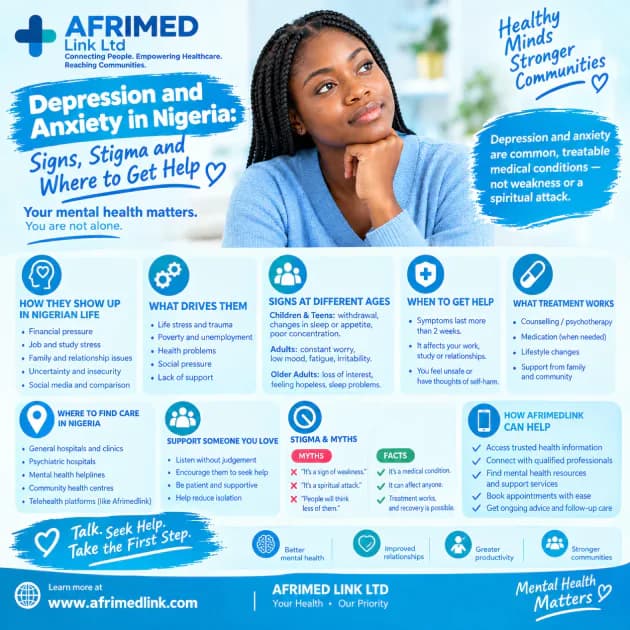
Depression and anxiety are common, treatable medical conditions, not weakness or a spiritual attack. This guide explains how they often show up in Nigerian life, what drives them, the signs at different ages, when to get help, what treatment works, where to find care and how to support someone you love. It also covers stigma, myths, and how Afrimedlink can help.
Introduction
A man who has not slept properly for two months keeps telling his wife it is "just the work". A student who used to top her class stays in bed and says her head is "hot". A mother whose husband left for the UK last year has constant chest tightness and a heart that will not stop pounding. None of them says the words "depression" or "anxiety", and few of the people around them would think to say them either.
These are the two most common mental health conditions in the world. The World Health Organization (WHO) estimates that in 2023 about 322 million people had depression and 470 million had an anxiety disorder [1][2][3]. Nigeria is thought to have more people with depression than any other African country, simply because it has so many people, yet fewer than one in ten Nigerians who need mental health care are thought to receive it [4]. Behind that gap are too few trained professionals, too little public understanding, and a great deal of stigma.
The good news is just as real. Depression and anxiety are medical conditions, not moral failures, spiritual attacks or signs of weakness. They respond to treatment, often simple treatment that trained counsellors can deliver, and most people who get help get better [1][2].
This guide is general information, not a diagnosis. If you recognise yourself in it, that is not a verdict; it is a reason to talk to someone.
The single most important message: Depression and anxiety are common, they are medical conditions, and they are treatable. If you have felt low, hopeless or constantly on edge for two weeks or more, please speak to a doctor or counsellor. If you are having thoughts of ending your life, that is a medical emergency, and help is available right now (see "When to get help").
What depression and anxiety are, and what they are not
Depression is more than sadness after a bad week. WHO describes a depressive episode as low mood (sadness, irritability or emptiness) or loss of interest and pleasure, lasting most of the day, nearly every day, for at least two weeks. Other signs include poor concentration, guilt or worthlessness, hopelessness, disturbed sleep, changes in appetite and low energy [1].
Anxiety is a normal response to danger or pressure. It becomes an anxiety disorder when fear or worry is intense, excessive, lasts for months and gets in the way of life. People may avoid situations, struggle to concentrate, feel tense or restless, and have a pounding heart, sweating, trembling, nausea or poor sleep. Some have panic attacks, a sudden surge of fear with a sense of doom [2].
The two often occur together. In one study of 222 patients at a teaching hospital outpatient clinic in Ogbomoso, 27.5% had both; that figure applies to that clinic, not to Nigeria as a whole, but it shows how often they overlap [5].
What they are not
- Not weakness. They affect strong, hardworking, faithful people. They are not a failure of character or willpower.
- Not a curse or a spiritual attack. They have biological, psychological and social causes. Prayer and the support of a faith community can comfort, alongside treatment but not instead of it.
- Not "thinking too much". Worry that cannot be switched off, or a low mood that will not lift, is a symptom. "Just stop thinking about it" has never worked.
- Not "madness". In a 2019 national survey, 70% of Nigerians pictured mental illness as someone "running around naked" [6]. That describes a few severe conditions. Most people with depression or anxiety look like everyone else: your colleague, your pastor, your mother.
How depression and anxiety show up in Nigerian life

Many people describe these conditions first through the body. A study of 865 adults at primary health care facilities in rural south-western Nigeria found that about one in five reported bodily sensations of the kind many Nigerians describe: feelings of heat, peppery or burning sensations, crawling sensations or numbness. The researchers found these complaints closely linked to psychological distress [7]. This is the "heat in the head" that people take to the chemist, the herbalist and the prayer house, often for months, before anyone asks how they are coping.
Other common signs:
- Body complaints with no clear cause: headaches, body pains, chest tightness, a pounding heart, stomach trouble, constant tiredness. They are real, not "all in the mind".
- Sleep gone wrong: lying awake with worries, waking at 3 or 4 am, or sleeping too much and still feeling drained.
- Irritability. In many people, especially men, depression shows as a short temper rather than sadness.
- Withdrawal: missing church or mosque, ignoring calls, skipping weddings, losing interest in things once enjoyed.
- Coping through substances: more alcohol, or tramadol, cannabis or other drugs to numb feelings, which hides the problem and worsens it.
- Flatness or hopelessness: "I just don't care any more."
Most of us recognise one or two of these from time to time. What matters is when several last for weeks and make it hard to work, study, parent or enjoy life.
How common are depression and anxiety in Nigeria?
 Global figures are for 2023; the Nigerian depression estimate is WHO's 2015 figure. Sources: WHO; Africa Check; Dike (RPublc), 2023; NAN, 2026.
Reliable national numbers are scarce. The most recent large national survey is old: the Nigerian arm of the WHO World Mental Health Survey, carried out in 2002 among more than 6,600 adults in five of the six geopolitical zones, found that one in eight had had a mental illness in their lifetime, with depression and anxiety among the commonest [4]. WHO's Global Health Estimates, using 2015 data, put depression in Nigeria at 3.9%, about 7.1 million people, the largest number in Africa [4].
You may see claims that "one in four Nigerians has a mental illness". Africa Check looked for the evidence and rated it unproven [4]. We have not used it here.
Smaller recent studies, with their limits, suggest the burden is substantial:
- Young people. A 2025 preprint (not yet peer-reviewed) pooling Nigerian studies estimated major depression at about 17% and generalised anxiety at about 9.5% among secondary school students, with wide uncertainty [8].
- New mothers. A 2024 review across sub-Saharan Africa estimated postnatal depression at about 22%, with results varying widely [9]. WHO says more than 10% of women worldwide have depression in pregnancy or after birth [1].
- Older people. About 15% of adults aged 70 and over have a mental disorder, most often depression or anxiety, and it is often under-recognised [10].
- Women and men. Depression is about 1.5 times more common in women worldwide [1]. Men are less likely to seek help and more likely to show it as anger or substance use.
The care gap
WHO estimates that fewer than 10% of Nigerians with a mental illness get the care they need [4]. Professor Oye Gureje, who led the national survey, notes that people with severe anxiety, depression and substance use rarely get treatment at all [4].
Part of the reason is the number of specialists. The Association of Psychiatrists in Nigeria reported about 250 psychiatrists in 2020, and the Nigerian Medical Association gave 350, for around 200 million people [4][13]. That is roughly one for every 600,000 to 800,000 people, by our own arithmetic. The president of the Association has said more than half of the country's mental health workers have moved abroad [11]. The United Kingdom has about 14 psychiatrists per 100,000 people, one for every 7,000 [36].
The Mental Health Act
There is progress. The National Mental Health Act (No. 46 of 2021) was signed by President Muhammadu Buhari in January 2023 (most reports say 5 January), replacing the colonial-era Lunacy Act, which dated from a 1916 ordinance and was last revised in 1958 [33][34][35]. It gives people with mental health conditions the same rights as other citizens, protects them from discrimination and abuse, makes ill-treatment or neglect an offence, and calls for mental health services in primary and secondary care [34][35][37]. Delivering that, with trained staff in primary health centres across the 36 states and the FCT, is the work still ahead.
What puts pressure on Nigerian minds
 Depression and anxiety rarely have a single cause. Sources: NAN, 2023; UNODC and NBS, 2018; Population Medicine, 2026; WHO; SAJS, 2024.
These conditions usually arise when biology, personal history and life circumstances combine. Several pressures will be familiar to many families:
- Money worries. In December 2023, the Chief Medical Director of the Federal Neuro-Psychiatric Hospital, Yaba, said psychiatric admissions had doubled that year, linking it to "the current economic challenges" [14]. The president of the Association of Psychiatrists says poverty, inflation, insecurity and violence are taking a toll on citizens' mental wellbeing [11].
- Insecurity and displacement. A 2023 study of 450 displaced people in Yobe State found very high rates of depression and post-traumatic stress symptoms [15].
- Japa and family separation. A survey of 1,278 adults in Ibadan in early 2025 found that people with relatives abroad reported markedly more anxiety and depression than those without [16]. Parents left behind and partners holding the household alone feel it.
- Long-term illness. Diabetes, HIV, stroke and chronic pain raise the risk of depression, and depression makes illness harder to manage [10][5].
- Pregnancy and birth. Hormonal change, broken sleep, money strain and lack of support all play a part [1][9].
- Alcohol, tramadol and other substances. The 2018 national survey found 14.4% of Nigerians aged 15 to 64 (14.3 million people) used drugs in the past year, more than double the global average, including about 4.6 million using prescription opioids such as tramadol non-medically [17]. Substances can be a cause, a consequence, or both.
- Loss, abuse and loneliness, especially bereavement and isolation in older age [10], and difficult childhoods: abuse, harsh parenting and severe poverty raise risk in young people [18].
None of this means a person is to blame, or that they would feel fine if circumstances improved. Many people with every advantage get depressed, and many people under great strain do not. Once a condition has taken hold, it needs treatment in its own right.
Signs in adults, young people and older adults
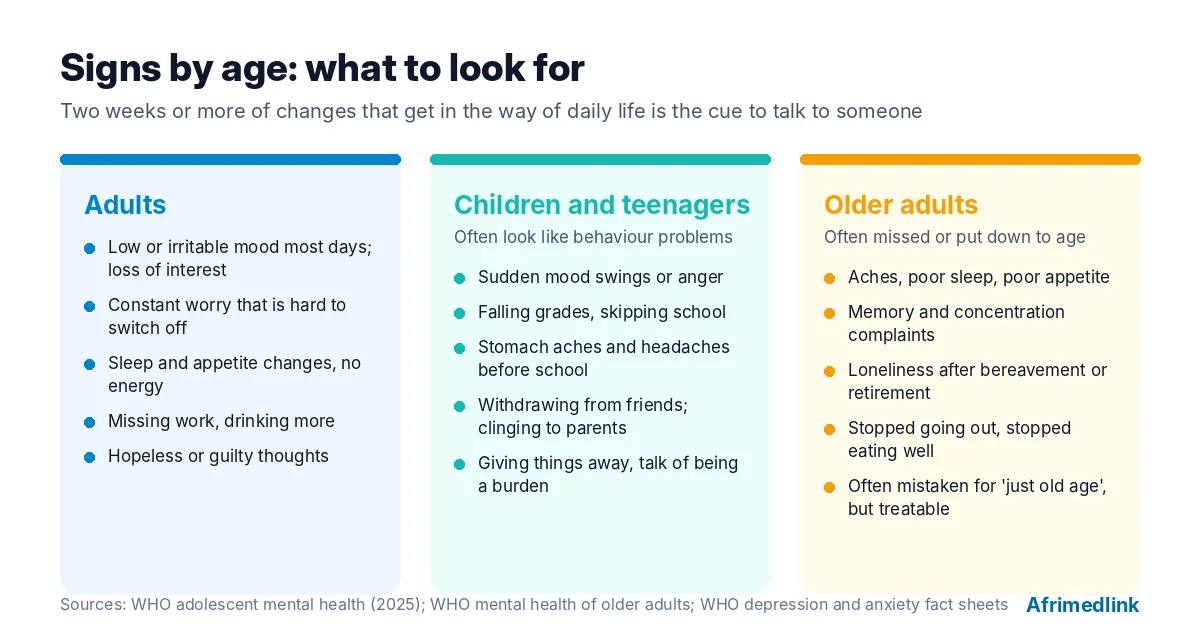 The same conditions look different at different ages. Sources: WHO.
Adults show the signs above: low or irritable mood, loss of interest, constant worry, poor sleep and appetite, tiredness, guilt, a fall in performance at work, more drinking. Men especially mention aches and sleeplessness rather than feelings.
Children and teenagers often show distress through behaviour. WHO notes that adolescent depression and anxiety share symptoms such as rapid, unexpected mood changes, and can affect school attendance and schoolwork, with withdrawal increasing isolation [18]. Watch for sudden anger or tearfulness, falling grades, school refusal, repeated headaches or stomach aches before school, and withdrawal from friends. About 1 in 7 young people aged 10 to 19 worldwide has a mental health condition [18]. A calm, private conversation without shaming is the best start.
Older adults are often missed because it is put down to "just old age" [10]. Look for aches, poor sleep and appetite, memory and concentration complaints, loneliness and no longer going out. Treatment is as worthwhile as at any age.
After childbirth, feeling tearful and overwhelmed in the first days is common. If low mood, anxiety or exhaustion lasts beyond two weeks, makes it hard to look after yourself or your baby, or includes thoughts of harming yourself, please see a doctor. It is common, treatable and not a sign that you are a bad mother [1][9].
When to get help
 Soon, urgently, or in an emergency: what to do. Sources: WHO; Government of Nigeria; SURPIN.
Book a consultation (within days to two weeks). Low mood, worry or irritability for two weeks or more; sleep, appetite or energy changes that will not settle; repeated body complaints with no cause found; drinking or using more to cope; or trouble managing work, studies or family.
See a doctor soon (within a day or two). You cannot work, eat, sleep or look after your children; panic attacks keep returning; you are barely leaving the house or bed; a new mother cannot cope; or someone has stopped their medicine suddenly.
Emergency (act now). Any thought of ending your life or harming yourself, or a friend or relative who talks about wanting to die, feeling like a burden, or saying goodbye. Also extreme confusion, hearing voices, or being a danger to yourself or others.
Thoughts of suicide are a medical emergency, not a character flaw or a sin. They are a sign of pain that has become unbearable, and they can be treated. People who get help, even people who felt life was not worth living, go on to recover and live lives they value. WHO estimates about 727,000 people died by suicide worldwide in 2021, and it is the third leading cause of death among 15 to 29 year olds [1][12]. In Nigeria, WHO figures cited by the News Agency of Nigeria put suicide deaths at 10,912 in 2021 [19].
If you or someone you know is in immediate danger: do not wait, and do not leave the person alone. Go to the nearest hospital emergency department, or call 112, the national emergency number, which is free to call [20]. (Coverage of 112 varies by state, so if no one answers, go to the nearest hospital or ask someone to take you.) You can also call the SURPIN toll-free helpline on 0800 078 7746, which the organisation says is staffed 24 hours a day by trained counsellors [21]. If you are the one struggling, tell one trusted adult today exactly how you feel. Saying "I am not safe" or "I need help" is enough.
Attempted suicide is still an offence under Nigeria's Criminal Code, although the Federal Executive Council has approved an amendment to remove it, which now awaits the National Assembly. The Minister of Health has said publicly that the law conflicts with Nigeria's mental health policy and Mental Health Act [19]. It is one more reason people hide their pain. Doctors and counsellors are there to help, not to punish.
How depression and anxiety are diagnosed
There is no blood test or scan for either. A doctor, psychiatrist, clinical psychologist or trained counsellor assesses you by listening: how you have felt, for how long, how it affects daily life, your sleep, health, medicines, substance use and circumstances, and whether you have had thoughts of harming yourself. Short questionnaires may track severity but do not replace the conversation. A good assessment also checks for other causes, such as thyroid problems, anaemia, diabetes, HIV or certain medicines, so a few blood tests may be ordered. That is also why a quiz or a friend's guess is not enough.
What works: treatment for depression and anxiety
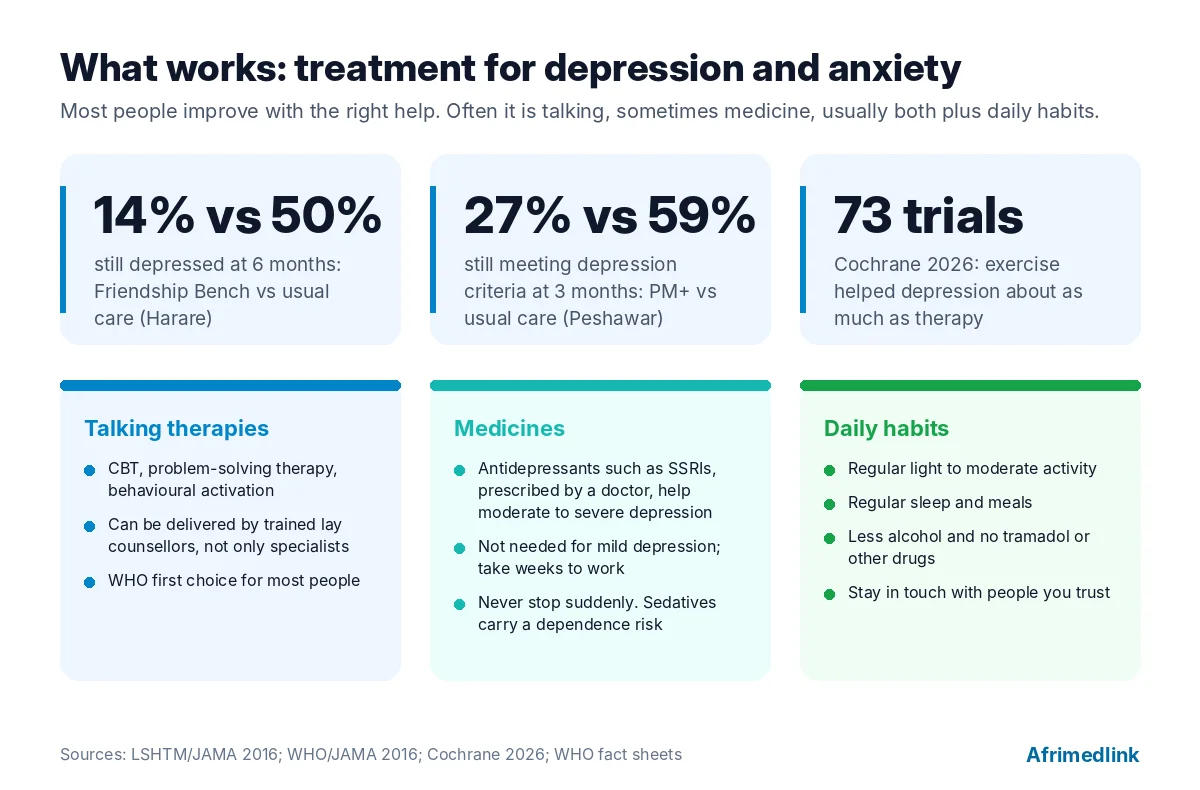 Evidence from talking therapy delivered by trained lay counsellors, and from exercise. Sources: LSHTM/JAMA 2016; WHO/JAMA 2016; Cochrane 2026; WHO.
Most people improve with treatment. WHO says psychological treatment is the first choice for most people, with medicines added in some cases [1][2].
Talking therapies
The best-evidenced include cognitive behavioural therapy (CBT), problem-solving therapy, behavioural activation (returning step by step to activities that give life meaning) and interpersonal therapy [1][2]. They teach practical skills. Two models were designed for places with few specialists:
- The Friendship Bench (Zimbabwe). Six one-to-one problem-solving sessions of about 45 minutes, on a wooden bench in a clinic's grounds, delivered by trained, supervised lay health workers known as "grandmothers". In a 2016 JAMA trial across 24 Harare clinics with more than 550 adults, 14% of those who had the Friendship Bench still had depression symptoms at six months, against 50% with standard care; for anxiety, 12% against 48%; for suicidal thoughts, 2% against 12% [22]. A later trial in rural Zimbabwe among people with HIV found a smaller benefit that faded by 12 months, a reminder that no programme works for everyone [23].
- Problem Management Plus (PM+). A WHO programme in which a non-specialist helper delivers five weekly sessions of about 90 minutes on stress management, problem-solving, getting active again and social support [24][25]. In Peshawar, Pakistan, among 346 adults, 27% still met depression criteria three months later with PM+, against 59% with enhanced usual care [24].
These programmes are not yet widely available in Nigerian primary care, but they show effective help need not wait for more psychiatrists.
Medicines
Antidepressants such as the SSRI fluoxetine can help people with moderate to severe depression, and some adults with anxiety. WHO says they are not needed for mild depression, should not be used for depression in children, and are not first-line for adolescents [1][2]. They take a few weeks to work, can cause side effects, and should be prescribed, monitored and stopped by a doctor, never stopped suddenly on your own.
A word on "nerve tablets". WHO advises that benzodiazepine sedatives are generally not recommended for anxiety because of the risk of dependence and limited long-term benefit [2]. If you have been prescribed one, do not stop abruptly; ask your doctor for a safe plan. If you have been buying one without a prescription, please see a doctor.
Exercise, sleep and company
A 2026 Cochrane review of 73 trials with nearly 5,000 adults with depression found that exercise reduced symptoms compared with no treatment, with effects similar to psychological therapy (moderate-certainty evidence) and, with lower certainty, to antidepressants. Light to moderate activity seemed more helpful than vigorous exercise, and the authors noted it works well for some people but not everyone [26]. WHO also lists regular exercise, consistent sleep and eating, relaxation, and limiting alcohol and drugs as supports for anxiety [2].
Where to get help in Nigeria
Start with a doctor, who can assess you, rule out physical causes and refer you. In a crisis, go to the nearest emergency department.
- Federal neuropsychiatric hospitals at Yaba (Lagos), Aro (Abeokuta), Benin City, Calabar, Enugu, Kaduna, Maiduguri and Kware (Sokoto), with newer ones in Kwara and Kano [13]. They offer specialist outpatient and inpatient care and treatment for substance use; Kware, for example, lists an emergency department and a drug dependence rehabilitation centre [27]. Call ahead for clinic days and costs.
- Teaching hospital psychiatry departments. The Lagos University Teaching Hospital's department, for example, offers adult, child and adolescent, old-age, addiction and consultation-liaison psychiatry, with clinics at Idi-Araba and Yaba and a community centre in Ogun State [28]. Clinic days change, so confirm by phone.
- General hospitals and primary health centres. The Mental Health Act envisages mental health care at primary and secondary level [35]. A doctor there can start an assessment and refer you on.
- NGOs and helplines. SURPIN runs a helpline which, according to its website, offers 24-hour crisis counselling on 0800 078 7746 (toll-free), with a Hausa-language line, plus counselling, support groups and referrals [21][29]. The Mentally Aware Nigeria Initiative (MANI) offers free, confidential support and information, particularly for young people, via mentallyaware.org [30][38]. Contact details change, so check the organisation's own website, and if someone is in immediate danger, go to an emergency department rather than waiting for a call-back.
What about cost? Government hospitals are usually cheaper than private clinics, though waits can be long. If you have NHIA, state scheme or HMO cover, ask specifically what mental health care it includes, because cover varies. Do not let cost stop you seeking help in an emergency; ask the hospital's social welfare or accounts office about options.
Stigma, myths and beliefs
 Six common beliefs, and the evidence. Sources: WHO; Africa Polling Institute and EpiAfric, 2019; LSHTM.
Stigma is one of the biggest reasons people do not seek help. In the 2019 Mental Health in Nigeria survey of 5,315 adults, 70% said they would take a person with mental illness to a hospital, 18% to a prayer house for deliverance and 8% to a traditional healer, and rural respondents were more likely to blame evil spirits [6]. An earlier survey of 2,078 adults in the south-west found 41% preferred spiritual healers and 30% traditional healers, against 29% who preferred hospitals; those with more education, or who had cared for someone with mental illness, were more likely to choose orthodox care [31]. A 2004 village survey near Kano found almost half held negative feelings towards people with mental illness, mainly fear and avoidance [32].
These are not reasons to blame anyone. Beliefs about spirits and "what people will say" come from a long tradition of explaining suffering and a long absence of accessible care. But they mean help often comes last, after months of prayer, herbs and silence. The Mental Health Act prohibits discrimination and ill-treatment of people with mental health conditions [34][35][37].
Faith and medicine can work together. Prayer, worship and the support of a pastor or imam give meaning, community and hope, which protect mental health. The problem arises when it becomes "either-or": when someone is told that taking medicine shows lack of faith, or that depression is sin. A good rule: pray, and see a doctor.
Words matter. "Mad", "crazy", "possessed" and "attention-seeking" do harm. Say someone is "going through depression" or "living with anxiety", and never share someone's mental health history without permission.
Supporting a family member or friend
You do not need to be an expert. Simple things help most.
- Start a private conversation. Say what you have noticed ("You haven't seemed yourself, and I'm worried about you") rather than what you think is wrong.
- Listen more than you advise. "Be strong" and "others have it worse" feel dismissive. "That sounds really hard" and "I'm here" are better.
- Do not blame or label. Avoid "you just need more faith" or "pull yourself together".
- Offer practical help: find a doctor, go with them, mind the children for an afternoon, help them book an online consultation.
- Keep in touch. A short message, a visit, a shared meal. Isolation deepens depression.
- Take thoughts of suicide seriously. If someone says they want to die, or you fear they may harm themselves, stay with them, listen without judgement and get help immediately: take them to the nearest emergency department or call 112. Do not leave them alone, and do not promise to keep it secret.
- Look after yourself. Supporting someone is draining. Talk to someone you trust.
Parents and teachers: if a child seems low, anxious or is refusing school, ask gently and listen, avoid threats and shaming, and speak to a doctor or school counsellor. Take bullying, violence and abuse seriously; they are among the biggest risks to adolescent mental health [18].
Self-help habits that support recovery
These strengthen professional care; they do not replace it.
- Move your body: a 20 to 30 minute walk most days, football, dancing or steady housework. Start small [26].
- Protect your sleep and eat regularly: similar bed and wake times, no screens or heavy meals late at night, caffeine only in the morning [2].
- Cut back on alcohol and avoid tramadol and other drugs. They may seem to calm you but worsen anxiety and depression over time [2].
- Break big problems into small steps: write the problem down, list options, pick one small step and do it [22][24].
- Do one meaningful thing a day even when you do not feel like it: call a friend, attend a service, cook a meal [1].
- Stay connected. Speak to one trusted person every day.
- Slow your breathing when anxious: in for four counts, out for six, several times. Slow breathing is one of the stress-management skills in PM+ [24].
How Afrimedlink can help
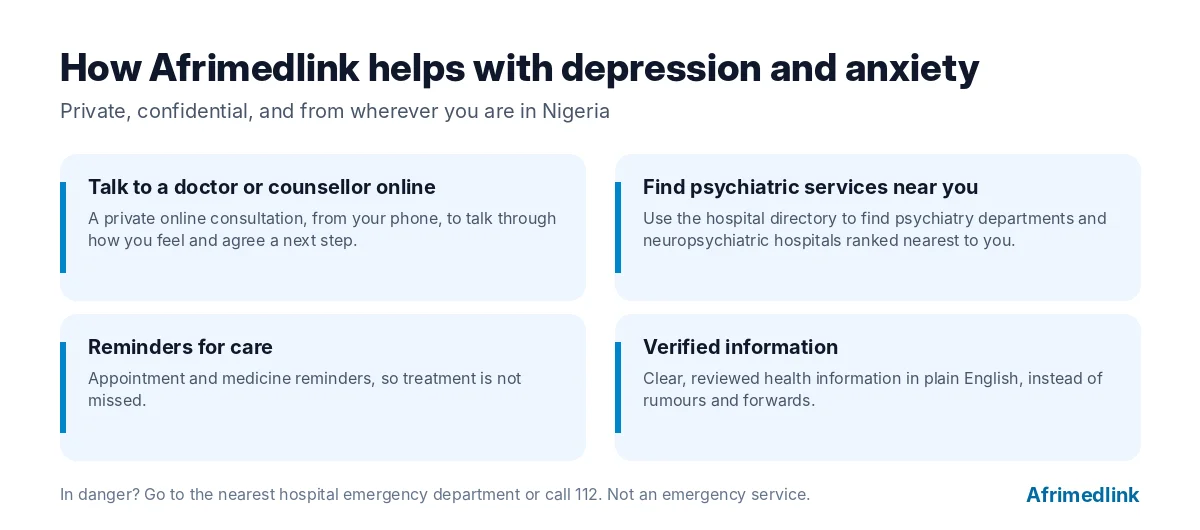 How to use Afrimedlink for mental health support, and when to go straight to emergency care. Afrimedlink is not an emergency service.
Many Nigerians never take the first step because of cost, distance, time off work, or fear of being seen walking into a psychiatric hospital. Afrimedlink is designed to make that first step easier and more private.
- Talk to a doctor or counsellor online. A private online consultation from your phone lets you describe how you have been feeling, get an initial assessment and agree a next step: treatment, a referral, or tests to rule out physical causes.
- Find psychiatric services near you. Our hospital directory ranks hospitals and clinics on the platform by how close they are to you, so you can find psychiatry departments and neuropsychiatric services and see their details before you travel.
- Be referred when you need more. If a consultation shows you need in-person specialist care, the doctor can refer you to a suitable partner hospital.
- Appointment and medicine reminders to help you keep to treatment.
- Verified information in plain English, instead of rumours and forwarded messages.
- Support for families. If you are worried about a relative, you can book a consultation to talk through what you are seeing and how to approach them.
What Afrimedlink is not: an emergency service or a replacement for emergency care. If you or someone you know is in immediate danger, or is thinking about ending their life, go to the nearest hospital emergency department or call 112 straight away; do not wait for an online reply. You can also call the SURPIN toll-free helpline on 0800 078 7746.
Key takeaways
- Depression and anxiety are common medical conditions, not weakness, a curse or "thinking too much". About 322 million people had depression and 470 million an anxiety disorder worldwide in 2023.
- In Nigeria they often show up through the body: headaches, "heat in the head", pains, poor sleep, irritability and withdrawal, as well as low mood or worry.
- Fewer than 1 in 10 Nigerians with a mental illness are thought to get care, with only a few hundred psychiatrists for over 200 million people. The Mental Health Act, signed in January 2023, replaced the colonial-era Lunacy Act.
- Pressures include money worries, insecurity, family separation through japa, long-term illness, pregnancy and birth, and substance use. They are nobody's fault.
- See a doctor if low mood, worry or irritability last two weeks or more. Thoughts of suicide are a medical emergency: go to the nearest hospital emergency department or call 112; SURPIN's toll-free line is 0800 078 7746.
- Treatment works. Talking therapy, even delivered by trained lay counsellors, produced large improvements in trials in Zimbabwe and Pakistan; medicines help some people; exercise, sleep and company support recovery. Use sedatives only as prescribed.
- Pray, and see a doctor. Faith and medicine can work together.
- To support someone: listen, do not judge, help them reach care, and never leave someone at risk alone.
- Afrimedlink can help you talk to a doctor or counsellor privately, find psychiatric services near you, and keep up with care, but it is not an emergency service.
References and further reading
- World Health Organization. Depression: fact sheet. who.int
- World Health Organization. Anxiety disorders: fact sheet. who.int
- World Health Organization. Mental disorders: fact sheet. who.int
- Africa Check. Fact-checked: Al Jazeera's claims about Nigeria's mental health problem (WHO Global Health Estimates; Gureje et al. national survey). africacheck.org
- Comorbid anxiety and depression among patients attending the general outpatient clinic of a Nigerian teaching hospital. Annals of Health Research, March 2024. doaj.org
- ICIR. Report reveals drug abuse is major cause of mental disorder in Nigeria (Africa Polling Institute and EpiAfric, Mental Health in Nigeria Survey, 2019, n=5,315). 14 January 2020. icirnigeria.org
- Ohaeri JU, Odejide OA. Somatization symptoms among patients using primary health care facilities in a rural community in Nigeria. American Journal of Psychiatry, 1994;151(5). mentalhealthdataprizeafrica.aphrc.org
- Prevalence of psychiatric disorders among children and adolescents in Nigeria since 2010: a systematic review and meta-analysis. medRxiv preprint, 2025. medrxiv.org
- Burden of postpartum depression in sub-Saharan Africa: an updated systematic review. South African Journal of Science, 2024. sajs.co.za
- World Health Organization. Mental health of older adults: fact sheet. who.int
- Gazette Nigeria. Economic hardship: more Nigerians prone to mental health crisis, says psychiatrist (Dr Taiwo Obindo, Association of Psychiatrists in Nigeria). 28 February 2024. gazettengr.com
- World Health Organization. Suicide: fact sheet. who.int
- Wikipedia contributors. Mental healthcare in Nigeria (psychiatrist counts reported by the Association of Psychiatrists in Nigeria and the Nigerian Medical Association, 2020; list of federal neuropsychiatric hospitals). en.wikipedia.org
- News Agency of Nigeria. 2023: Yaba psychiatric hospital records 100% admission increase, CMD. 20 December 2023. nannews.ng
- Prevalence of Boko Haram crisis related depression and post-traumatic stress disorder symptomatology among internally displaced persons in Yobe State. Journal of Affective Disorders Reports, 2023. doaj.org
- Mental health outcomes among left-behind families in Ibadan, Nigeria. Population Medicine, 2026. populationmedicine.eu
- UNODC. Nigeria: EU and UNODC release first-ever national drug use survey. January 2019. unodc.org
- World Health Organization. Adolescent mental health: fact sheet. 1 September 2025. who.int
- News Agency of Nigeria. Appraising Nigeria's push to decriminalise attempted suicide (WHO 2021 estimates; remarks by the Minister of Health). nannews.ng
- IT Edge News Africa. Nigeria adopts 112 as unified national emergency number to strengthen rapid response system. 1 May 2026. itedgenews.africa
- Suicide Research and Prevention Initiative (SURPIN). Helpline and FAQ. surpinng.com
- London School of Hygiene and Tropical Medicine. Friendship Bench therapy reduced anxiety and depression (Chibanda et al., JAMA, 2016). lshtm.ac.uk
- Haas AD et al. Effect of the Friendship Bench intervention on antiretroviral therapy outcomes and mental health symptoms in rural Zimbabwe: a cluster randomized trial. JAMA Network Open, 2023;6(7):e2323205. pmc.ncbi.nlm.nih.gov
- World Health Organization. WHO behavioural intervention shows promise for treating depression and anxiety in conflict-affected areas (Problem Management Plus, Pakistan; JAMA, 2016). who.int
- A qualitative evaluation of a brief multicomponent intervention provided by lay health workers for women affected by adversity in urban Kenya. Global Mental Health, 2018. pmc.ncbi.nlm.nih.gov
- ScienceDaily. Exercise for depression: Cochrane review (73 trials; reported 8 January 2026). sciencedaily.com
- Wikipedia contributors. Federal Neuro-Psychiatric Hospital, Kware. en.wikipedia.org
- Lagos University Teaching Hospital. Department of Psychiatry. luth.gov.ng
- LifeLine International. Nigeria (SURPIN) member profile. lifeline-international.com
- Mentally Aware Nigeria Initiative. mentallyaware.org
- Adewuya AA, Makanjuola ROA. Preferred treatment for mental illness among southwestern Nigerians. Psychiatric Services, 2009;60(1). mentalhealthdataprizeafrica.aphrc.org
- Kabir M, Iliyasu Z, Abubakar IS, et al. Perception and beliefs about mental illness among adults in Karfi village, northern Nigeria. BMC International Health and Human Rights, 2004;4:3. biomedcentral.com
- Dike O. Nigeria's mental health sector has a new messiah behind the 2021 Mental Health Act. RPublc, 2023. rpublc.com
- allAfrica. Nigeria: Mental health for Nigerians is officially a priority, now to ensure implementation. 16 January 2023. allafrica.com
- South African Journal of Psychiatry. Review of Nigeria's National Mental Health Act No. 46 of 2021. scielo.org.za
- Our World in Data. Psychiatrists per 100,000 people (WHO Mental Health Atlas 2020, via UNICEF; United Kingdom 2019). ourworldindata.org
- Policy and Legal Advocacy Centre (PLAC). Landmark Mental Health Bill receives presidential assent. January 2023. placng.org
- Find A Helpline. Mentally Aware Nigeria Initiative (MANI). findahelpline.com
This article is for general health education and does not replace advice from a doctor or mental health professional who knows your history. It cannot diagnose any condition. If you are worried about your mental health or someone else's, please speak to a qualified health professional; in an emergency, go to the nearest hospital emergency department or call 112. Figures are correct as of 22 October 2026 and may change.
Sign in to react.
Speak with verified foreign doctors and other healthcare professionals — within minutes. Vetted professionals abroad, then a vetted partner hospital near you if you need more care.
Consult a doctor nowTake Control
of Your Health
Get access to qualified doctors, personalised health records, and expert care — all from your phone.